{"title":"A nomogram based on hematological parameters for prediction of spontaneous abortion risk in pregnancies.","authors":"Junmiao Xiang, Lin Liu, Ruru Bao, Zhuhua Cai","doi":"10.1186/s12884-025-07396-4","DOIUrl":null,"url":null,"abstract":"<p><strong>Background: </strong>Pregnancy loss significantly affects physical and mental health. A nomogram for predicting spontaneous abortion risk was developed to improve pregnancy outcomes.</p><p><strong>Methods: </strong>A total of 1346 pregnant women were enrolled from The Third Affiliated Hospital of Wenzhou Medical University (May 2020 - May 2022). The training set included 941 participants, and the validation set had 405. Feature selection was optimized using a random forest model, and a predictive model was constructed via multivariable logistic regression. The nomogram's performance was assessed with receiver operator characteristic (ROC), Hosmer-Lemeshow test, calibration curve, and clinical impact curve (CIC). Discrimination and clinical utility were compared between the nomogram and its individual variables.</p><p><strong>Results: </strong>Antithrombin III (AT-III), homocysteine (Hcy), complement component 3 (C3), protein C (PC), and anti-β2 glycoprotein I antibody (anti-β2GP1) were identified as risk factors. The nomogram demonstrated satisfactory discrimination (Training AUC: 0.813, 95% CI: 0.790-0.842; Validation AUC: 0.792, 95% CI: 0.741-0.838). The Hosmer-Lemeshow test (P = 0.331) indicated a good fit, and the CIC showed clinical net benefit. The nomogram outperformed individual variables in discrimination (AUC: 0.804, 95% CI: 0.779-0.829).</p><p><strong>Conclusion: </strong>The developed nomogram, incorporating AT-III, Hcy, C3, PC, and anti-β2GP1, aids clinicians in identifying pregnant women at high risk for spontaneous abortion.</p>","PeriodicalId":9033,"journal":{"name":"BMC Pregnancy and Childbirth","volume":"25 1","pages":"271"},"PeriodicalIF":2.7000,"publicationDate":"2025-03-11","publicationTypes":"Journal Article","fieldsOfStudy":null,"isOpenAccess":false,"openAccessPdf":"https://www.ncbi.nlm.nih.gov/pmc/articles/PMC11899064/pdf/","citationCount":"0","resultStr":null,"platform":"Semanticscholar","paperid":null,"PeriodicalName":"BMC Pregnancy and Childbirth","FirstCategoryId":"3","ListUrlMain":"https://doi.org/10.1186/s12884-025-07396-4","RegionNum":2,"RegionCategory":"医学","ArticlePicture":[],"TitleCN":null,"AbstractTextCN":null,"PMCID":null,"EPubDate":"","PubModel":"","JCR":"Q1","JCRName":"OBSTETRICS & GYNECOLOGY","Score":null,"Total":0}
引用次数: 0
Abstract
Background: Pregnancy loss significantly affects physical and mental health. A nomogram for predicting spontaneous abortion risk was developed to improve pregnancy outcomes.
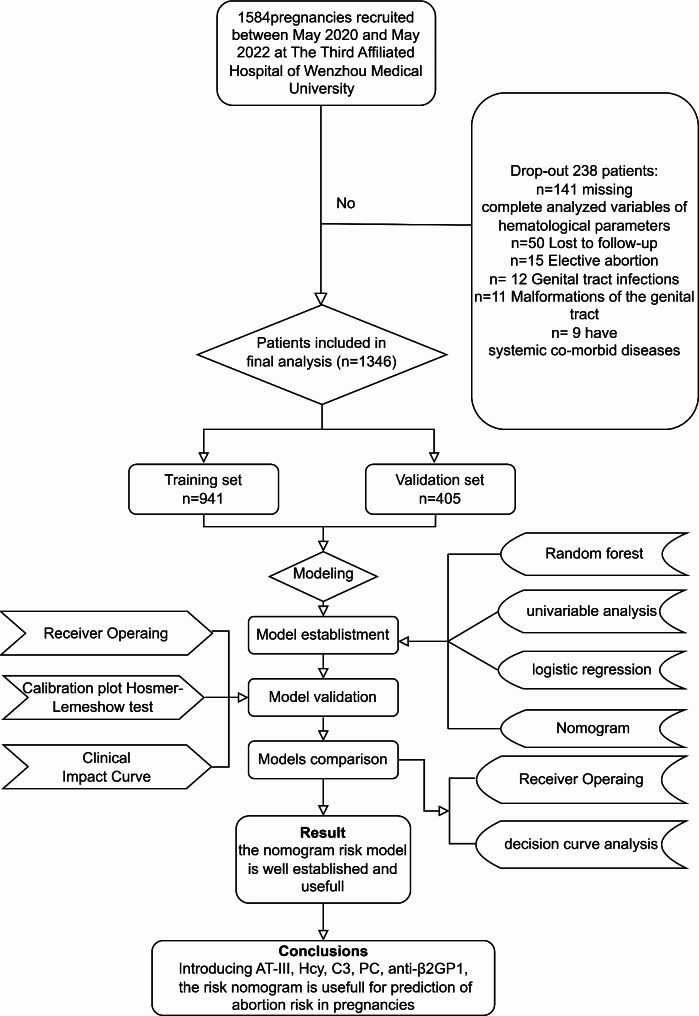
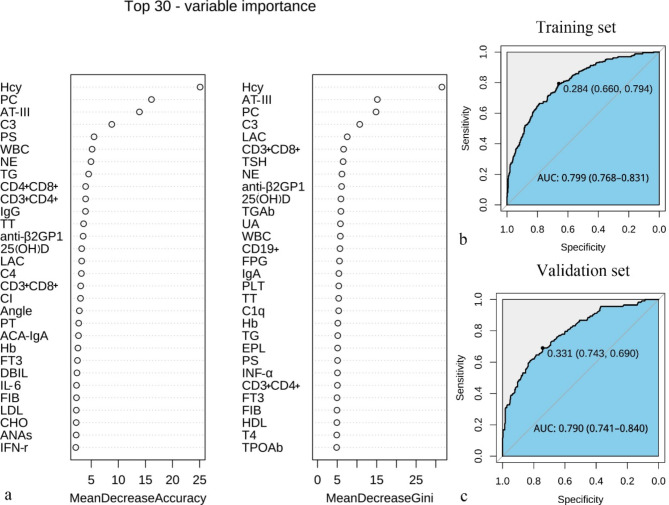
Methods: A total of 1346 pregnant women were enrolled from The Third Affiliated Hospital of Wenzhou Medical University (May 2020 - May 2022). The training set included 941 participants, and the validation set had 405. Feature selection was optimized using a random forest model, and a predictive model was constructed via multivariable logistic regression. The nomogram's performance was assessed with receiver operator characteristic (ROC), Hosmer-Lemeshow test, calibration curve, and clinical impact curve (CIC). Discrimination and clinical utility were compared between the nomogram and its individual variables.
Results: Antithrombin III (AT-III), homocysteine (Hcy), complement component 3 (C3), protein C (PC), and anti-β2 glycoprotein I antibody (anti-β2GP1) were identified as risk factors. The nomogram demonstrated satisfactory discrimination (Training AUC: 0.813, 95% CI: 0.790-0.842; Validation AUC: 0.792, 95% CI: 0.741-0.838). The Hosmer-Lemeshow test (P = 0.331) indicated a good fit, and the CIC showed clinical net benefit. The nomogram outperformed individual variables in discrimination (AUC: 0.804, 95% CI: 0.779-0.829).
Conclusion: The developed nomogram, incorporating AT-III, Hcy, C3, PC, and anti-β2GP1, aids clinicians in identifying pregnant women at high risk for spontaneous abortion.
期刊介绍:
BMC Pregnancy & Childbirth is an open access, peer-reviewed journal that considers articles on all aspects of pregnancy and childbirth. The journal welcomes submissions on the biomedical aspects of pregnancy, breastfeeding, labor, maternal health, maternity care, trends and sociological aspects of pregnancy and childbirth.




 京公网安备 11010802042870号
京ICP备2023020795号-1
京公网安备 11010802042870号
京ICP备2023020795号-1

 分享
分享
 求助内容:
求助内容: 应助结果提醒方式:
 扫码关注我们
