Thao M Dang, Qifeng Zhou, Yuzhi Guo, Hehuan Ma, Saiyang Na, Thao Bich Dang, Jean Gao, Junzhou Huang
{"title":"Abnormality-aware multimodal learning for WSI classification.","authors":"Thao M Dang, Qifeng Zhou, Yuzhi Guo, Hehuan Ma, Saiyang Na, Thao Bich Dang, Jean Gao, Junzhou Huang","doi":"10.3389/fmed.2025.1546452","DOIUrl":null,"url":null,"abstract":"<p><p>Whole slide images (WSIs) play a vital role in cancer diagnosis and prognosis. However, their gigapixel resolution, lack of pixel-level annotations, and reliance on unimodal visual data present challenges for accurate and efficient computational analysis. Existing methods typically divide WSIs into thousands of patches, which increases computational demands and makes it challenging to effectively focus on diagnostically relevant regions. Furthermore, these methods frequently rely on feature extractors pretrained on natural images, which are not optimized for pathology tasks, and overlook multimodal data sources such as cellular and textual information that can provide critical insights. To address these limitations, we propose the <b>A</b>bnormality-<b>A</b>ware <b>M</b>ulti<b>M</b>odal (AAMM) learning framework, which integrates abnormality detection and multimodal feature learning for WSI classification. AAMM incorporates a Gaussian Mixture Variational Autoencoder (GMVAE) to identify and select the most informative patches, reducing computational complexity while retaining critical diagnostic information. It further integrates multimodal features from pathology-specific foundation models, combining patch-level, cell-level, and text-level representations through cross-attention mechanisms. This approach enhances the ability to comprehensively analyze WSIs for cancer diagnosis and subtyping. Extensive experiments on normal-tumor classification and cancer subtyping demonstrate that AAMM achieves superior performance compared to state-of-the-art methods. By combining abnormal detection with multimodal feature integration, our framework offers an efficient and scalable solution for advancing computational pathology.</p>","PeriodicalId":12488,"journal":{"name":"Frontiers in Medicine","volume":"12 ","pages":"1546452"},"PeriodicalIF":3.1000,"publicationDate":"2025-02-25","publicationTypes":"Journal Article","fieldsOfStudy":null,"isOpenAccess":false,"openAccessPdf":"https://www.ncbi.nlm.nih.gov/pmc/articles/PMC11893561/pdf/","citationCount":"0","resultStr":null,"platform":"Semanticscholar","paperid":null,"PeriodicalName":"Frontiers in Medicine","FirstCategoryId":"3","ListUrlMain":"https://doi.org/10.3389/fmed.2025.1546452","RegionNum":3,"RegionCategory":"医学","ArticlePicture":[],"TitleCN":null,"AbstractTextCN":null,"PMCID":null,"EPubDate":"2025/1/1 0:00:00","PubModel":"eCollection","JCR":"Q1","JCRName":"MEDICINE, GENERAL & INTERNAL","Score":null,"Total":0}
引用次数: 0
Abstract
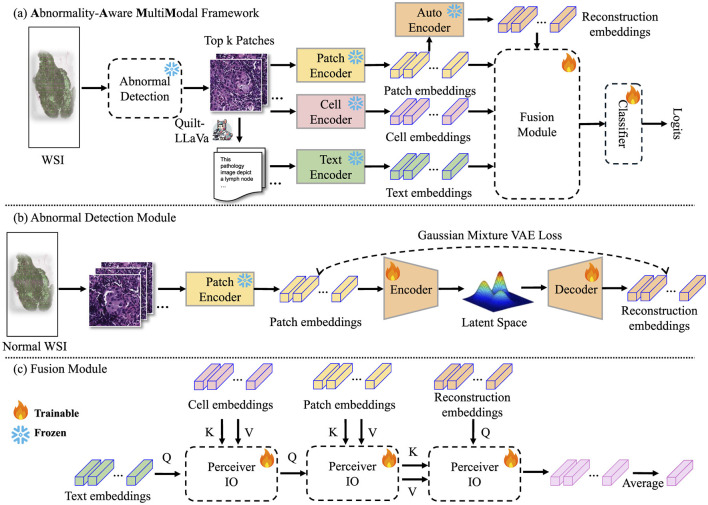
Whole slide images (WSIs) play a vital role in cancer diagnosis and prognosis. However, their gigapixel resolution, lack of pixel-level annotations, and reliance on unimodal visual data present challenges for accurate and efficient computational analysis. Existing methods typically divide WSIs into thousands of patches, which increases computational demands and makes it challenging to effectively focus on diagnostically relevant regions. Furthermore, these methods frequently rely on feature extractors pretrained on natural images, which are not optimized for pathology tasks, and overlook multimodal data sources such as cellular and textual information that can provide critical insights. To address these limitations, we propose the Abnormality-Aware MultiModal (AAMM) learning framework, which integrates abnormality detection and multimodal feature learning for WSI classification. AAMM incorporates a Gaussian Mixture Variational Autoencoder (GMVAE) to identify and select the most informative patches, reducing computational complexity while retaining critical diagnostic information. It further integrates multimodal features from pathology-specific foundation models, combining patch-level, cell-level, and text-level representations through cross-attention mechanisms. This approach enhances the ability to comprehensively analyze WSIs for cancer diagnosis and subtyping. Extensive experiments on normal-tumor classification and cancer subtyping demonstrate that AAMM achieves superior performance compared to state-of-the-art methods. By combining abnormal detection with multimodal feature integration, our framework offers an efficient and scalable solution for advancing computational pathology.
期刊介绍:
Frontiers in Medicine publishes rigorously peer-reviewed research linking basic research to clinical practice and patient care, as well as translating scientific advances into new therapies and diagnostic tools. Led by an outstanding Editorial Board of international experts, this multidisciplinary open-access journal is at the forefront of disseminating and communicating scientific knowledge and impactful discoveries to researchers, academics, clinicians and the public worldwide.
In addition to papers that provide a link between basic research and clinical practice, a particular emphasis is given to studies that are directly relevant to patient care. In this spirit, the journal publishes the latest research results and medical knowledge that facilitate the translation of scientific advances into new therapies or diagnostic tools. The full listing of the Specialty Sections represented by Frontiers in Medicine is as listed below. As well as the established medical disciplines, Frontiers in Medicine is launching new sections that together will facilitate
- the use of patient-reported outcomes under real world conditions
- the exploitation of big data and the use of novel information and communication tools in the assessment of new medicines
- the scientific bases for guidelines and decisions from regulatory authorities
- access to medicinal products and medical devices worldwide
- addressing the grand health challenges around the world




 京公网安备 11010802042870号
京ICP备2023020795号-1
京公网安备 11010802042870号
京ICP备2023020795号-1

 分享
分享
 求助内容:
求助内容: 应助结果提醒方式:
 扫码关注我们
