{"title":"Effects of cipepofol on breathing patterns, respiratory drive, and inspiratory effort in mechanically ventilated patients.","authors":"Rui Su, Linlin Zhang, Yu-Mei Wang, Ming-Yue Miao, Shuya Wang, Yong Cao, Jian-Xin Zhou","doi":"10.3389/fmed.2025.1539238","DOIUrl":null,"url":null,"abstract":"<p><strong>Background: </strong>Cipepofol is a highly selective gamma-aminobutyric acid A receptor potentiator. As a new sedative drug, detailed studies on its respiratory effects are further needed. The present study aims to investigate the effects of cipepofol on breathing patterns, respiratory drive, and inspiratory effort in mechanically ventilated patients.</p><p><strong>Methods: </strong>In this one-arm physiological study, cipepofol was initiated at 0.3 mg/kg/h and increased by 0.1 mg/kg/h every 30 min until reaching 0.8 mg/kg/h. Discontinuation criteria were Richmond Agitation and Sedation Scale (RASS) score ≤ -4 or respiratory rate (RR) < 8 breaths/min or pulse oxygen saturation (SpO<sub>2</sub>) < 90%. The primary outcomes were changes from baseline in respiratory variables [RR, tidal volume (VT), minute ventilation (V<sub>min</sub>), airway occlusion pressure at 100 msec (P<sub>0.1</sub>), pressure muscle index (PMI), expiratory occlusion pressure (P<sub>occ</sub>)] at 30 min after 0.3 mg/kg/h cipepofol infusion. The secondary outcomes included changes in respiratory variables, cardiorespiratory variables, and RASS scores at rates of cipepofol from 0.3 to 0.8 mg/kg/h.</p><p><strong>Results: </strong>20 patients were enrolled and all of them completed the cipepofol infusion rate at 0.3 mg/kg/h, achieving RASS score of -2 to +1. For the primary outcomes, there was a significant reduction in VT (390.9, [356.6-511.0] vs. 451.6 [393.5-565.9], <i>p</i> = 0.002), while changes in RR (16.7 ± 2.7 vs. 16.2 ± 3.4, <i>p</i> = 0.465) and V<sub>min</sub> (7.2 ± 1.8 vs. 7.5 ± 1.9, <i>p</i> = 0.154) were not significant. The reductions in P<sub>0.1</sub> (<i>p</i> = 0.020), PMI (<i>p</i> = 0.019), and P<sub>occ</sub> (<i>p</i> = 0.007) were significant. For secondary outcomes, as the infusion rate of cipepofol increased from 0.3 to 0.8 mg/kg/h, there was a further decrease in VT (<i>p</i> = 0.002) and an increase in RR (<i>p</i> < 0.001), while the change in V<sub>min</sub> (<i>p</i> = 0.430) was not significant. RASS score (<i>p</i> < 0.001) was further decreased.</p><p><strong>Conclusion: </strong>Cipepofol demonstrates the capability to achieve RASS score -2 to +1 in mechanically ventilated adult patients. The effect of cipepofol on breathing patterns was a decrease in VT, while changes in RR and V<sub>min</sub> were insignificant. The effect on respiratory drive and inspiratory effort significantly reduced P<sub>0.1</sub>, PMI, and P<sub>occ</sub>.</p><p><strong>Clinical trial registration: </strong>ClinicalTrials.gov, identifier NCT06287138. https://clinicaltrials.gov/study/NCT06287138.</p>","PeriodicalId":12488,"journal":{"name":"Frontiers in Medicine","volume":"12 ","pages":"1539238"},"PeriodicalIF":3.1000,"publicationDate":"2025-02-25","publicationTypes":"Journal Article","fieldsOfStudy":null,"isOpenAccess":false,"openAccessPdf":"https://www.ncbi.nlm.nih.gov/pmc/articles/PMC11893854/pdf/","citationCount":"0","resultStr":null,"platform":"Semanticscholar","paperid":null,"PeriodicalName":"Frontiers in Medicine","FirstCategoryId":"3","ListUrlMain":"https://doi.org/10.3389/fmed.2025.1539238","RegionNum":3,"RegionCategory":"医学","ArticlePicture":[],"TitleCN":null,"AbstractTextCN":null,"PMCID":null,"EPubDate":"2025/1/1 0:00:00","PubModel":"eCollection","JCR":"Q1","JCRName":"MEDICINE, GENERAL & INTERNAL","Score":null,"Total":0}
引用次数: 0
Abstract
Background: Cipepofol is a highly selective gamma-aminobutyric acid A receptor potentiator. As a new sedative drug, detailed studies on its respiratory effects are further needed. The present study aims to investigate the effects of cipepofol on breathing patterns, respiratory drive, and inspiratory effort in mechanically ventilated patients.
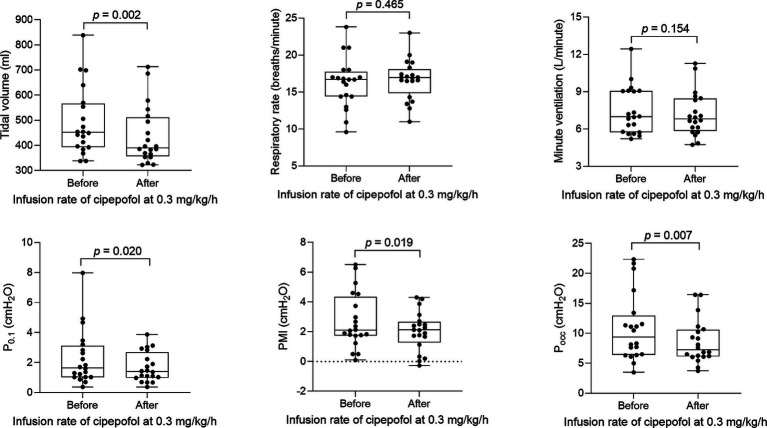
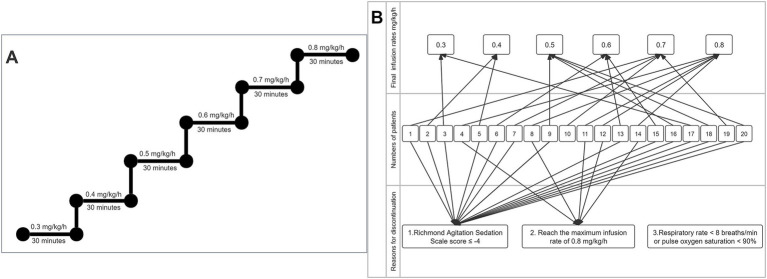
Methods: In this one-arm physiological study, cipepofol was initiated at 0.3 mg/kg/h and increased by 0.1 mg/kg/h every 30 min until reaching 0.8 mg/kg/h. Discontinuation criteria were Richmond Agitation and Sedation Scale (RASS) score ≤ -4 or respiratory rate (RR) < 8 breaths/min or pulse oxygen saturation (SpO2) < 90%. The primary outcomes were changes from baseline in respiratory variables [RR, tidal volume (VT), minute ventilation (Vmin), airway occlusion pressure at 100 msec (P0.1), pressure muscle index (PMI), expiratory occlusion pressure (Pocc)] at 30 min after 0.3 mg/kg/h cipepofol infusion. The secondary outcomes included changes in respiratory variables, cardiorespiratory variables, and RASS scores at rates of cipepofol from 0.3 to 0.8 mg/kg/h.
Results: 20 patients were enrolled and all of them completed the cipepofol infusion rate at 0.3 mg/kg/h, achieving RASS score of -2 to +1. For the primary outcomes, there was a significant reduction in VT (390.9, [356.6-511.0] vs. 451.6 [393.5-565.9], p = 0.002), while changes in RR (16.7 ± 2.7 vs. 16.2 ± 3.4, p = 0.465) and Vmin (7.2 ± 1.8 vs. 7.5 ± 1.9, p = 0.154) were not significant. The reductions in P0.1 (p = 0.020), PMI (p = 0.019), and Pocc (p = 0.007) were significant. For secondary outcomes, as the infusion rate of cipepofol increased from 0.3 to 0.8 mg/kg/h, there was a further decrease in VT (p = 0.002) and an increase in RR (p < 0.001), while the change in Vmin (p = 0.430) was not significant. RASS score (p < 0.001) was further decreased.
Conclusion: Cipepofol demonstrates the capability to achieve RASS score -2 to +1 in mechanically ventilated adult patients. The effect of cipepofol on breathing patterns was a decrease in VT, while changes in RR and Vmin were insignificant. The effect on respiratory drive and inspiratory effort significantly reduced P0.1, PMI, and Pocc.
期刊介绍:
Frontiers in Medicine publishes rigorously peer-reviewed research linking basic research to clinical practice and patient care, as well as translating scientific advances into new therapies and diagnostic tools. Led by an outstanding Editorial Board of international experts, this multidisciplinary open-access journal is at the forefront of disseminating and communicating scientific knowledge and impactful discoveries to researchers, academics, clinicians and the public worldwide.
In addition to papers that provide a link between basic research and clinical practice, a particular emphasis is given to studies that are directly relevant to patient care. In this spirit, the journal publishes the latest research results and medical knowledge that facilitate the translation of scientific advances into new therapies or diagnostic tools. The full listing of the Specialty Sections represented by Frontiers in Medicine is as listed below. As well as the established medical disciplines, Frontiers in Medicine is launching new sections that together will facilitate
- the use of patient-reported outcomes under real world conditions
- the exploitation of big data and the use of novel information and communication tools in the assessment of new medicines
- the scientific bases for guidelines and decisions from regulatory authorities
- access to medicinal products and medical devices worldwide
- addressing the grand health challenges around the world



 京公网安备 11010802042870号
京ICP备2023020795号-1
京公网安备 11010802042870号
京ICP备2023020795号-1

 分享
分享
 求助内容:
求助内容: 应助结果提醒方式:
 扫码关注我们
