{"title":"Prognostic nutritional index as an independent risk factor for disease progression in patients with IgA nephropathy.","authors":"Siqing Wang, Huan Zhou, Lingqiu Dong, Wei Qin","doi":"10.3389/fmed.2025.1530312","DOIUrl":null,"url":null,"abstract":"<p><strong>Background: </strong>Immunoglobulin A nephropathy (IgAN), a common primary glomerulonephritis worldwide, has been investigated, and complex factors are involved in disease progression. A group of evidence emerged that nutrition status plays a nonsubstitutable role in the management of chronic kidney disease. Meanwhile, a novel marker of nutrition and inflammation, the prognostic nutritional index (PNI), has been studied in various diseases. Whether PNI can predict the renal outcome of patients with IgAN remains unclear. Thus, we aimed to evaluate the relationships between PNI and clinicopathologic features, renal progression and renal prognosis in patients with IgAN.</p><p><strong>Methods: </strong>A total of 1,377 patients with biopsy-proven IgAN were recruited for this retrospective study. All patients were divided into two groups based on the cutoff value of PNI: the high group (PNI ≥ 47.1, <i>n</i> = 886) and the low group (PNI < 47.1, <i>n</i> = 491). Our study endpoint was end-stage renal disease [estimated glomerular filtration rate (eGFR) < 15 mL/min/1.73 m<sup>2</sup> or performance of renal replacement therapy]. A correlation test was conducted to explore the relationship between PNI and other important clinicopathologic parameters. The predictive value was determined by the area under the receiver operating characteristic curve (AUROC). Kaplan-Meier and Cox proportional hazards analyses were performed to assess the value of PNI in predicting renal progression and prognosis.</p><p><strong>Results: </strong>The correlation test revealed that PNI was positively associated with eGFR (<i>r</i> = 0.16, <i>p</i> < 0.001) and negatively related to 24-h proteinuria (<i>r</i> = -0.387, <i>p</i> < 0.001). Multivariate Cox regression analysis indicated that low PNI was an independent risk factor for IgAN patients even after adjusting for important clinical and pathological parameters (HR, 0.664; 95% CI, 0.443-0.994; <i>p</i> = 0.047). Kaplan-Meier analysis showed that low PNI was significantly correlated with severe renal outcome in patients with IgAN (<i>p</i> < 0.001). Moreover, the subgroup analyses of Kaplan-Meier survival demonstrated that low PNI predicted severe renal prognosis in different types of IgAN patients when considering the level of glomerular filtration rate, 24 h proteinuria and hemoglobin.</p><p><strong>Conclusion: </strong>PNI is associated with renal function and pathologic lesions in IgAN patients and could be a novel marker for the evaluation of renal progression and prognosis.</p>","PeriodicalId":12488,"journal":{"name":"Frontiers in Medicine","volume":"12 ","pages":"1530312"},"PeriodicalIF":3.1000,"publicationDate":"2025-02-25","publicationTypes":"Journal Article","fieldsOfStudy":null,"isOpenAccess":false,"openAccessPdf":"https://www.ncbi.nlm.nih.gov/pmc/articles/PMC11893860/pdf/","citationCount":"0","resultStr":null,"platform":"Semanticscholar","paperid":null,"PeriodicalName":"Frontiers in Medicine","FirstCategoryId":"3","ListUrlMain":"https://doi.org/10.3389/fmed.2025.1530312","RegionNum":3,"RegionCategory":"医学","ArticlePicture":[],"TitleCN":null,"AbstractTextCN":null,"PMCID":null,"EPubDate":"2025/1/1 0:00:00","PubModel":"eCollection","JCR":"Q1","JCRName":"MEDICINE, GENERAL & INTERNAL","Score":null,"Total":0}
引用次数: 0
Abstract
Background: Immunoglobulin A nephropathy (IgAN), a common primary glomerulonephritis worldwide, has been investigated, and complex factors are involved in disease progression. A group of evidence emerged that nutrition status plays a nonsubstitutable role in the management of chronic kidney disease. Meanwhile, a novel marker of nutrition and inflammation, the prognostic nutritional index (PNI), has been studied in various diseases. Whether PNI can predict the renal outcome of patients with IgAN remains unclear. Thus, we aimed to evaluate the relationships between PNI and clinicopathologic features, renal progression and renal prognosis in patients with IgAN.
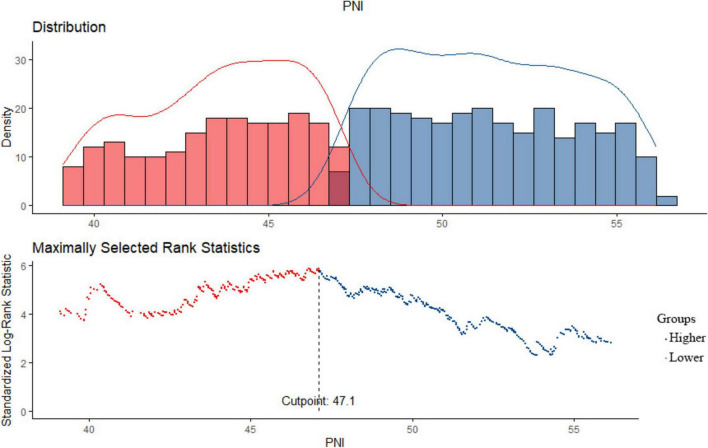
Methods: A total of 1,377 patients with biopsy-proven IgAN were recruited for this retrospective study. All patients were divided into two groups based on the cutoff value of PNI: the high group (PNI ≥ 47.1, n = 886) and the low group (PNI < 47.1, n = 491). Our study endpoint was end-stage renal disease [estimated glomerular filtration rate (eGFR) < 15 mL/min/1.73 m2 or performance of renal replacement therapy]. A correlation test was conducted to explore the relationship between PNI and other important clinicopathologic parameters. The predictive value was determined by the area under the receiver operating characteristic curve (AUROC). Kaplan-Meier and Cox proportional hazards analyses were performed to assess the value of PNI in predicting renal progression and prognosis.
Results: The correlation test revealed that PNI was positively associated with eGFR (r = 0.16, p < 0.001) and negatively related to 24-h proteinuria (r = -0.387, p < 0.001). Multivariate Cox regression analysis indicated that low PNI was an independent risk factor for IgAN patients even after adjusting for important clinical and pathological parameters (HR, 0.664; 95% CI, 0.443-0.994; p = 0.047). Kaplan-Meier analysis showed that low PNI was significantly correlated with severe renal outcome in patients with IgAN (p < 0.001). Moreover, the subgroup analyses of Kaplan-Meier survival demonstrated that low PNI predicted severe renal prognosis in different types of IgAN patients when considering the level of glomerular filtration rate, 24 h proteinuria and hemoglobin.
Conclusion: PNI is associated with renal function and pathologic lesions in IgAN patients and could be a novel marker for the evaluation of renal progression and prognosis.
期刊介绍:
Frontiers in Medicine publishes rigorously peer-reviewed research linking basic research to clinical practice and patient care, as well as translating scientific advances into new therapies and diagnostic tools. Led by an outstanding Editorial Board of international experts, this multidisciplinary open-access journal is at the forefront of disseminating and communicating scientific knowledge and impactful discoveries to researchers, academics, clinicians and the public worldwide.
In addition to papers that provide a link between basic research and clinical practice, a particular emphasis is given to studies that are directly relevant to patient care. In this spirit, the journal publishes the latest research results and medical knowledge that facilitate the translation of scientific advances into new therapies or diagnostic tools. The full listing of the Specialty Sections represented by Frontiers in Medicine is as listed below. As well as the established medical disciplines, Frontiers in Medicine is launching new sections that together will facilitate
- the use of patient-reported outcomes under real world conditions
- the exploitation of big data and the use of novel information and communication tools in the assessment of new medicines
- the scientific bases for guidelines and decisions from regulatory authorities
- access to medicinal products and medical devices worldwide
- addressing the grand health challenges around the world





 京公网安备 11010802042870号
京ICP备2023020795号-1
京公网安备 11010802042870号
京ICP备2023020795号-1

 分享
分享
 求助内容:
求助内容: 应助结果提醒方式:
 扫码关注我们
