{"title":"Lipid Profiles After Changes in Alcohol Consumption Among Adults Undergoing Annual Checkups.","authors":"Takahiro Suzuki, Sho Fukui, Tomohiro Shinozaki, Taku Asano, Toshiko Yoshida, Jiro Aoki, Atsushi Mizuno","doi":"10.1001/jamanetworkopen.2025.0583","DOIUrl":null,"url":null,"abstract":"<p><strong>Importance: </strong>Despite growing criticism of alcohol consumption due to its overall health risks, it remains unknown how changes in alcohol consumption, particularly cessation, affect lipid profiles outside of intense interventions.</p><p><strong>Objective: </strong>To clarify the association of alcohol initiation and cessation with subsequent changes in low-density lipoprotein cholesterol (LDL-C) and high-density lipoprotein cholesterol (HDL-C).</p><p><strong>Design, setting, and participants: </strong>This cohort study included individuals undergoing annual checkups at a center for preventive medicine in Tokyo, Japan, from October 2012 to October 2022. Individuals treated with lipid-lowering medications were excluded. Data were analyzed from May to December 2024.</p><p><strong>Exposures: </strong>Alcohol initiation (vs remaining abstainer) and cessation (vs continuing same alcohol intake) between 2 consecutive visits. One standard drink was equivalent to 10 g of pure ethanol.</p><p><strong>Main outcomes and measures: </strong>Change in LDL-C and HDL-C levels between 2 consecutive visits.</p><p><strong>Results: </strong>Among the 328 676 visits from 57 691 individuals (mean [SD] age, 46.8 [12.5] years; 30 576 female [53.0%]), the cohort for evaluating alcohol cessation comprised 49 898 visits among 25 144 participants (mean [SD] age, 49 [12.1] years; 12 334 female [49.1%]; mean [SD] LDL-C, 114.7 [28.4] mg/dL; mean [SD] HDL-C, 65.5 [16.4] mg/dL). Alcohol cessation was associated with changes in LDL-C of 1.10 mg/dL (95% CI, 0.76 to 1.45 mg/dL) among those discontinuing habits of fewer than 1.5 drinks/d, 3.71 mg/dL (95% CI, 2.71 to 4.71 mg/dL) for 1.5 to 3.0 drinks/d, and 6.53 mg/dL (95% CI, 5.14 to 7.91 mg/dL) for 3.0 or more drinks/d. Cessation was associated with a change in HDL-C of -1.25 mg/dL (95% CI, -1.41 to -1.09 mg/dL) among those discontinuing habits of fewer than 1.5 drinks/d, -3.35 mg/dL (-4.41 to -2.29 mg/dL) for 1.5 to 3.0 drinks/d, and -5.65 mg/dL (95% CI, -6.28 to -5.01 mg/dL) for 3.0 or more drinks/d. The cohort for evaluating alcohol initiation (107 880 visits; 29 042 participants) showed inverse dose-response associations.</p><p><strong>Conclusions and relevance: </strong>In this cohort study of Japanese annual health checkup participants, alcohol initiation was associated with modest cholesterol improvement, whereas cessation was associated with less favorable changes. After alcohol reduction, lipid profile changes should be carefully monitored to optimize cardiovascular disease risk management at both individual and population levels.</p>","PeriodicalId":14694,"journal":{"name":"JAMA Network Open","volume":"8 3","pages":"e250583"},"PeriodicalIF":9.7000,"publicationDate":"2025-03-03","publicationTypes":"Journal Article","fieldsOfStudy":null,"isOpenAccess":false,"openAccessPdf":"https://www.ncbi.nlm.nih.gov/pmc/articles/PMC11904732/pdf/","citationCount":"0","resultStr":null,"platform":"Semanticscholar","paperid":null,"PeriodicalName":"JAMA Network Open","FirstCategoryId":"3","ListUrlMain":"https://doi.org/10.1001/jamanetworkopen.2025.0583","RegionNum":1,"RegionCategory":"医学","ArticlePicture":[],"TitleCN":null,"AbstractTextCN":null,"PMCID":null,"EPubDate":"","PubModel":"","JCR":"Q1","JCRName":"MEDICINE, GENERAL & INTERNAL","Score":null,"Total":0}
引用次数: 0
Abstract
Importance: Despite growing criticism of alcohol consumption due to its overall health risks, it remains unknown how changes in alcohol consumption, particularly cessation, affect lipid profiles outside of intense interventions.
Objective: To clarify the association of alcohol initiation and cessation with subsequent changes in low-density lipoprotein cholesterol (LDL-C) and high-density lipoprotein cholesterol (HDL-C).
Design, setting, and participants: This cohort study included individuals undergoing annual checkups at a center for preventive medicine in Tokyo, Japan, from October 2012 to October 2022. Individuals treated with lipid-lowering medications were excluded. Data were analyzed from May to December 2024.
Exposures: Alcohol initiation (vs remaining abstainer) and cessation (vs continuing same alcohol intake) between 2 consecutive visits. One standard drink was equivalent to 10 g of pure ethanol.
Main outcomes and measures: Change in LDL-C and HDL-C levels between 2 consecutive visits.
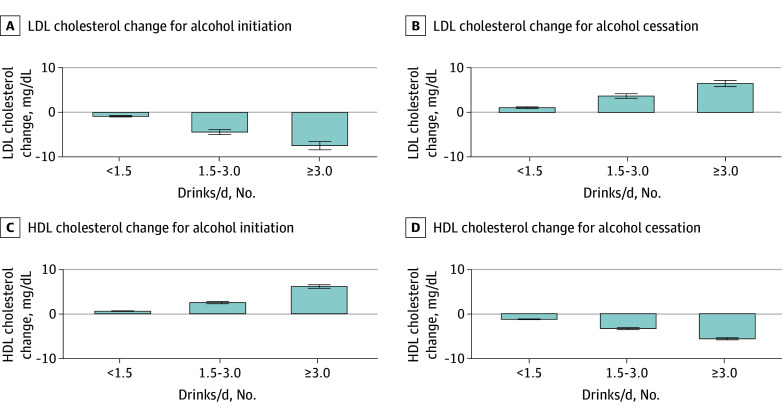
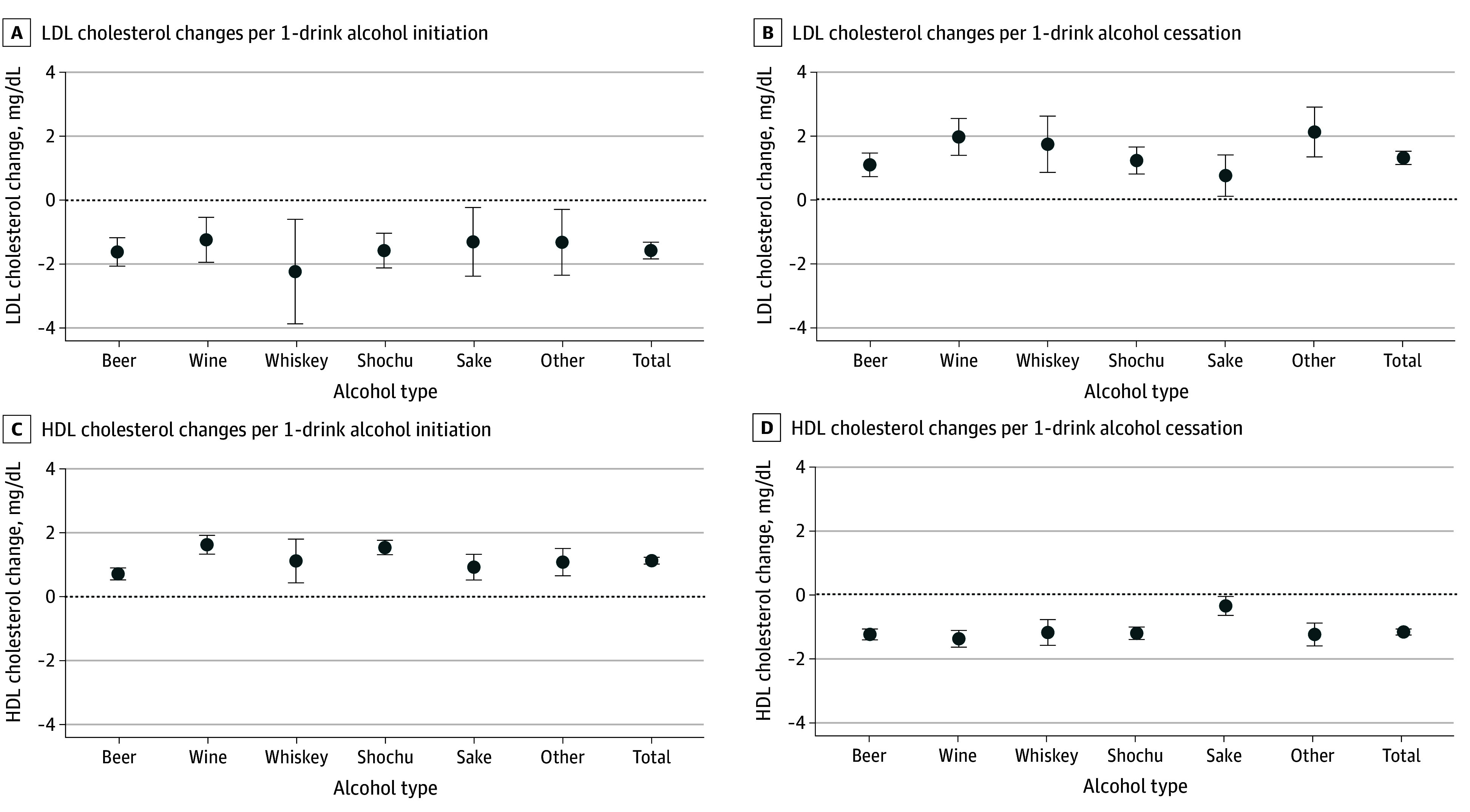
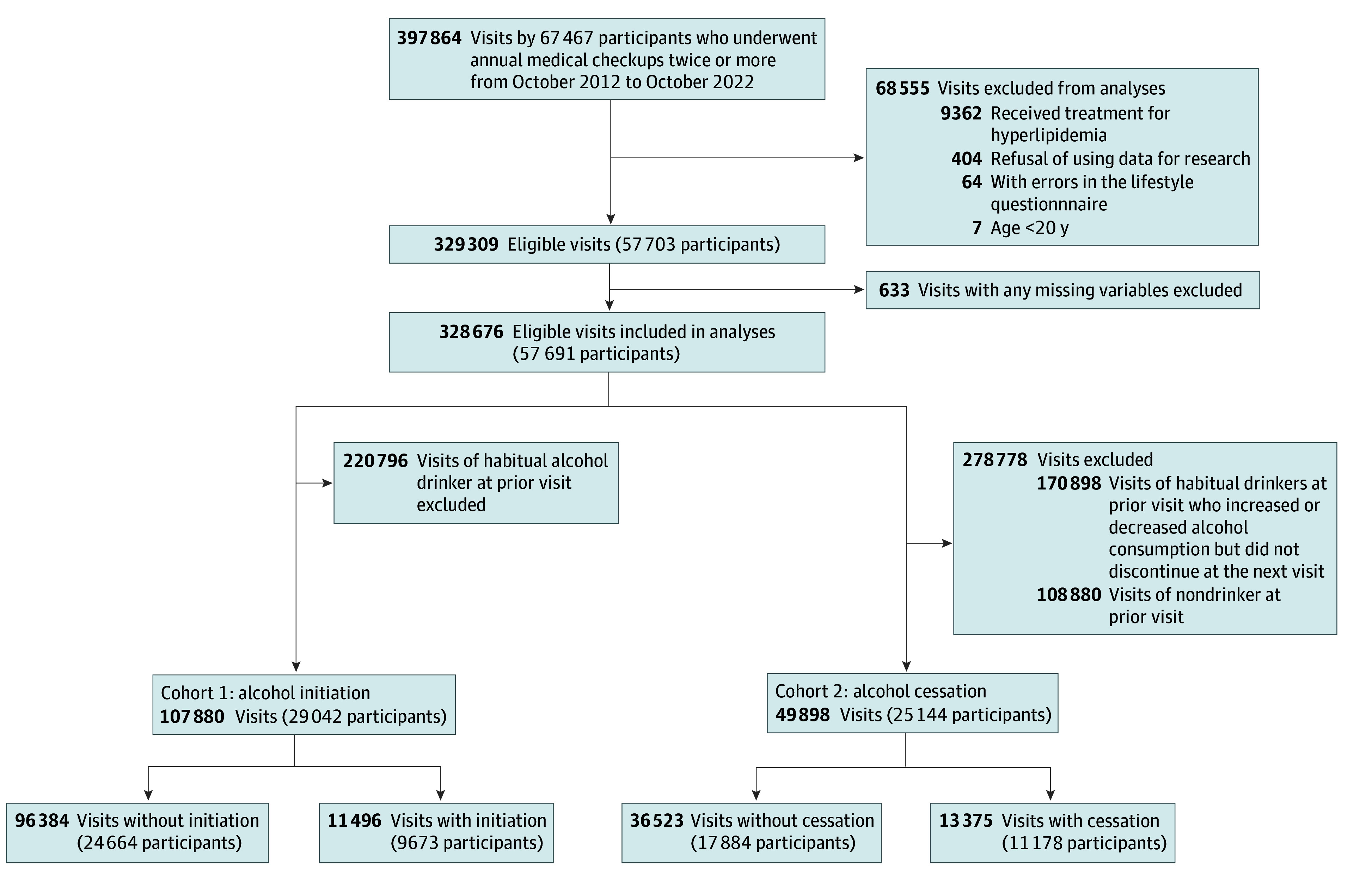
Results: Among the 328 676 visits from 57 691 individuals (mean [SD] age, 46.8 [12.5] years; 30 576 female [53.0%]), the cohort for evaluating alcohol cessation comprised 49 898 visits among 25 144 participants (mean [SD] age, 49 [12.1] years; 12 334 female [49.1%]; mean [SD] LDL-C, 114.7 [28.4] mg/dL; mean [SD] HDL-C, 65.5 [16.4] mg/dL). Alcohol cessation was associated with changes in LDL-C of 1.10 mg/dL (95% CI, 0.76 to 1.45 mg/dL) among those discontinuing habits of fewer than 1.5 drinks/d, 3.71 mg/dL (95% CI, 2.71 to 4.71 mg/dL) for 1.5 to 3.0 drinks/d, and 6.53 mg/dL (95% CI, 5.14 to 7.91 mg/dL) for 3.0 or more drinks/d. Cessation was associated with a change in HDL-C of -1.25 mg/dL (95% CI, -1.41 to -1.09 mg/dL) among those discontinuing habits of fewer than 1.5 drinks/d, -3.35 mg/dL (-4.41 to -2.29 mg/dL) for 1.5 to 3.0 drinks/d, and -5.65 mg/dL (95% CI, -6.28 to -5.01 mg/dL) for 3.0 or more drinks/d. The cohort for evaluating alcohol initiation (107 880 visits; 29 042 participants) showed inverse dose-response associations.
Conclusions and relevance: In this cohort study of Japanese annual health checkup participants, alcohol initiation was associated with modest cholesterol improvement, whereas cessation was associated with less favorable changes. After alcohol reduction, lipid profile changes should be carefully monitored to optimize cardiovascular disease risk management at both individual and population levels.
期刊介绍:
JAMA Network Open, a member of the esteemed JAMA Network, stands as an international, peer-reviewed, open-access general medical journal.The publication is dedicated to disseminating research across various health disciplines and countries, encompassing clinical care, innovation in health care, health policy, and global health.
JAMA Network Open caters to clinicians, investigators, and policymakers, providing a platform for valuable insights and advancements in the medical field. As part of the JAMA Network, a consortium of peer-reviewed general medical and specialty publications, JAMA Network Open contributes to the collective knowledge and understanding within the medical community.




 京公网安备 11010802042870号
京ICP备2023020795号-1
京公网安备 11010802042870号
京ICP备2023020795号-1

 分享
分享
 求助内容:
求助内容: 应助结果提醒方式:
 扫码关注我们
