{"title":"Prediction of Flares in Systemic Lupus Erythematosus During Post-Remission Follow-up.","authors":"Yu Bai, Jiuliang Zhao, Qian Wang, Dong Xu, Xiaofeng Zeng, Xinping Tian, He-Jun Li, Mengtao Li","doi":"10.2147/JIR.S504995","DOIUrl":null,"url":null,"abstract":"<p><strong>Purpose: </strong>Patients at high risk of SLE flares benefit from being identified before flares; this can be done by predictors of flares. This study aimed to explore the predictive factors and model of SLE flares after remission, providing basis for clinical decision-making.</p><p><strong>Patients and methods: </strong>SLE patients recruited at the Peking Union Medical College Hospital (PUMCH), were all registered in the Chinese SLE treatment and research (CSTAR) registry cohort and had experienced at least one remission before December 31, 2020. Demographic, clinical, and laboratory parameters were collected through CSTAR online registry. The predictive effects of variables were analyzed using a Cox proportional hazards model. A nomogram was formulated to predict flares.</p><p><strong>Results: </strong>A total of 359 patients were included in the analysis, among which, 108 (30.1%) patients had at least one flare. Multivariate Cox regression model showed that younger age (hazard ratio [HR], 0.97; 95% CI, 0.95-0.99), positive anti-dsDNA at remission (HR, 1.64; 95% CI, 1.08-2.51), significantly low levels of C3 and C4 (HR, 2.09; 95% CI, 1.17-3.73) were independent risk factors associated with flares. A nomogram was established based on the multivariate analysis. The internal bootstrap resampling approach suggested the nomogram has a certain degree of discriminatory power with a C-index of 0.654 (95% CI, 0.601-0.707). The calibration plots also showed good consistency between the prediction and the observation.</p><p><strong>Conclusion: </strong>This study highlights that SLE patients with significantly low levels of C3 and C4, younger age, and elevated anti-dsDNA levels may require closer monitoring and follow-up after remission. Identifying these predictors allows clinicians to better assess the risk of flare and tailor therapeutic strategies accordingly for more effective long-term management.</p>","PeriodicalId":16107,"journal":{"name":"Journal of Inflammation Research","volume":"18 ","pages":"3377-3384"},"PeriodicalIF":4.1000,"publicationDate":"2025-03-07","publicationTypes":"Journal Article","fieldsOfStudy":null,"isOpenAccess":false,"openAccessPdf":"https://www.ncbi.nlm.nih.gov/pmc/articles/PMC11895687/pdf/","citationCount":"0","resultStr":null,"platform":"Semanticscholar","paperid":null,"PeriodicalName":"Journal of Inflammation Research","FirstCategoryId":"3","ListUrlMain":"https://doi.org/10.2147/JIR.S504995","RegionNum":2,"RegionCategory":"医学","ArticlePicture":[],"TitleCN":null,"AbstractTextCN":null,"PMCID":null,"EPubDate":"2025/1/1 0:00:00","PubModel":"eCollection","JCR":"Q2","JCRName":"IMMUNOLOGY","Score":null,"Total":0}
引用次数: 0
Abstract
Purpose: Patients at high risk of SLE flares benefit from being identified before flares; this can be done by predictors of flares. This study aimed to explore the predictive factors and model of SLE flares after remission, providing basis for clinical decision-making.
Patients and methods: SLE patients recruited at the Peking Union Medical College Hospital (PUMCH), were all registered in the Chinese SLE treatment and research (CSTAR) registry cohort and had experienced at least one remission before December 31, 2020. Demographic, clinical, and laboratory parameters were collected through CSTAR online registry. The predictive effects of variables were analyzed using a Cox proportional hazards model. A nomogram was formulated to predict flares.
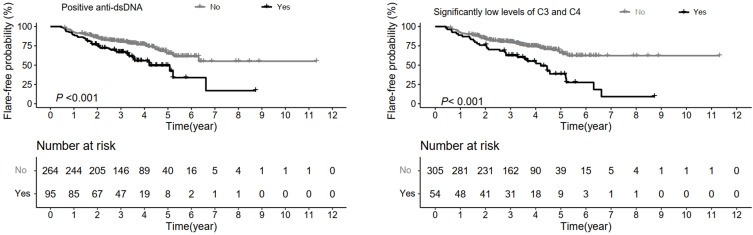
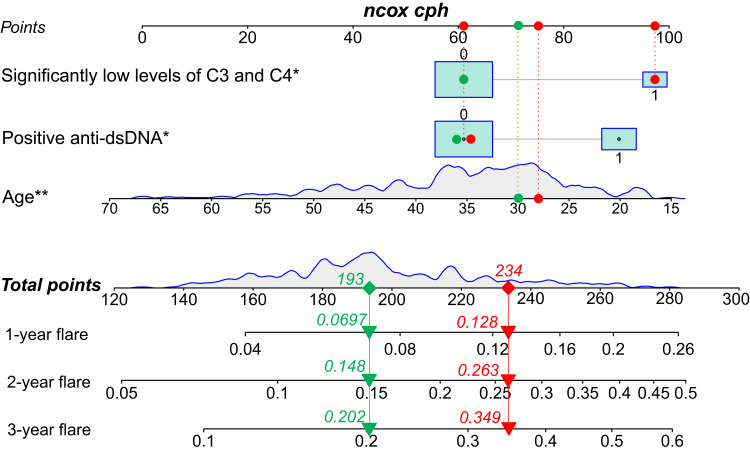
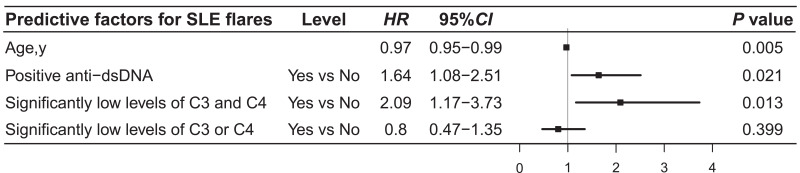
Results: A total of 359 patients were included in the analysis, among which, 108 (30.1%) patients had at least one flare. Multivariate Cox regression model showed that younger age (hazard ratio [HR], 0.97; 95% CI, 0.95-0.99), positive anti-dsDNA at remission (HR, 1.64; 95% CI, 1.08-2.51), significantly low levels of C3 and C4 (HR, 2.09; 95% CI, 1.17-3.73) were independent risk factors associated with flares. A nomogram was established based on the multivariate analysis. The internal bootstrap resampling approach suggested the nomogram has a certain degree of discriminatory power with a C-index of 0.654 (95% CI, 0.601-0.707). The calibration plots also showed good consistency between the prediction and the observation.
Conclusion: This study highlights that SLE patients with significantly low levels of C3 and C4, younger age, and elevated anti-dsDNA levels may require closer monitoring and follow-up after remission. Identifying these predictors allows clinicians to better assess the risk of flare and tailor therapeutic strategies accordingly for more effective long-term management.
期刊介绍:
An international, peer-reviewed, open access, online journal that welcomes laboratory and clinical findings on the molecular basis, cell biology and pharmacology of inflammation.




 京公网安备 11010802042870号
京ICP备2023020795号-1
京公网安备 11010802042870号
京ICP备2023020795号-1

 分享
分享
 求助内容:
求助内容: 应助结果提醒方式:
 扫码关注我们
