Daniel Stránský, Monika Šteigerová, Markéta Kuklová, Veronika Hanzíková, Nikolina Canová, Jiří Novotný, Ladislav Šenolt, Ondřej Slanař
{"title":"Simple, streamlined, cost-effective cDNA synthesis method from cell cultures.","authors":"Daniel Stránský, Monika Šteigerová, Markéta Kuklová, Veronika Hanzíková, Nikolina Canová, Jiří Novotný, Ladislav Šenolt, Ondřej Slanař","doi":"10.1098/rsob.240226","DOIUrl":null,"url":null,"abstract":"<p><p>Applications like drug development need simple and streamlined methods to process samples from 96-well cell culture plates for gene expression measurements. Unfortunately, current options are expensive for such processing. Therefore, our aim was to develop a method that would allow streamlined analysis of mRNA from 96-well cell culture plates while being relatively cheap and simple. We developed a method based on the qPCR 'Cells-to-cDNA' approach and validated it against commercially available kits using the same approach or spin columns-based RNA purification. For this purpose, we conducted a series of comparisons of gene expression from peripheral blood mononuclear cells, SK-HEP-1 and U-87 cell cultures in 96-well plates. Our final method involved lysing cells with 25-100 µl solution of 0.5% SDS, 10 mM DTT, 1 mg ml<sup>-1</sup> proteinase K dissolved in water, 1 h incubation at 50°C, followed by proteinase K inactivation at 90°C for 5 min and lysate neutralization with 1 : 1 dilution by 20% Tween 20 solution. Reverse transcription and qPCR were carried out using standard methods. This method showed a mean reduction of Ct ± s.d. value by 2.4 ± 1.3 compared with the 'Cells-to-cDNA' kit and by 1.4 ± 0.5 compared with the RNA purification kit with lower variability.</p>","PeriodicalId":19629,"journal":{"name":"Open Biology","volume":"15 3","pages":"240226"},"PeriodicalIF":3.6000,"publicationDate":"2025-03-01","publicationTypes":"Journal Article","fieldsOfStudy":null,"isOpenAccess":false,"openAccessPdf":"https://www.ncbi.nlm.nih.gov/pmc/articles/PMC11896693/pdf/","citationCount":"0","resultStr":null,"platform":"Semanticscholar","paperid":null,"PeriodicalName":"Open Biology","FirstCategoryId":"99","ListUrlMain":"https://doi.org/10.1098/rsob.240226","RegionNum":3,"RegionCategory":"生物学","ArticlePicture":[],"TitleCN":null,"AbstractTextCN":null,"PMCID":null,"EPubDate":"2025/3/12 0:00:00","PubModel":"Epub","JCR":"Q1","JCRName":"BIOCHEMISTRY & MOLECULAR BIOLOGY","Score":null,"Total":0}
引用次数: 0
Abstract
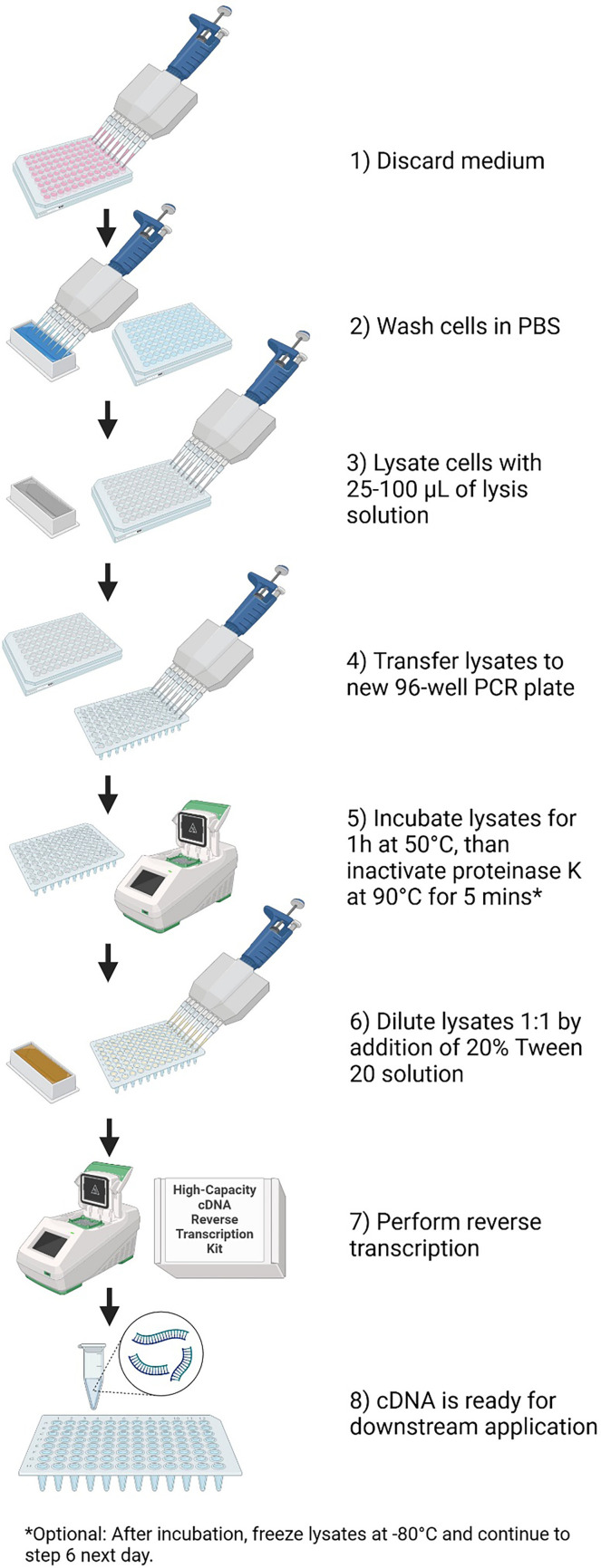
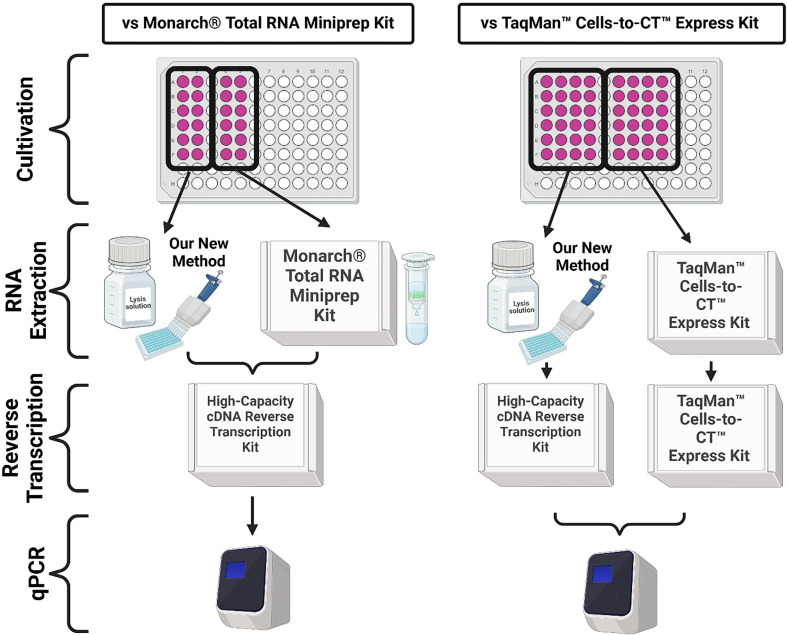
Applications like drug development need simple and streamlined methods to process samples from 96-well cell culture plates for gene expression measurements. Unfortunately, current options are expensive for such processing. Therefore, our aim was to develop a method that would allow streamlined analysis of mRNA from 96-well cell culture plates while being relatively cheap and simple. We developed a method based on the qPCR 'Cells-to-cDNA' approach and validated it against commercially available kits using the same approach or spin columns-based RNA purification. For this purpose, we conducted a series of comparisons of gene expression from peripheral blood mononuclear cells, SK-HEP-1 and U-87 cell cultures in 96-well plates. Our final method involved lysing cells with 25-100 µl solution of 0.5% SDS, 10 mM DTT, 1 mg ml-1 proteinase K dissolved in water, 1 h incubation at 50°C, followed by proteinase K inactivation at 90°C for 5 min and lysate neutralization with 1 : 1 dilution by 20% Tween 20 solution. Reverse transcription and qPCR were carried out using standard methods. This method showed a mean reduction of Ct ± s.d. value by 2.4 ± 1.3 compared with the 'Cells-to-cDNA' kit and by 1.4 ± 0.5 compared with the RNA purification kit with lower variability.
期刊介绍:
Open Biology is an online journal that welcomes original, high impact research in cell and developmental biology, molecular and structural biology, biochemistry, neuroscience, immunology, microbiology and genetics.



 京公网安备 11010802042870号
京ICP备2023020795号-1
京公网安备 11010802042870号
京ICP备2023020795号-1

 分享
分享
 求助内容:
求助内容: 应助结果提醒方式:
 扫码关注我们
