Investigating the Mechanism of Conditioning Versus Postoperative Electrical Stimulation to Enhance Nerve Regeneration: One Therapy, Two Distinct Effects.
Paige B Hardy, Bonnie Y Wang, K Ming Chan, Christine A Webber, Jenna-Lynn B Senger
{"title":"Investigating the Mechanism of Conditioning Versus Postoperative Electrical Stimulation to Enhance Nerve Regeneration: One Therapy, Two Distinct Effects.","authors":"Paige B Hardy, Bonnie Y Wang, K Ming Chan, Christine A Webber, Jenna-Lynn B Senger","doi":"10.1002/mus.28385","DOIUrl":null,"url":null,"abstract":"<p><p>Regeneration after peripheral nerve injury is often insufficient for functional recovery. Postoperative electrical stimulation (PES) following injury and repair significantly improves clinical outcomes; recently, conditioning electrical stimulation (CES), delivered before nerve injury, has been introduced as a candidate for clinical translation. PES accelerates the crossing of regenerating axons across the injury site, whereas CES accelerates the intrinsic rate of axonal regeneration; thus, it is likely that their mechanisms are distinct. The large body of literature investigating the mechanisms of electrical stimulation has not differentiated between CES and PES. In this review, we investigate the CES and PES paradigms within the existing literature, distinguish their mechanistic insights, and identify gaps in the literature. A systematic literature review was conducted, selecting articles identifying the pro-regenerative effects of electrical stimulation in the setting of peripheral nerve injury. As a mechanistic template, both paradigms implicate cation channels for the initiation of numerous signaling pathways that together upregulate regeneration-associated genes. CES and PES feature some overlap; activation of PI3K and MAPK signaling pathways, and upregulation of BDNF, GAP43, and GFAP are similar. Currently, the inflammatory environment in which PES is administered predominantly differentiates these mechanisms. However, gaps within the literature complicate the comparison between paradigms. Systematic review revealed the mechanisms for both CES and PES paradigms remain fragmented; though much of the literature assumes the involvement of particular signaling pathways, the evidence remains limited. Though it is likely there is overlap between mechanisms, further investigation is needed.</p>","PeriodicalId":18968,"journal":{"name":"Muscle & Nerve","volume":" ","pages":"15-33"},"PeriodicalIF":3.1000,"publicationDate":"2025-07-01","publicationTypes":"Journal Article","fieldsOfStudy":null,"isOpenAccess":false,"openAccessPdf":"https://www.ncbi.nlm.nih.gov/pmc/articles/PMC12138495/pdf/","citationCount":"0","resultStr":null,"platform":"Semanticscholar","paperid":null,"PeriodicalName":"Muscle & Nerve","FirstCategoryId":"3","ListUrlMain":"https://doi.org/10.1002/mus.28385","RegionNum":3,"RegionCategory":"医学","ArticlePicture":[],"TitleCN":null,"AbstractTextCN":null,"PMCID":null,"EPubDate":"2025/3/11 0:00:00","PubModel":"Epub","JCR":"Q2","JCRName":"CLINICAL NEUROLOGY","Score":null,"Total":0}
引用次数: 0
Abstract
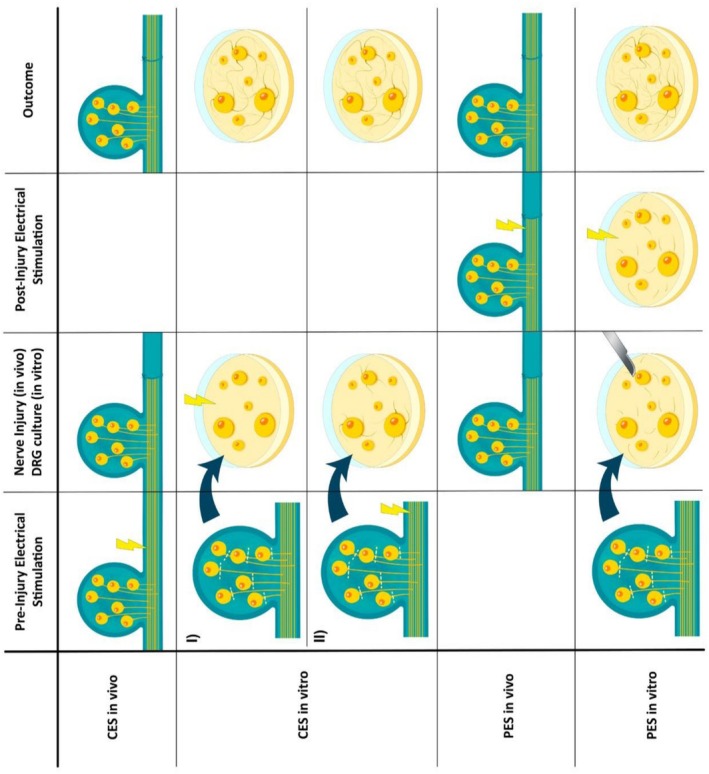
Regeneration after peripheral nerve injury is often insufficient for functional recovery. Postoperative electrical stimulation (PES) following injury and repair significantly improves clinical outcomes; recently, conditioning electrical stimulation (CES), delivered before nerve injury, has been introduced as a candidate for clinical translation. PES accelerates the crossing of regenerating axons across the injury site, whereas CES accelerates the intrinsic rate of axonal regeneration; thus, it is likely that their mechanisms are distinct. The large body of literature investigating the mechanisms of electrical stimulation has not differentiated between CES and PES. In this review, we investigate the CES and PES paradigms within the existing literature, distinguish their mechanistic insights, and identify gaps in the literature. A systematic literature review was conducted, selecting articles identifying the pro-regenerative effects of electrical stimulation in the setting of peripheral nerve injury. As a mechanistic template, both paradigms implicate cation channels for the initiation of numerous signaling pathways that together upregulate regeneration-associated genes. CES and PES feature some overlap; activation of PI3K and MAPK signaling pathways, and upregulation of BDNF, GAP43, and GFAP are similar. Currently, the inflammatory environment in which PES is administered predominantly differentiates these mechanisms. However, gaps within the literature complicate the comparison between paradigms. Systematic review revealed the mechanisms for both CES and PES paradigms remain fragmented; though much of the literature assumes the involvement of particular signaling pathways, the evidence remains limited. Though it is likely there is overlap between mechanisms, further investigation is needed.
期刊介绍:
Muscle & Nerve is an international and interdisciplinary publication of original contributions, in both health and disease, concerning studies of the muscle, the neuromuscular junction, the peripheral motor, sensory and autonomic neurons, and the central nervous system where the behavior of the peripheral nervous system is clarified. Appearing monthly, Muscle & Nerve publishes clinical studies and clinically relevant research reports in the fields of anatomy, biochemistry, cell biology, electrophysiology and electrodiagnosis, epidemiology, genetics, immunology, pathology, pharmacology, physiology, toxicology, and virology. The Journal welcomes articles and reports on basic clinical electrophysiology and electrodiagnosis. We expedite some papers dealing with timely topics to keep up with the fast-moving pace of science, based on the referees'' recommendation.





 京公网安备 11010802042870号
京ICP备2023020795号-1
京公网安备 11010802042870号
京ICP备2023020795号-1

 分享
分享
 求助内容:
求助内容: 应助结果提醒方式:
 扫码关注我们
