Marianne Philibert, Mika Gissler, Oscar Zurriaga, Serena Donati, Zeljka Drausnik, Günther Heller, Alison Macfarlane, Ashna Mohangoo, Luule Sakkeus, Vlad Tica, Petr Velebil, Jeannette Klimont, Lisa Broeders, Tonia A Rihs, Jennifer Zeitlin
{"title":"Evaluating Perinatal Health in Europe: A Comparison of Routine Population Birth Data Sources.","authors":"Marianne Philibert, Mika Gissler, Oscar Zurriaga, Serena Donati, Zeljka Drausnik, Günther Heller, Alison Macfarlane, Ashna Mohangoo, Luule Sakkeus, Vlad Tica, Petr Velebil, Jeannette Klimont, Lisa Broeders, Tonia A Rihs, Jennifer Zeitlin","doi":"10.1111/ppe.13178","DOIUrl":null,"url":null,"abstract":"<p><strong>Background: </strong>International comparisons of population birth data provide essential benchmarks for evaluating perinatal health policies.</p><p><strong>Objectives: </strong>This study aimed to describe routine national data sources in Europe by their ability to provide core perinatal health indicators.</p><p><strong>Methods: </strong>The Euro-Peristat Network collected routine national data on a recommended set of core indicators from 2015 to 2021 using a federated protocol based on a common data model with 16 data items. Data providers completed an online questionnaire to describe the sources used in each country. We classified countries by the number of data items they provided (all 16, 15-14, < 14).</p><p><strong>Results: </strong>A total of 29 out of the 31 countries that provided data responded to the survey. Routine data sources included birth certificates (15 countries), electronic medical records (EMR) from delivery hospitalisations (16 countries), direct entry by health providers (9 countries), EMR from other care providers (7 countries) and Hospital Discharge Summaries (7 countries). Completeness of population coverage was at least 98%, with 17 countries reporting 100%. These databases most often included mothers giving birth in the national territory, regardless of nationality or place of residence (24 countries), whereas others register births to residents only. In 20 countries, routine sources were linked, including linkage between birth and death certificates (16 countries). Countries providing all 16 items (n = 8) were more likely to use EMRs from delivery hospitalisations (100%) compared to 50% and 11% in countries with 15-14 items (n = 12) and < 14 items (n = 9), respectively. Linkage was also more common in these countries (100%) versus 75% and 56%, respectively. Other data source characteristics did not differ by the ability to provide data on core perinatal indicators.</p><p><strong>Conclusions: </strong>There are wide differences between countries in the data sources used to construct perinatal health indicators in Europe. Countries using EMR linking to other sources had the best data availability.</p>","PeriodicalId":19698,"journal":{"name":"Paediatric and perinatal epidemiology","volume":" ","pages":"405-416"},"PeriodicalIF":2.5000,"publicationDate":"2025-07-01","publicationTypes":"Journal Article","fieldsOfStudy":null,"isOpenAccess":false,"openAccessPdf":"https://www.ncbi.nlm.nih.gov/pmc/articles/PMC12308632/pdf/","citationCount":"0","resultStr":null,"platform":"Semanticscholar","paperid":null,"PeriodicalName":"Paediatric and perinatal epidemiology","FirstCategoryId":"3","ListUrlMain":"https://doi.org/10.1111/ppe.13178","RegionNum":3,"RegionCategory":"医学","ArticlePicture":[],"TitleCN":null,"AbstractTextCN":null,"PMCID":null,"EPubDate":"2025/3/11 0:00:00","PubModel":"Epub","JCR":"Q2","JCRName":"OBSTETRICS & GYNECOLOGY","Score":null,"Total":0}
引用次数: 0
Abstract
Background: International comparisons of population birth data provide essential benchmarks for evaluating perinatal health policies.
Objectives: This study aimed to describe routine national data sources in Europe by their ability to provide core perinatal health indicators.
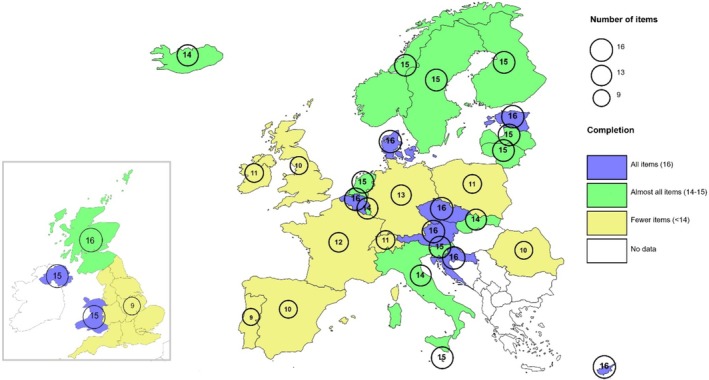
Methods: The Euro-Peristat Network collected routine national data on a recommended set of core indicators from 2015 to 2021 using a federated protocol based on a common data model with 16 data items. Data providers completed an online questionnaire to describe the sources used in each country. We classified countries by the number of data items they provided (all 16, 15-14, < 14).
Results: A total of 29 out of the 31 countries that provided data responded to the survey. Routine data sources included birth certificates (15 countries), electronic medical records (EMR) from delivery hospitalisations (16 countries), direct entry by health providers (9 countries), EMR from other care providers (7 countries) and Hospital Discharge Summaries (7 countries). Completeness of population coverage was at least 98%, with 17 countries reporting 100%. These databases most often included mothers giving birth in the national territory, regardless of nationality or place of residence (24 countries), whereas others register births to residents only. In 20 countries, routine sources were linked, including linkage between birth and death certificates (16 countries). Countries providing all 16 items (n = 8) were more likely to use EMRs from delivery hospitalisations (100%) compared to 50% and 11% in countries with 15-14 items (n = 12) and < 14 items (n = 9), respectively. Linkage was also more common in these countries (100%) versus 75% and 56%, respectively. Other data source characteristics did not differ by the ability to provide data on core perinatal indicators.
Conclusions: There are wide differences between countries in the data sources used to construct perinatal health indicators in Europe. Countries using EMR linking to other sources had the best data availability.
期刊介绍:
Paediatric and Perinatal Epidemiology crosses the boundaries between the epidemiologist and the paediatrician, obstetrician or specialist in child health, ensuring that important paediatric and perinatal studies reach those clinicians for whom the results are especially relevant. In addition to original research articles, the Journal also includes commentaries, book reviews and annotations.



 京公网安备 11010802042870号
京ICP备2023020795号-1
京公网安备 11010802042870号
京ICP备2023020795号-1

 分享
分享
 求助内容:
求助内容: 应助结果提醒方式:
 扫码关注我们
