Mengyao Wang, Paul James Collings, Felix R Day, Ken K Ong, Soren Brage, Stephen J Sharp, Haeyoon Jang, Siyeon Suh, Shan Luo, Shiu Lun Au Yeung, Youngwon Kim
{"title":"Genetic Susceptibility to Type 2 Diabetes, Television Viewing, and Atherosclerotic Cardiovascular Disease Risk.","authors":"Mengyao Wang, Paul James Collings, Felix R Day, Ken K Ong, Soren Brage, Stephen J Sharp, Haeyoon Jang, Siyeon Suh, Shan Luo, Shiu Lun Au Yeung, Youngwon Kim","doi":"10.1161/JAHA.124.036811","DOIUrl":null,"url":null,"abstract":"<p><strong>Background: </strong>Type 2 diabetes (T2D) is a major risk factor for atherosclerotic cardiovascular disease (ASCVD). This study examined the interplay between watching television and T2D genetic risk for risk of ASCVD.</p><p><strong>Methods: </strong>We included 346 916 White British individuals from UK Biobank. A weighted polygenic risk score for T2D was calculated on the basis of 138 genetic variants associated with T2D. Time spent watching television was self-reported and categorized into 2 groups: ≤1 h/d and ≥2 h/d. Over a median 13.8-year follow-up, 21 265 incident ASCVD events were identified. Models using Cox regression with age as the underlying time scale adjusted for potential confounders (demographic, anthropometric, lifestyle factors, and medication use) were fit.</p><p><strong>Results: </strong>Compared with watching television for ≤1 h/d, watching ≥2 h/d was associated with 12% (95% CI, 1.07-1.16) higher hazards of ASCVD, independently of T2D genetic risk. Joint analyses (with low T2D genetic risk and ≤1 h/d of television viewing as reference) indicated that medium and high T2D genetic risk was not associated with higher hazards of ASCVD as long as television viewing was ≤1 h/d. The <i>P</i> values for multiplicative and additive interactions between T2D genetic risk and television viewing were 0.050 and 0.038, respectively. The 10-year absolute risk of ASCVD was lower for high T2D genetic risk combined with ≤1 h/d of television viewing (2.13%) than for low T2D genetic risk combined with ≥2 h/d of television viewing (2.46%).</p><p><strong>Conclusions: </strong>Future clinical trials of lifestyle-modification interventions targeting specific types of screen-based sedentary activities could be implemented to individuals at high genetic risk of T2D for primary prevention of ASCVD.</p>","PeriodicalId":54370,"journal":{"name":"Journal of the American Heart Association","volume":" ","pages":"e036811"},"PeriodicalIF":5.3000,"publicationDate":"2025-03-18","publicationTypes":"Journal Article","fieldsOfStudy":null,"isOpenAccess":false,"openAccessPdf":"https://www.ncbi.nlm.nih.gov/pmc/articles/PMC12132744/pdf/","citationCount":"0","resultStr":null,"platform":"Semanticscholar","paperid":null,"PeriodicalName":"Journal of the American Heart Association","FirstCategoryId":"3","ListUrlMain":"https://doi.org/10.1161/JAHA.124.036811","RegionNum":1,"RegionCategory":"医学","ArticlePicture":[],"TitleCN":null,"AbstractTextCN":null,"PMCID":null,"EPubDate":"2025/3/12 0:00:00","PubModel":"Epub","JCR":"Q1","JCRName":"CARDIAC & CARDIOVASCULAR SYSTEMS","Score":null,"Total":0}
引用次数: 0
Abstract
Background: Type 2 diabetes (T2D) is a major risk factor for atherosclerotic cardiovascular disease (ASCVD). This study examined the interplay between watching television and T2D genetic risk for risk of ASCVD.
Methods: We included 346 916 White British individuals from UK Biobank. A weighted polygenic risk score for T2D was calculated on the basis of 138 genetic variants associated with T2D. Time spent watching television was self-reported and categorized into 2 groups: ≤1 h/d and ≥2 h/d. Over a median 13.8-year follow-up, 21 265 incident ASCVD events were identified. Models using Cox regression with age as the underlying time scale adjusted for potential confounders (demographic, anthropometric, lifestyle factors, and medication use) were fit.
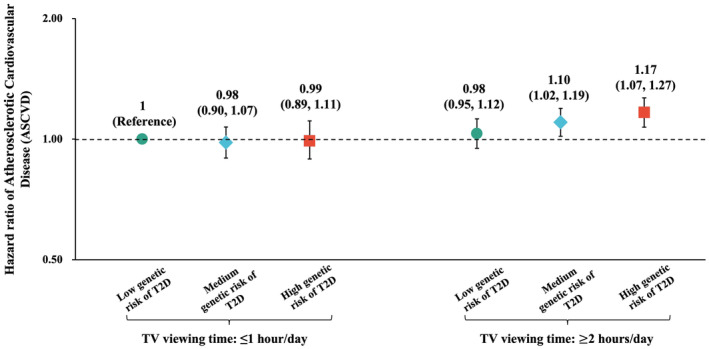
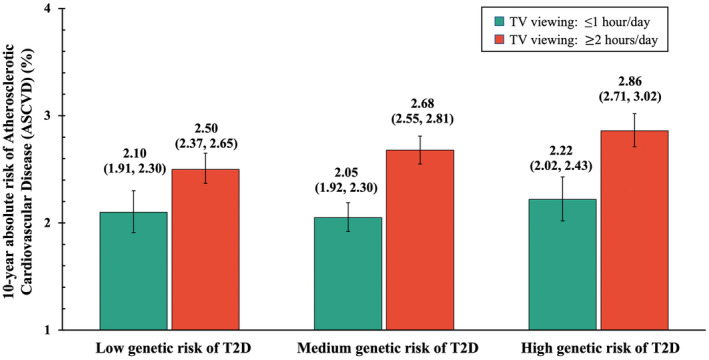
Results: Compared with watching television for ≤1 h/d, watching ≥2 h/d was associated with 12% (95% CI, 1.07-1.16) higher hazards of ASCVD, independently of T2D genetic risk. Joint analyses (with low T2D genetic risk and ≤1 h/d of television viewing as reference) indicated that medium and high T2D genetic risk was not associated with higher hazards of ASCVD as long as television viewing was ≤1 h/d. The P values for multiplicative and additive interactions between T2D genetic risk and television viewing were 0.050 and 0.038, respectively. The 10-year absolute risk of ASCVD was lower for high T2D genetic risk combined with ≤1 h/d of television viewing (2.13%) than for low T2D genetic risk combined with ≥2 h/d of television viewing (2.46%).
Conclusions: Future clinical trials of lifestyle-modification interventions targeting specific types of screen-based sedentary activities could be implemented to individuals at high genetic risk of T2D for primary prevention of ASCVD.
期刊介绍:
As an Open Access journal, JAHA - Journal of the American Heart Association is rapidly and freely available, accelerating the translation of strong science into effective practice.
JAHA is an authoritative, peer-reviewed Open Access journal focusing on cardiovascular and cerebrovascular disease. JAHA provides a global forum for basic and clinical research and timely reviews on cardiovascular disease and stroke. As an Open Access journal, its content is free on publication to read, download, and share, accelerating the translation of strong science into effective practice.




 京公网安备 11010802042870号
京ICP备2023020795号-1
京公网安备 11010802042870号
京ICP备2023020795号-1

 分享
分享
 求助内容:
求助内容: 应助结果提醒方式:
 扫码关注我们
