Attitudes and Perceptions of eHealth Among Female Patients with Urinary Incontinence and Healthcare Providers: A Systematic Review and Thematic Synthesis.
{"title":"Attitudes and Perceptions of eHealth Among Female Patients with Urinary Incontinence and Healthcare Providers: A Systematic Review and Thematic Synthesis.","authors":"Linlin Zhao, Na Li, Lianqi Gu, Chen Shen, Rao Wang, Xin Yang, Zhiping Chu","doi":"10.2147/RMHP.S496997","DOIUrl":null,"url":null,"abstract":"<p><strong>Aim: </strong>The objective of this systematic review was to synthesize qualitative evidence to explore the promoters and barriers to implementing eHealth interventions from the perspective of female patients with urinary incontinence and healthcare providers.</p><p><strong>Background: </strong>Guiding patients to pelvic floor muscle training through eHealth can effectively improve urinary incontinence symptoms, and understanding the attitudes and perceptions of patients and healthcare providers is critical to the successful application of eHealth. However, systematic reviews that combine both views are lacking.</p><p><strong>Design: </strong>A systematic review of qualitative research and thematic synthesis. This was reported following the Preferred Reporting Items for Systematic Reviews and Meta Analysis (PRISMA) guidelines 2020.</p><p><strong>Date sources: </strong>The search period was from the establishment of the database to May 2024, and eligible English literature was searched in PubMed, Web of Science, Cochrane Library, Embase, CINAHL, PsycINFO, and MEDLINE databases.</p><p><strong>Review methods: </strong>Two researchers independently screened and included the literature and used the Critical Appraisal Skills Program tool (CASP) to evaluate the methodological quality of the included literature. Themes were developed using thematic synthesis.</p><p><strong>Results: </strong>A total of nine studies were included, which included 678 patients and 13 healthcare providers. Four themes were condensed into ten categories: multiple motivations for eHealth use, diverse reasons for taking action, complex reasons for preventing action, and conflict in establishing eHealth use behaviors.</p><p><strong>Conclusion: </strong>The majority of patients are enthusiastic about utilizing eHealth to train their pelvic floor muscles, although there are occasionally issues like low desire. Although some medical practitioners are not well versed in eHealth, their engagement can aid patients in making use of eHealth. The future should focus on the difficulties and needs of women with urinary incontinence during the use of eHealth exercise and improve the understanding of eHealth among healthcare personnel.</p>","PeriodicalId":56009,"journal":{"name":"Risk Management and Healthcare Policy","volume":"18 ","pages":"785-800"},"PeriodicalIF":2.0000,"publicationDate":"2025-03-06","publicationTypes":"Journal Article","fieldsOfStudy":null,"isOpenAccess":false,"openAccessPdf":"https://www.ncbi.nlm.nih.gov/pmc/articles/PMC11894429/pdf/","citationCount":"0","resultStr":null,"platform":"Semanticscholar","paperid":null,"PeriodicalName":"Risk Management and Healthcare Policy","FirstCategoryId":"3","ListUrlMain":"https://doi.org/10.2147/RMHP.S496997","RegionNum":4,"RegionCategory":"医学","ArticlePicture":[],"TitleCN":null,"AbstractTextCN":null,"PMCID":null,"EPubDate":"2025/1/1 0:00:00","PubModel":"eCollection","JCR":"Q2","JCRName":"HEALTH CARE SCIENCES & SERVICES","Score":null,"Total":0}
引用次数: 0
Abstract
Aim: The objective of this systematic review was to synthesize qualitative evidence to explore the promoters and barriers to implementing eHealth interventions from the perspective of female patients with urinary incontinence and healthcare providers.
Background: Guiding patients to pelvic floor muscle training through eHealth can effectively improve urinary incontinence symptoms, and understanding the attitudes and perceptions of patients and healthcare providers is critical to the successful application of eHealth. However, systematic reviews that combine both views are lacking.
Design: A systematic review of qualitative research and thematic synthesis. This was reported following the Preferred Reporting Items for Systematic Reviews and Meta Analysis (PRISMA) guidelines 2020.
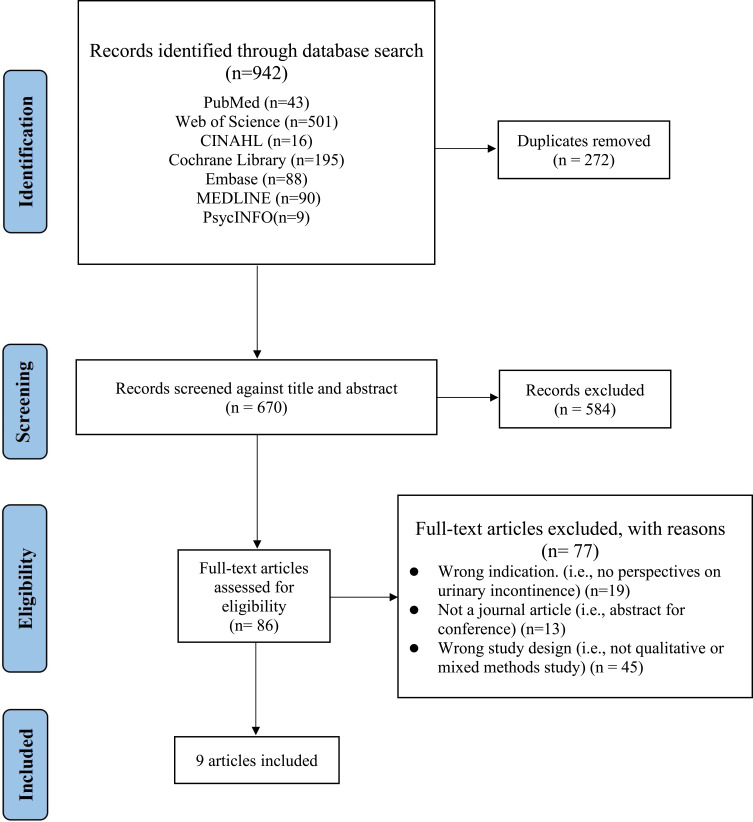
Date sources: The search period was from the establishment of the database to May 2024, and eligible English literature was searched in PubMed, Web of Science, Cochrane Library, Embase, CINAHL, PsycINFO, and MEDLINE databases.
Review methods: Two researchers independently screened and included the literature and used the Critical Appraisal Skills Program tool (CASP) to evaluate the methodological quality of the included literature. Themes were developed using thematic synthesis.
Results: A total of nine studies were included, which included 678 patients and 13 healthcare providers. Four themes were condensed into ten categories: multiple motivations for eHealth use, diverse reasons for taking action, complex reasons for preventing action, and conflict in establishing eHealth use behaviors.
Conclusion: The majority of patients are enthusiastic about utilizing eHealth to train their pelvic floor muscles, although there are occasionally issues like low desire. Although some medical practitioners are not well versed in eHealth, their engagement can aid patients in making use of eHealth. The future should focus on the difficulties and needs of women with urinary incontinence during the use of eHealth exercise and improve the understanding of eHealth among healthcare personnel.
目的:本系统综述的目的是综合定性证据,从女性尿失禁患者和医疗保健提供者的角度探讨实施电子健康干预的促进因素和障碍。背景:通过eHealth引导患者进行盆底肌训练可以有效改善尿失禁症状,了解患者和医护人员的态度和看法是eHealth成功应用的关键。然而,缺乏结合这两种观点的系统评价。设计:对定性研究和专题综合的系统回顾。这是根据2020年系统评价和元分析(PRISMA)指南的首选报告项目报告的。资料来源:检索时间为建库至2024年5月,检索PubMed、Web of Science、Cochrane Library、Embase、CINAHL、PsycINFO、MEDLINE数据库中符合条件的英文文献。综述方法:两位研究者独立筛选并纳入文献,并使用关键评估技能程序工具(CASP)评估纳入文献的方法学质量。主题是通过主题综合来发展的。结果:共纳入9项研究,包括678名患者和13名医疗保健提供者。四个主题被浓缩为十类:电子健康使用的多重动机、采取行动的多种原因、阻止行动的复杂原因以及建立电子健康使用行为的冲突。结论:尽管偶尔会出现性欲低下等问题,但大多数患者对利用电子健康来训练盆底肌肉很有热情。虽然有些医生并不精通电子医疗,但他们的参与可以帮助病人利用电子医疗。未来应关注尿失禁女性在使用电子健康运动过程中的困难和需求,并提高医护人员对电子健康的理解。
期刊介绍:
Risk Management and Healthcare Policy is an international, peer-reviewed, open access journal focusing on all aspects of public health, policy and preventative measures to promote good health and improve morbidity and mortality in the population. Specific topics covered in the journal include:
Public and community health
Policy and law
Preventative and predictive healthcare
Risk and hazard management
Epidemiology, detection and screening
Lifestyle and diet modification
Vaccination and disease transmission/modification programs
Health and safety and occupational health
Healthcare services provision
Health literacy and education
Advertising and promotion of health issues
Health economic evaluations and resource management
Risk Management and Healthcare Policy focuses on human interventional and observational research. The journal welcomes submitted papers covering original research, clinical and epidemiological studies, reviews and evaluations, guidelines, expert opinion and commentary, and extended reports. Case reports will only be considered if they make a valuable and original contribution to the literature. The journal does not accept study protocols, animal-based or cell line-based studies.




 京公网安备 11010802042870号
京ICP备2023020795号-1
京公网安备 11010802042870号
京ICP备2023020795号-1

 分享
分享
 求助内容:
求助内容: 应助结果提醒方式:
 扫码关注我们
