{"title":"Surface moieties drive the superior protection of curcumin-derived carbon quantum dots against retinal ischemia-reperfusion injury†","authors":"Ming-Hui Sun, Kuan-Jen Chen, Yu-Ting Tsao, Chi-Chin Sun, Jui-Yang Lai, Chin-Jung Lin, Yu-Fen Huang and Chih-Ching Huang","doi":"10.1039/D4TB02364A","DOIUrl":null,"url":null,"abstract":"<p >Despite the recognized neuroprotective benefits of curcumin, its clinical utility is constrained by poor bioavailability and high cytotoxicity at effective doses. This study evaluates the therapeutic potential of curcumin-derived carbon quantum dots (Cur-CQDs) for retinal protection against ischemia-reperfusion (IR) injury in rats. Cur-CQDs were synthesized <em>via</em> mild pyrolysis at varying temperatures and assessed for efficacy in rat retinal ganglion cells and a model of retinal IR injury. The Cur-CQDs, particularly those synthesized at 150 °C, displayed significant reductions in apoptosis in retinal tissues, as indicated by TUNEL assays, immunofluorescence localization of HIF-α, CD68, BCL-2, and Grp78, and Western blot analysis for HO-1, Grp78, CHOP, caspase 3, and Nrf2. These results suggest that Cur-CQDs not only enhance cell survival and reduce inflammation but also decrease oxidative and endoplasmic reticulum stress markers. Mechanistic insights reveal that Cur-CQDs modulate pathways involved in oxidative stress, apoptosis, and inflammation, specifically through the upregulation of BCL-2 and HO-1 and the downregulation of CHOP, caspase-3, and endoplasmic reticulum stress markers. The identification of cinnamic acid-, anisole-, guaiacol, and ferulic acid-like structures on Cur-CQDs’ surfaces may contribute to their superior antioxidative and anti-inflammatory activities. Collectively, these findings position Cur-CQDs as a promising approach for treating retinal IR injuries, enhancing curcumin's bioavailability and therapeutic efficacy, and paving new pathways in ocular neuroprotection research and potential clinical applications.</p>","PeriodicalId":83,"journal":{"name":"Journal of Materials Chemistry B","volume":" 13","pages":" 4225-4237"},"PeriodicalIF":6.1000,"publicationDate":"2025-03-05","publicationTypes":"Journal Article","fieldsOfStudy":null,"isOpenAccess":false,"openAccessPdf":"","citationCount":"0","resultStr":null,"platform":"Semanticscholar","paperid":null,"PeriodicalName":"Journal of Materials Chemistry B","FirstCategoryId":"1","ListUrlMain":"https://pubs.rsc.org/en/content/articlelanding/2025/tb/d4tb02364a","RegionNum":3,"RegionCategory":"医学","ArticlePicture":[],"TitleCN":null,"AbstractTextCN":null,"PMCID":null,"EPubDate":"","PubModel":"","JCR":"Q1","JCRName":"MATERIALS SCIENCE, BIOMATERIALS","Score":null,"Total":0}
引用次数: 0
Abstract
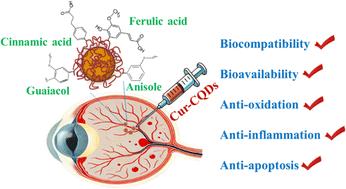
Despite the recognized neuroprotective benefits of curcumin, its clinical utility is constrained by poor bioavailability and high cytotoxicity at effective doses. This study evaluates the therapeutic potential of curcumin-derived carbon quantum dots (Cur-CQDs) for retinal protection against ischemia-reperfusion (IR) injury in rats. Cur-CQDs were synthesized via mild pyrolysis at varying temperatures and assessed for efficacy in rat retinal ganglion cells and a model of retinal IR injury. The Cur-CQDs, particularly those synthesized at 150 °C, displayed significant reductions in apoptosis in retinal tissues, as indicated by TUNEL assays, immunofluorescence localization of HIF-α, CD68, BCL-2, and Grp78, and Western blot analysis for HO-1, Grp78, CHOP, caspase 3, and Nrf2. These results suggest that Cur-CQDs not only enhance cell survival and reduce inflammation but also decrease oxidative and endoplasmic reticulum stress markers. Mechanistic insights reveal that Cur-CQDs modulate pathways involved in oxidative stress, apoptosis, and inflammation, specifically through the upregulation of BCL-2 and HO-1 and the downregulation of CHOP, caspase-3, and endoplasmic reticulum stress markers. The identification of cinnamic acid-, anisole-, guaiacol, and ferulic acid-like structures on Cur-CQDs’ surfaces may contribute to their superior antioxidative and anti-inflammatory activities. Collectively, these findings position Cur-CQDs as a promising approach for treating retinal IR injuries, enhancing curcumin's bioavailability and therapeutic efficacy, and paving new pathways in ocular neuroprotection research and potential clinical applications.
期刊介绍:
Journal of Materials Chemistry A, B & C cover high quality studies across all fields of materials chemistry. The journals focus on those theoretical or experimental studies that report new understanding, applications, properties and synthesis of materials. Journal of Materials Chemistry A, B & C are separated by the intended application of the material studied. Broadly, applications in energy and sustainability are of interest to Journal of Materials Chemistry A, applications in biology and medicine are of interest to Journal of Materials Chemistry B, and applications in optical, magnetic and electronic devices are of interest to Journal of Materials Chemistry C.Journal of Materials Chemistry B is a Transformative Journal and Plan S compliant. Example topic areas within the scope of Journal of Materials Chemistry B are listed below. This list is neither exhaustive nor exclusive:
Antifouling coatings
Biocompatible materials
Bioelectronics
Bioimaging
Biomimetics
Biomineralisation
Bionics
Biosensors
Diagnostics
Drug delivery
Gene delivery
Immunobiology
Nanomedicine
Regenerative medicine & Tissue engineering
Scaffolds
Soft robotics
Stem cells
Therapeutic devices



 京公网安备 11010802042870号
京ICP备2023020795号-1
京公网安备 11010802042870号
京ICP备2023020795号-1

 分享
分享
 求助内容:
求助内容: 应助结果提醒方式:
 扫码关注我们
