Jiaomeng Pan, Mao Zhang, Dongning Rao, Junjie Ma, Xia Shen, Haokai Qin, Kun Gan, Jian Lin, Yingying Huang, Chen Sang, Juan Zhang, Jiaqiang Ma, Yingcheng Wu, Zheng Tang, Daming Gao, Qiang Gao, Liuxiao Yang, Jia Fan
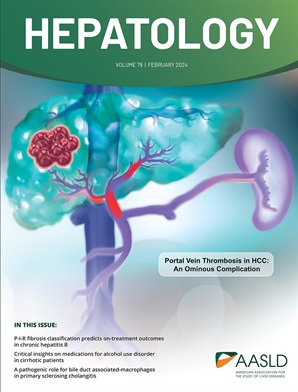
{"title":"CAD manipulates tumor intrinsic DHO/UBE4B/NF-κB pathway and fuels macrophage cross-talk, promoting hepatocellular carcinoma metastasis","authors":"Jiaomeng Pan, Mao Zhang, Dongning Rao, Junjie Ma, Xia Shen, Haokai Qin, Kun Gan, Jian Lin, Yingying Huang, Chen Sang, Juan Zhang, Jiaqiang Ma, Yingcheng Wu, Zheng Tang, Daming Gao, Qiang Gao, Liuxiao Yang, Jia Fan","doi":"10.1097/hep.0000000000001304","DOIUrl":null,"url":null,"abstract":"Background and Aims: Portal vein tumor thrombosis (PVTT), an indicator of clinical metastasis, significantly shortens hepatocellular carcinoma (HCC) patients’ lifespan, and no effective treatment has been established. We aimed to illustrate mechanisms underlying PVTT formation and tumor metastasis, and identified potential targets for clinical intervention. Approach and Results: Multi-omics data of 159 HCC patients (including 37 cases with PVTT) was analyzed to identify contributors to PVTT formation and tumor metastasis. <jats:italic toggle=\"yes\">In vitro</jats:italic> and <jats:italic toggle=\"yes\">in vivo</jats:italic> experiments were performed to confirm the critical role of carbamoyl-phosphate synthetase 2, aspartate transcarbamylase, and dihydroorotase (CAD) in HCC metastasis. Metabolomics and transcriptomics techniques, single-cell RNA sequencing, combined with experimental verification were complemented to illustrate mechanisms underlying CAD induced pro-metastatic efficacy. Analysis of proteogenomic data of HCC cohort identified CAD as the key contributor to PVTT formation and tumor metastasis in HCC. Further experiments confirmed that high CAD expression could significantly promote HCC metastasis, and vice versa. Mechanistically, CAD manipulated de novo pyrimidine anabolism, leading to dihydroorotic acid (DHO) accumulation which directly bound to ubiquitination factor E4B (UBE4B). UBE4B subsequently regulated JAK1 ubiquitination and activated the NF-κB pathway to promote epithelial-mesenchymal transition (EMT) of HCC cells. Additionally, CAD generated an immunosuppressive milieu conducive to HCC metastasis by recruiting and reprogramming macrophages into a “pro-tumor” phenotype. Consequently, the metastatic capability of HCC was remarkably enhanced. Conclusion: Therapy targeting CAD may offer a promising approach to curb HCC metastasis by reducing tumor cells’ metastatic potential and also shifting the tumor microenvironment towards a less pro-metastatic state.","PeriodicalId":177,"journal":{"name":"Hepatology","volume":"33 1","pages":""},"PeriodicalIF":15.8000,"publicationDate":"2025-03-12","publicationTypes":"Journal Article","fieldsOfStudy":null,"isOpenAccess":false,"openAccessPdf":"","citationCount":"0","resultStr":null,"platform":"Semanticscholar","paperid":null,"PeriodicalName":"Hepatology","FirstCategoryId":"3","ListUrlMain":"https://doi.org/10.1097/hep.0000000000001304","RegionNum":1,"RegionCategory":"医学","ArticlePicture":[],"TitleCN":null,"AbstractTextCN":null,"PMCID":null,"EPubDate":"","PubModel":"","JCR":"Q1","JCRName":"GASTROENTEROLOGY & HEPATOLOGY","Score":null,"Total":0}
引用次数: 0
Abstract
Background and Aims: Portal vein tumor thrombosis (PVTT), an indicator of clinical metastasis, significantly shortens hepatocellular carcinoma (HCC) patients’ lifespan, and no effective treatment has been established. We aimed to illustrate mechanisms underlying PVTT formation and tumor metastasis, and identified potential targets for clinical intervention. Approach and Results: Multi-omics data of 159 HCC patients (including 37 cases with PVTT) was analyzed to identify contributors to PVTT formation and tumor metastasis. In vitro and in vivo experiments were performed to confirm the critical role of carbamoyl-phosphate synthetase 2, aspartate transcarbamylase, and dihydroorotase (CAD) in HCC metastasis. Metabolomics and transcriptomics techniques, single-cell RNA sequencing, combined with experimental verification were complemented to illustrate mechanisms underlying CAD induced pro-metastatic efficacy. Analysis of proteogenomic data of HCC cohort identified CAD as the key contributor to PVTT formation and tumor metastasis in HCC. Further experiments confirmed that high CAD expression could significantly promote HCC metastasis, and vice versa. Mechanistically, CAD manipulated de novo pyrimidine anabolism, leading to dihydroorotic acid (DHO) accumulation which directly bound to ubiquitination factor E4B (UBE4B). UBE4B subsequently regulated JAK1 ubiquitination and activated the NF-κB pathway to promote epithelial-mesenchymal transition (EMT) of HCC cells. Additionally, CAD generated an immunosuppressive milieu conducive to HCC metastasis by recruiting and reprogramming macrophages into a “pro-tumor” phenotype. Consequently, the metastatic capability of HCC was remarkably enhanced. Conclusion: Therapy targeting CAD may offer a promising approach to curb HCC metastasis by reducing tumor cells’ metastatic potential and also shifting the tumor microenvironment towards a less pro-metastatic state.
期刊介绍:
HEPATOLOGY is recognized as the leading publication in the field of liver disease. It features original, peer-reviewed articles covering various aspects of liver structure, function, and disease. The journal's distinguished Editorial Board carefully selects the best articles each month, focusing on topics including immunology, chronic hepatitis, viral hepatitis, cirrhosis, genetic and metabolic liver diseases, liver cancer, and drug metabolism.



 京公网安备 11010802042870号
京ICP备2023020795号-1
京公网安备 11010802042870号
京ICP备2023020795号-1

 分享
分享
 求助内容:
求助内容: 应助结果提醒方式:
 扫码关注我们
