{"title":"A Structurally Simple Polymer Donor Enables High-Efficiency Organic Solar Cells with Minimal Energy Losses","authors":"Qiuju Jiang, Xiyue Yuan, Yao Li, Yongmin Luo, Jiayuan Zhu, Feixiang Zhao, Yue Zhang, Wenkui Wei, Haozhe Feng, Hongxiang Li, Jiaying Wu, Zaifei Ma, Zheng Tang, Fei Huang, Yong Cao, Chunhui Duan","doi":"10.1002/anie.202416883","DOIUrl":null,"url":null,"abstract":"<p>Energy loss (<i>E</i><sub>loss</sub>) between optical energy gap (<i>E</i><sub>g</sub>) and open-circuit voltage (e<i>V</i><sub>oc</sub>) sets efficiency upper limits for organic solar cells (OSCs). Nevertheless, further breaking the limit of <i>E</i><sub>loss</sub> in OSCs is challenging, especially via structurally simple materials in binary OSCs. Herein, a structurally simple nonhalogenated polymer donor, namely PBDCT, is developed for realizing high-efficiency OSCs with record-breaking <i>E</i><sub>loss</sub>. The critical building block 3,4-dicyanothiophene with high electron affinity results in a deep-lying highest occupied molecular orbital (HOMO), which effectively reduces radiative and nonradiative recombination energy losses in OSCs. Meanwhile, the finely tuned alkyl chains offer high crystallinity and low energetic disorder for the polymer, which enables efficient exciton dissociation at low energy loss. Moreover, bi-continuous crystalline fibrillary network structure is formed in the blend consisting of PBDCT due to the optimal aggregation property of the polymer, which is conducive to exciton diffusion and charge transport. Consequently, the OSC with a record-breaking low <i>E</i><sub>loss</sub> of 0.476 eV has been achieved, which thereby resulted in a power conversion efficiency (PCE) of 19.84%, the highest value achieved by nonhalogenated polymer donors in binary OSCs to date. This work demonstrates the prospect of breaking the limit of <i>E</i><sub>loss</sub> and realizing efficiency breakthroughs in OSCs.</p>","PeriodicalId":125,"journal":{"name":"Angewandte Chemie International Edition","volume":"64 21","pages":""},"PeriodicalIF":16.9000,"publicationDate":"2025-03-12","publicationTypes":"Journal Article","fieldsOfStudy":null,"isOpenAccess":false,"openAccessPdf":"","citationCount":"0","resultStr":null,"platform":"Semanticscholar","paperid":null,"PeriodicalName":"Angewandte Chemie International Edition","FirstCategoryId":"92","ListUrlMain":"https://onlinelibrary.wiley.com/doi/10.1002/anie.202416883","RegionNum":1,"RegionCategory":"化学","ArticlePicture":[],"TitleCN":null,"AbstractTextCN":null,"PMCID":null,"EPubDate":"","PubModel":"","JCR":"Q1","JCRName":"CHEMISTRY, MULTIDISCIPLINARY","Score":null,"Total":0}
引用次数: 0
Abstract
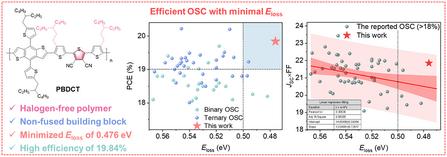
Energy loss (Eloss) between optical energy gap (Eg) and open-circuit voltage (eVoc) sets efficiency upper limits for organic solar cells (OSCs). Nevertheless, further breaking the limit of Eloss in OSCs is challenging, especially via structurally simple materials in binary OSCs. Herein, a structurally simple nonhalogenated polymer donor, namely PBDCT, is developed for realizing high-efficiency OSCs with record-breaking Eloss. The critical building block 3,4-dicyanothiophene with high electron affinity results in a deep-lying highest occupied molecular orbital (HOMO), which effectively reduces radiative and nonradiative recombination energy losses in OSCs. Meanwhile, the finely tuned alkyl chains offer high crystallinity and low energetic disorder for the polymer, which enables efficient exciton dissociation at low energy loss. Moreover, bi-continuous crystalline fibrillary network structure is formed in the blend consisting of PBDCT due to the optimal aggregation property of the polymer, which is conducive to exciton diffusion and charge transport. Consequently, the OSC with a record-breaking low Eloss of 0.476 eV has been achieved, which thereby resulted in a power conversion efficiency (PCE) of 19.84%, the highest value achieved by nonhalogenated polymer donors in binary OSCs to date. This work demonstrates the prospect of breaking the limit of Eloss and realizing efficiency breakthroughs in OSCs.
期刊介绍:
Angewandte Chemie, a journal of the German Chemical Society (GDCh), maintains a leading position among scholarly journals in general chemistry with an impressive Impact Factor of 16.6 (2022 Journal Citation Reports, Clarivate, 2023). Published weekly in a reader-friendly format, it features new articles almost every day. Established in 1887, Angewandte Chemie is a prominent chemistry journal, offering a dynamic blend of Review-type articles, Highlights, Communications, and Research Articles on a weekly basis, making it unique in the field.



 京公网安备 11010802042870号
京ICP备2023020795号-1
京公网安备 11010802042870号
京ICP备2023020795号-1

 分享
分享
 求助内容:
求助内容: 应助结果提醒方式:
 扫码关注我们
