{"title":"Characterization of treatment intensified (add-on to metformin) adults with type 2 diabetes in Thailand: A cross-sectional real-world study (CONVERGE)","authors":"Chutintorn Sriphrapradang, Ammarin Thakkinstian, Ratiporn Chinthammit, Gurudutt Nayak","doi":"10.1111/jdi.14409","DOIUrl":null,"url":null,"abstract":"<div>\n \n \n <section>\n \n <h3> Objective</h3>\n \n <p>The CONVERGE (Cardiovascular Outcomes and Value in the Real-World with GLP-1RAs) study characterized demographics, clinical characteristics, and medication use in treatment-intensified (add-on to metformin) adults with type 2 diabetes (T2D) in Thailand.</p>\n </section>\n \n <section>\n \n <h3> Methods</h3>\n \n <p>A retrospective cross-sectional study of data from medical records (Jul 26, 2013, to Dec 31, 2017) was descriptively summarized for overall population and subgroups defined by glucose-lowering agent (GLA) classes.</p>\n </section>\n \n <section>\n \n <h3> Results</h3>\n \n <p>Data from 1,000 adults were collected in reverse chronological order. At baseline, the mean (SD) age was 60 (12) years, HbA<sub>1c</sub> was 8.0%, and the median (IQR) T2D duration was 1.0 (0.2–2.4) years. Patients taking SGLT2-is (sodium glucose cotransporter-2 inhibitors) had a longer T2D duration (1.8 years, 0.8–3.2), GLP-1RAs (glucagon-like peptide-1 receptor agonists) had a higher body mass index of 32.0 (8.84) kg/m<sup>2</sup>, and insulin subgroup had a higher HbA<sub>1c</sub> 8.5% (7.5–10.1). The utilization of GLP-1 RAs/SGLT-2is was low (1.5% and 6%, respectively). Among the subgroups, most patients in the GLP-1RA (80.0%) and insulin subgroup (81.3%) receiving 3/≥4 GLAs. The most frequently prescribed GLAs post-metformin were sulfonylureas (45.2%) and dipeptidyl peptidase-4 inhibitors (39.4%). Overall, 90% received ≥1 cardiovascular (CV) medication; lipid-lowering agents (78%) were the most prescribed.</p>\n </section>\n \n <section>\n \n <h3> Conclusions</h3>\n \n <p>These results indicate low utilization of GLAs with CV benefits, attributed to a lack of CV benefit data during the study period and partial reimbursement implementation. Future studies must identify barriers to adoption and estimate the usage of these GLAs with CV benefits as more evidence becomes available on positive CV outcomes to improve patient care in Thailand.</p>\n </section>\n </div>","PeriodicalId":51250,"journal":{"name":"Journal of Diabetes Investigation","volume":"16 6","pages":"1010-1019"},"PeriodicalIF":3.0000,"publicationDate":"2025-03-12","publicationTypes":"Journal Article","fieldsOfStudy":null,"isOpenAccess":false,"openAccessPdf":"https://onlinelibrary.wiley.com/doi/epdf/10.1111/jdi.14409","citationCount":"0","resultStr":null,"platform":"Semanticscholar","paperid":null,"PeriodicalName":"Journal of Diabetes Investigation","FirstCategoryId":"3","ListUrlMain":"https://onlinelibrary.wiley.com/doi/10.1111/jdi.14409","RegionNum":3,"RegionCategory":"医学","ArticlePicture":[],"TitleCN":null,"AbstractTextCN":null,"PMCID":null,"EPubDate":"","PubModel":"","JCR":"Q2","JCRName":"ENDOCRINOLOGY & METABOLISM","Score":null,"Total":0}
引用次数: 0
Abstract
Objective
The CONVERGE (Cardiovascular Outcomes and Value in the Real-World with GLP-1RAs) study characterized demographics, clinical characteristics, and medication use in treatment-intensified (add-on to metformin) adults with type 2 diabetes (T2D) in Thailand.
Methods
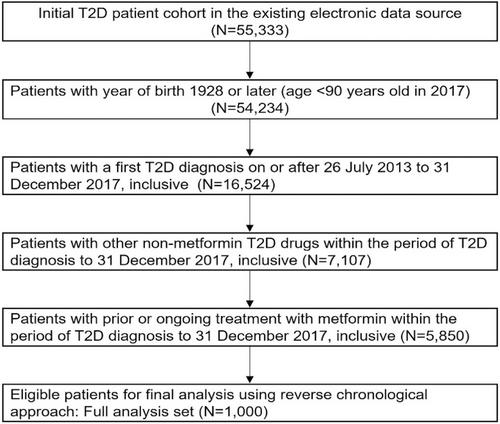
A retrospective cross-sectional study of data from medical records (Jul 26, 2013, to Dec 31, 2017) was descriptively summarized for overall population and subgroups defined by glucose-lowering agent (GLA) classes.
Results
Data from 1,000 adults were collected in reverse chronological order. At baseline, the mean (SD) age was 60 (12) years, HbA1c was 8.0%, and the median (IQR) T2D duration was 1.0 (0.2–2.4) years. Patients taking SGLT2-is (sodium glucose cotransporter-2 inhibitors) had a longer T2D duration (1.8 years, 0.8–3.2), GLP-1RAs (glucagon-like peptide-1 receptor agonists) had a higher body mass index of 32.0 (8.84) kg/m2, and insulin subgroup had a higher HbA1c 8.5% (7.5–10.1). The utilization of GLP-1 RAs/SGLT-2is was low (1.5% and 6%, respectively). Among the subgroups, most patients in the GLP-1RA (80.0%) and insulin subgroup (81.3%) receiving 3/≥4 GLAs. The most frequently prescribed GLAs post-metformin were sulfonylureas (45.2%) and dipeptidyl peptidase-4 inhibitors (39.4%). Overall, 90% received ≥1 cardiovascular (CV) medication; lipid-lowering agents (78%) were the most prescribed.
Conclusions
These results indicate low utilization of GLAs with CV benefits, attributed to a lack of CV benefit data during the study period and partial reimbursement implementation. Future studies must identify barriers to adoption and estimate the usage of these GLAs with CV benefits as more evidence becomes available on positive CV outcomes to improve patient care in Thailand.
目的:CONVERGE (Cardiovascular Outcomes and Value in Real-World with GLP-1RAs)研究描述了泰国2型糖尿病(T2D)患者的人口统计学、临床特征和用药情况。方法:对医疗记录(2013年7月26日至2017年12月31日)的数据进行回顾性横断面研究,对总体人群和按降糖药(GLA)类别定义的亚组进行描述性总结。结果:从1000名成年人中收集的数据是按时间倒序收集的。基线时,平均(SD)年龄为60(12)岁,HbA1c为8.0%,中位(IQR) T2D持续时间为1.0(0.2-2.4)年。服用SGLT2-is(钠葡萄糖共转运蛋白-2抑制剂)的患者T2D持续时间更长(1.8年,0.8-3.2年),GLP-1RAs(胰高血糖素样肽-1受体激动剂)的体重指数更高,为32.0 (8.84)kg/m2,胰岛素亚组的HbA1c升高8.5%(7.5-10.1)。GLP-1 RAs/SGLT-2is的利用率较低(分别为1.5%和6%)。在亚组中,大多数GLP-1RA患者(80.0%)和胰岛素亚组(81.3%)接受3/≥4 gla。二甲双胍后最常用的gla是磺脲类药物(45.2%)和二肽基肽酶-4抑制剂(39.4%)。总体而言,90%接受了≥1种心血管(CV)药物治疗;降脂药(78%)是处方最多的。结论:这些结果表明,由于研究期间缺乏CV效益数据和部分报销实施,具有CV效益的gla利用率较低。未来的研究必须确定采用gla的障碍,并评估这些具有CV益处的gla的使用情况,因为越来越多的证据表明,积极的CV结果可以改善泰国的患者护理。
期刊介绍:
Journal of Diabetes Investigation is your core diabetes journal from Asia; the official journal of the Asian Association for the Study of Diabetes (AASD). The journal publishes original research, country reports, commentaries, reviews, mini-reviews, case reports, letters, as well as editorials and news. Embracing clinical and experimental research in diabetes and related areas, the Journal of Diabetes Investigation includes aspects of prevention, treatment, as well as molecular aspects and pathophysiology. Translational research focused on the exchange of ideas between clinicians and researchers is also welcome. Journal of Diabetes Investigation is indexed by Science Citation Index Expanded (SCIE).




 京公网安备 11010802042870号
京ICP备2023020795号-1
京公网安备 11010802042870号
京ICP备2023020795号-1

 分享
分享
 求助内容:
求助内容: 应助结果提醒方式:
 扫码关注我们
