Propofol versus Dexmedetomidine for Sedation of Cancer Patients Undergoing Endoscopic Retrograde Cholangiopancreatography: Randomized Single-Blinded Controlled Study.
Ahmed Mohamed Soliman, Yehya Mohamed Hamad, Abeer AbdElmonem Almaghraby, Ahmed Abdalla Mohamed, Shady Rady Abdallah
{"title":"Propofol versus Dexmedetomidine for Sedation of Cancer Patients Undergoing Endoscopic Retrograde Cholangiopancreatography: Randomized Single-Blinded Controlled Study.","authors":"Ahmed Mohamed Soliman, Yehya Mohamed Hamad, Abeer AbdElmonem Almaghraby, Ahmed Abdalla Mohamed, Shady Rady Abdallah","doi":"10.5812/aapm-148512","DOIUrl":null,"url":null,"abstract":"<p><strong>Background: </strong>Endoscopic retrograde cholangiopancreatography (ERCP) is a primary diagnostic and therapeutic option for pancreaticobiliary pathologies.</p><p><strong>Objectives: </strong>This study aimed to investigate the efficacy and safety of dexmedetomidine versus propofol during ERCP in cancer patients.</p><p><strong>Methods: </strong>This randomized controlled single-blinded trial was conducted with 202 cancer patients aged 21 to 60 years, of both sexes, with a body mass index of 18.5 to 30 kg/m<sup>2</sup>, and classified as American Society of Anesthesiologists (ASA) class II - III, who were undergoing ERCP. The patients were randomly assigned to two equal groups. The Propofol Group (n = 101) received a loading dose of propofol (1 - 2 mg/kg over 30 seconds) followed by an infusion (0.05 - 0.1 mg/kg/hour). The Dexmedetomidine Group (n = 101) received a loading dose of dexmedetomidine (1 μg/kg over 10 minutes) followed by an infusion (0.2 - 0.7 μg/kg/hour). The maintenance dose was adjusted during the procedure based on vital signs, Bispectral Index (BIS), and oxygen saturation.</p><p><strong>Results: </strong>The Dexmedetomidine group showed a significantly lower incidence of intra-procedural hypoxemic events (14.9% vs. 26.7%, P = 0.037) and a comparable incidence of hypotension (17.8% vs. 13.9%, P = 0.441). Dexmedetomidine also demonstrated significantly lower intraoperative pain scores according to the Facial Pain Score (P < 0.05), significantly lower postoperative Visual Analog Scale (VAS) scores (P < 0.05), and a lower frequency of postoperative nausea and vomiting (PONV) compared to the Propofol group. Additionally, there was a significantly higher frequency of endoscopist satisfaction in the Dexmedetomidine group compared to the Propofol group (P < 0.05).</p><p><strong>Conclusions: </strong>Dexmedetomidine can be used as a safe and effective alternative to propofol for deep sedation of cancer patients undergoing ERCP. It is associated with a lower incidence of hypoxemic events, effective intraoperative sedation, quicker recovery, and superior analgesic effects both intraoperatively and postoperatively compared to propofol.</p>","PeriodicalId":7841,"journal":{"name":"Anesthesiology and Pain Medicine","volume":"14 4","pages":"e148512"},"PeriodicalIF":0.0000,"publicationDate":"2024-09-09","publicationTypes":"Journal Article","fieldsOfStudy":null,"isOpenAccess":false,"openAccessPdf":"https://www.ncbi.nlm.nih.gov/pmc/articles/PMC11895786/pdf/","citationCount":"0","resultStr":null,"platform":"Semanticscholar","paperid":null,"PeriodicalName":"Anesthesiology and Pain Medicine","FirstCategoryId":"1085","ListUrlMain":"https://doi.org/10.5812/aapm-148512","RegionNum":0,"RegionCategory":null,"ArticlePicture":[],"TitleCN":null,"AbstractTextCN":null,"PMCID":null,"EPubDate":"2024/8/1 0:00:00","PubModel":"eCollection","JCR":"Q2","JCRName":"Medicine","Score":null,"Total":0}
引用次数: 0
Abstract
Background: Endoscopic retrograde cholangiopancreatography (ERCP) is a primary diagnostic and therapeutic option for pancreaticobiliary pathologies.
Objectives: This study aimed to investigate the efficacy and safety of dexmedetomidine versus propofol during ERCP in cancer patients.
Methods: This randomized controlled single-blinded trial was conducted with 202 cancer patients aged 21 to 60 years, of both sexes, with a body mass index of 18.5 to 30 kg/m2, and classified as American Society of Anesthesiologists (ASA) class II - III, who were undergoing ERCP. The patients were randomly assigned to two equal groups. The Propofol Group (n = 101) received a loading dose of propofol (1 - 2 mg/kg over 30 seconds) followed by an infusion (0.05 - 0.1 mg/kg/hour). The Dexmedetomidine Group (n = 101) received a loading dose of dexmedetomidine (1 μg/kg over 10 minutes) followed by an infusion (0.2 - 0.7 μg/kg/hour). The maintenance dose was adjusted during the procedure based on vital signs, Bispectral Index (BIS), and oxygen saturation.
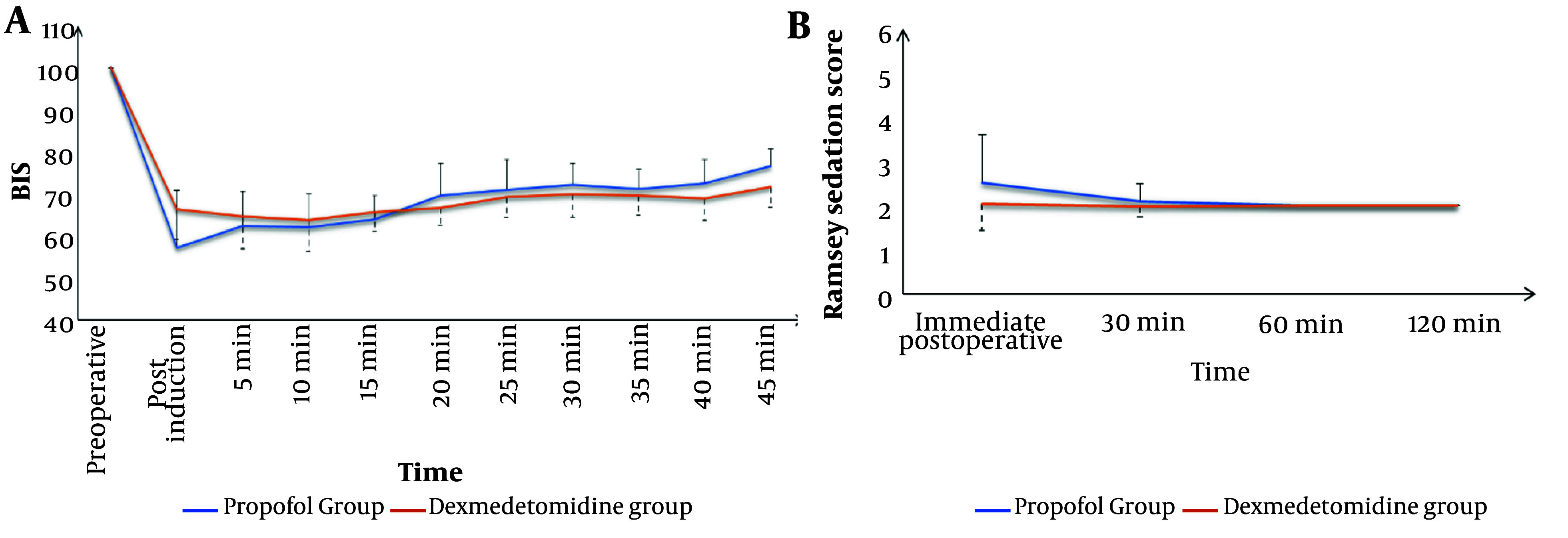
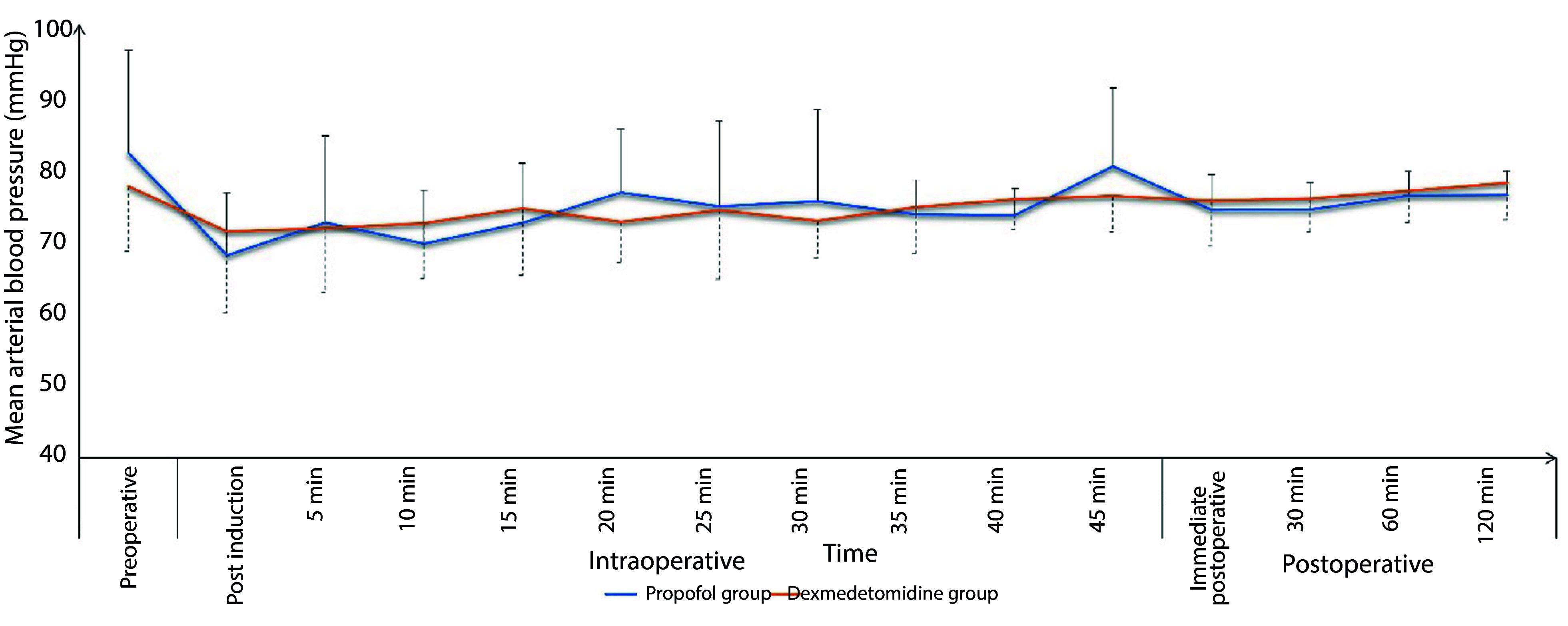
Results: The Dexmedetomidine group showed a significantly lower incidence of intra-procedural hypoxemic events (14.9% vs. 26.7%, P = 0.037) and a comparable incidence of hypotension (17.8% vs. 13.9%, P = 0.441). Dexmedetomidine also demonstrated significantly lower intraoperative pain scores according to the Facial Pain Score (P < 0.05), significantly lower postoperative Visual Analog Scale (VAS) scores (P < 0.05), and a lower frequency of postoperative nausea and vomiting (PONV) compared to the Propofol group. Additionally, there was a significantly higher frequency of endoscopist satisfaction in the Dexmedetomidine group compared to the Propofol group (P < 0.05).
Conclusions: Dexmedetomidine can be used as a safe and effective alternative to propofol for deep sedation of cancer patients undergoing ERCP. It is associated with a lower incidence of hypoxemic events, effective intraoperative sedation, quicker recovery, and superior analgesic effects both intraoperatively and postoperatively compared to propofol.




 京公网安备 11010802042870号
京ICP备2023020795号-1
京公网安备 11010802042870号
京ICP备2023020795号-1

 分享
分享
 求助内容:
求助内容: 应助结果提醒方式:
 扫码关注我们
