Fariha Ahmed Nishat, M F Mridha, Istiak Mahmud, Meshal Alfarhood, Mejdl Safran, Dunren Che
{"title":"Enhancing Typhoid Fever Diagnosis Based on Clinical Data Using a Lightweight Machine Learning Metamodel.","authors":"Fariha Ahmed Nishat, M F Mridha, Istiak Mahmud, Meshal Alfarhood, Mejdl Safran, Dunren Che","doi":"10.3390/diagnostics15050562","DOIUrl":null,"url":null,"abstract":"<p><p><b>Background:</b> Typhoid fever remains a significant public health challenge, especially in developing countries where diagnostic resources are limited. Accurate and timely diagnosis is crucial for effective treatment and disease containment. Traditional diagnostic methods, while effective, can be time-consuming and resource-intensive. This study aims to develop a lightweight machine learning-based diagnostic tool for the early and efficient detection of typhoid fever using clinical data. <b>Methods:</b> A custom dataset comprising 14 clinical and demographic parameters-including age, gender, headache, muscle pain, nausea, diarrhea, cough, fever range (°F), hemoglobin (g/dL), platelet count, urine culture bacteria, calcium (mg/dL), and potassium (mg/dL)-was analyzed. A machine learning metamodel, integrating Support Vector Machine (SVM), Gaussian Naive Bayes (GNB), and Decision Tree classifiers with a Light Gradient Boosting Machine (LGBM), was trained and evaluated using k-fold cross-validation. Performance was assessed using precision, recall, F1-score, and area under the receiver operating characteristic curve (AUC). <b>Results:</b> The proposed metamodel demonstrated superior diagnostic performance, achieving a precision of 99%, recall of 100%, and an AUC of 1.00. It outperformed traditional diagnostic methods and other standalone machine learning algorithms, offering high accuracy and generalizability. <b>Conclusions:</b> The lightweight machine learning metamodel provides a cost-effective, non-invasive, and rapid diagnostic alternative for typhoid fever, particularly suited for resource-limited settings. Its reliance on accessible clinical parameters ensures practical applicability and scalability, potentially improving patient outcomes and aiding in disease control. Future work will focus on broader validation and integration into clinical workflows to further enhance its utility.</p>","PeriodicalId":11225,"journal":{"name":"Diagnostics","volume":"15 5","pages":""},"PeriodicalIF":3.3000,"publicationDate":"2025-02-26","publicationTypes":"Journal Article","fieldsOfStudy":null,"isOpenAccess":false,"openAccessPdf":"https://www.ncbi.nlm.nih.gov/pmc/articles/PMC11899580/pdf/","citationCount":"0","resultStr":null,"platform":"Semanticscholar","paperid":null,"PeriodicalName":"Diagnostics","FirstCategoryId":"3","ListUrlMain":"https://doi.org/10.3390/diagnostics15050562","RegionNum":3,"RegionCategory":"医学","ArticlePicture":[],"TitleCN":null,"AbstractTextCN":null,"PMCID":null,"EPubDate":"","PubModel":"","JCR":"Q1","JCRName":"MEDICINE, GENERAL & INTERNAL","Score":null,"Total":0}
引用次数: 0
Abstract
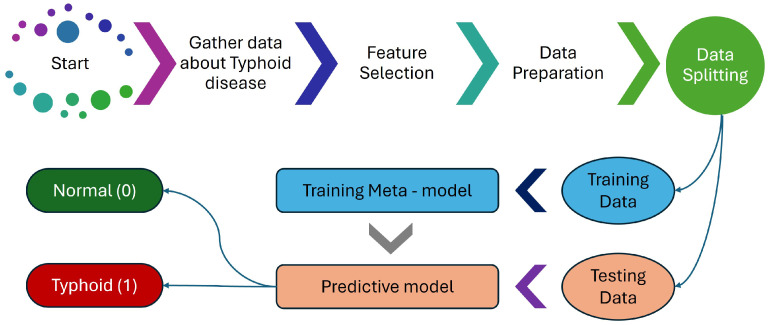
Background: Typhoid fever remains a significant public health challenge, especially in developing countries where diagnostic resources are limited. Accurate and timely diagnosis is crucial for effective treatment and disease containment. Traditional diagnostic methods, while effective, can be time-consuming and resource-intensive. This study aims to develop a lightweight machine learning-based diagnostic tool for the early and efficient detection of typhoid fever using clinical data. Methods: A custom dataset comprising 14 clinical and demographic parameters-including age, gender, headache, muscle pain, nausea, diarrhea, cough, fever range (°F), hemoglobin (g/dL), platelet count, urine culture bacteria, calcium (mg/dL), and potassium (mg/dL)-was analyzed. A machine learning metamodel, integrating Support Vector Machine (SVM), Gaussian Naive Bayes (GNB), and Decision Tree classifiers with a Light Gradient Boosting Machine (LGBM), was trained and evaluated using k-fold cross-validation. Performance was assessed using precision, recall, F1-score, and area under the receiver operating characteristic curve (AUC). Results: The proposed metamodel demonstrated superior diagnostic performance, achieving a precision of 99%, recall of 100%, and an AUC of 1.00. It outperformed traditional diagnostic methods and other standalone machine learning algorithms, offering high accuracy and generalizability. Conclusions: The lightweight machine learning metamodel provides a cost-effective, non-invasive, and rapid diagnostic alternative for typhoid fever, particularly suited for resource-limited settings. Its reliance on accessible clinical parameters ensures practical applicability and scalability, potentially improving patient outcomes and aiding in disease control. Future work will focus on broader validation and integration into clinical workflows to further enhance its utility.
DiagnosticsBiochemistry, Genetics and Molecular Biology-Clinical Biochemistry
CiteScore
4.70
自引率
8.30%
发文量
2699
审稿时长
19.64 days
期刊介绍:
Diagnostics (ISSN 2075-4418) is an international scholarly open access journal on medical diagnostics. It publishes original research articles, reviews, communications and short notes on the research and development of medical diagnostics. There is no restriction on the length of the papers. Our aim is to encourage scientists to publish their experimental and theoretical research in as much detail as possible. Full experimental and/or methodological details must be provided for research articles.





 京公网安备 11010802042870号
京ICP备2023020795号-1
京公网安备 11010802042870号
京ICP备2023020795号-1

 分享
分享
 求助内容:
求助内容: 应助结果提醒方式:
 扫码关注我们
