Frailty, malnutrition, healthcare utilization, and mortality in patients with dementia and cognitive impairment obtained from hospital administrative data.
Reshma Aziz Merchant, Ying Qiu Dong, Shikha Kumari, Diarmuid Murphy
{"title":"Frailty, malnutrition, healthcare utilization, and mortality in patients with dementia and cognitive impairment obtained from hospital administrative data.","authors":"Reshma Aziz Merchant, Ying Qiu Dong, Shikha Kumari, Diarmuid Murphy","doi":"10.3389/fmed.2025.1540050","DOIUrl":null,"url":null,"abstract":"<p><strong>Introduction: </strong>With aging populations, the prevalence of dementia, frailty and malnutrition will increase. The aim of this study is twofold (a) to determine the demographic data, including frailty and malnutrition prevalence in older patients with diagnosis of dementia and/or cognitive impairment and (b) to determine its impact on outcomes such as length of stay (LOS), readmission and mortality stratified by frailty status.</p><p><strong>Methods: </strong>Retrospective single-center cohort study conducted using hospital database on older patients ≥65 yrs. admitted to a tertiary hospital between March 2022 and Dec 2023 and discharged with either primary or secondary diagnosis of dementia or cognitive impairment. Data on age, gender, ethnicity, comorbidities, discharge diagnoses, Hospital Frailty Risk Score (HFRS), Clinical Frailty Scale (CFS), activity of daily living (ADL), 3-Minute Nutrition Screening and outcomes such as LOS, readmission, mortality and cost of hospitalization were extracted. Those aged between 65 to 74 years old were categorized as \"young-old,\" and ≥75 years old as \"old-old.\"</p><p><strong>Results: </strong>Dementia or cognitive impairment diagnosis was prevalent in 8.6% (3090) older patients, and 33.7% were malnourished. 54.5% were female with a mean age of 82.0 years. Almost one fourth were dependent on ADL. Based on frailty defined by (i) HFRS-26.0% had intermediate and 18.2% high frailty (ii) CFS-41.0% were mild/moderately frail, and 32.2% severely frail. Median LOS was 8 days. 30 and 90-days readmission rates were 23.2 and 35.4%, respectively. In-hospital mortality was 7.8% and 30-day mortality 14.0%. High HFRS (aOR 1.511, 95% CI: 1.089-2.097; <i>p</i> = 0.013), severe frailty (aOR 4.325, 95% CI: 0.960-2.684; <i>p</i> < 0.001) and terminal frailty (aOR 39.762, 95% CI: 18.311-86.344; <i>p</i> < 0.001) were significantly associated with inpatient mortality. Intermediate HFRS (aOR 1.682, 95% CI: 1.380-2.050; <i>p</i> < 0.001), mild/moderate frailty (1.609, 95% CI: 1.254-2.065; <i>p</i> < 0.01), high HFRS (aOR 2.178, 95% CI: 1.756-2.702; <i>p</i> < 0.001) and severe frailty (2.333, 95% CI: 1.804-3.017; <i>p</i> < 0.01) were significantly associated with 30-days readmission. The impact of malnutrition on healthcare utilization was highest in the old-old with high HFRS and severe frailty.</p><p><strong>Conclusion: </strong>Frailty and malnutrition have significant impact on healthcare utilization, readmission rates, and mortality among older adults with dementia and/or cognitive impairment.</p>","PeriodicalId":12488,"journal":{"name":"Frontiers in Medicine","volume":"12 ","pages":"1540050"},"PeriodicalIF":3.1000,"publicationDate":"2025-02-26","publicationTypes":"Journal Article","fieldsOfStudy":null,"isOpenAccess":false,"openAccessPdf":"https://www.ncbi.nlm.nih.gov/pmc/articles/PMC11897001/pdf/","citationCount":"0","resultStr":null,"platform":"Semanticscholar","paperid":null,"PeriodicalName":"Frontiers in Medicine","FirstCategoryId":"3","ListUrlMain":"https://doi.org/10.3389/fmed.2025.1540050","RegionNum":3,"RegionCategory":"医学","ArticlePicture":[],"TitleCN":null,"AbstractTextCN":null,"PMCID":null,"EPubDate":"2025/1/1 0:00:00","PubModel":"eCollection","JCR":"Q1","JCRName":"MEDICINE, GENERAL & INTERNAL","Score":null,"Total":0}
引用次数: 0
Abstract
Introduction: With aging populations, the prevalence of dementia, frailty and malnutrition will increase. The aim of this study is twofold (a) to determine the demographic data, including frailty and malnutrition prevalence in older patients with diagnosis of dementia and/or cognitive impairment and (b) to determine its impact on outcomes such as length of stay (LOS), readmission and mortality stratified by frailty status.
Methods: Retrospective single-center cohort study conducted using hospital database on older patients ≥65 yrs. admitted to a tertiary hospital between March 2022 and Dec 2023 and discharged with either primary or secondary diagnosis of dementia or cognitive impairment. Data on age, gender, ethnicity, comorbidities, discharge diagnoses, Hospital Frailty Risk Score (HFRS), Clinical Frailty Scale (CFS), activity of daily living (ADL), 3-Minute Nutrition Screening and outcomes such as LOS, readmission, mortality and cost of hospitalization were extracted. Those aged between 65 to 74 years old were categorized as "young-old," and ≥75 years old as "old-old."
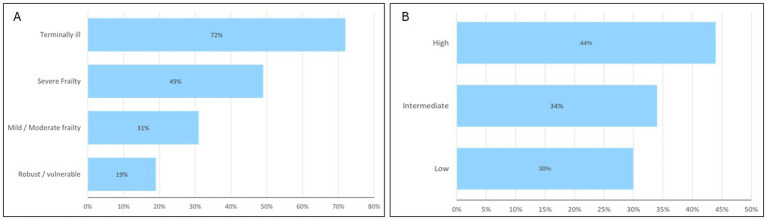
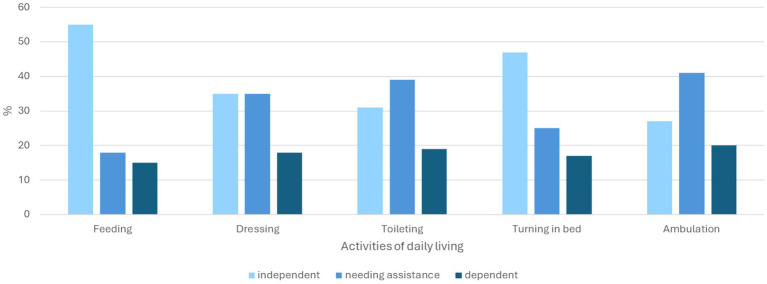
Results: Dementia or cognitive impairment diagnosis was prevalent in 8.6% (3090) older patients, and 33.7% were malnourished. 54.5% were female with a mean age of 82.0 years. Almost one fourth were dependent on ADL. Based on frailty defined by (i) HFRS-26.0% had intermediate and 18.2% high frailty (ii) CFS-41.0% were mild/moderately frail, and 32.2% severely frail. Median LOS was 8 days. 30 and 90-days readmission rates were 23.2 and 35.4%, respectively. In-hospital mortality was 7.8% and 30-day mortality 14.0%. High HFRS (aOR 1.511, 95% CI: 1.089-2.097; p = 0.013), severe frailty (aOR 4.325, 95% CI: 0.960-2.684; p < 0.001) and terminal frailty (aOR 39.762, 95% CI: 18.311-86.344; p < 0.001) were significantly associated with inpatient mortality. Intermediate HFRS (aOR 1.682, 95% CI: 1.380-2.050; p < 0.001), mild/moderate frailty (1.609, 95% CI: 1.254-2.065; p < 0.01), high HFRS (aOR 2.178, 95% CI: 1.756-2.702; p < 0.001) and severe frailty (2.333, 95% CI: 1.804-3.017; p < 0.01) were significantly associated with 30-days readmission. The impact of malnutrition on healthcare utilization was highest in the old-old with high HFRS and severe frailty.
Conclusion: Frailty and malnutrition have significant impact on healthcare utilization, readmission rates, and mortality among older adults with dementia and/or cognitive impairment.
随着人口老龄化,痴呆、虚弱和营养不良的患病率将会增加。本研究的目的有两个:(a)确定人口统计数据,包括诊断为痴呆和/或认知障碍的老年患者的虚弱和营养不良患病率;(b)确定其对住院时间(LOS)、再入院和按虚弱状态分层的死亡率等结果的影响。方法:采用医院数据库对≥65 岁的老年患者进行回顾性单中心队列研究。在2022年3月至2023年12月期间入住三级医院,出院时诊断为原发性或继发性痴呆或认知障碍。提取年龄、性别、种族、合并症、出院诊断、医院衰弱风险评分(HFRS)、临床衰弱量表(CFS)、日常生活活动(ADL)、3分钟营养筛查以及LOS、再入院、死亡率和住院费用等结局数据。年龄在65岁到74岁 之间的被归类为“young-old”,年龄≥75岁 的被归类为“old-old”。结果:8.6%(3090例)老年患者普遍诊断为痴呆或认知障碍,33.7%为营养不良。54.5%为女性,平均年龄82.0 岁。几乎四分之一的人依赖ADL。根据(i) hfrs定义的虚弱,26.0%为中度虚弱,18.2%为高度虚弱;(ii) CFS-41.0%为轻度/中度虚弱,32.2%为严重虚弱。平均生存时间为8 天。30天和90天再入院率分别为23.2%和35.4%。住院死亡率为7.8%,30天死亡率为14.0%。高HFRS (aOR 1.511, 95% CI: 1.089-2.097;p = 0.013),严重虚弱(aOR 4.325, 95% CI: 0.960-2.684;p p p p p p 结论:虚弱和营养不良对老年痴呆和/或认知障碍患者的医疗保健利用、再入院率和死亡率有显著影响。
期刊介绍:
Frontiers in Medicine publishes rigorously peer-reviewed research linking basic research to clinical practice and patient care, as well as translating scientific advances into new therapies and diagnostic tools. Led by an outstanding Editorial Board of international experts, this multidisciplinary open-access journal is at the forefront of disseminating and communicating scientific knowledge and impactful discoveries to researchers, academics, clinicians and the public worldwide.
In addition to papers that provide a link between basic research and clinical practice, a particular emphasis is given to studies that are directly relevant to patient care. In this spirit, the journal publishes the latest research results and medical knowledge that facilitate the translation of scientific advances into new therapies or diagnostic tools. The full listing of the Specialty Sections represented by Frontiers in Medicine is as listed below. As well as the established medical disciplines, Frontiers in Medicine is launching new sections that together will facilitate
- the use of patient-reported outcomes under real world conditions
- the exploitation of big data and the use of novel information and communication tools in the assessment of new medicines
- the scientific bases for guidelines and decisions from regulatory authorities
- access to medicinal products and medical devices worldwide
- addressing the grand health challenges around the world



 京公网安备 11010802042870号
京ICP备2023020795号-1
京公网安备 11010802042870号
京ICP备2023020795号-1

 分享
分享
 求助内容:
求助内容: 应助结果提醒方式:
 扫码关注我们
