{"title":"Relationship of teat canal score to milk somatic cell count, pathogen infection, and antimicrobial components in Holstein dairy cows.","authors":"Keiichi Hisaeda, Naomi Ohta, Naoki Yamamoto, Akira Goto, Yoichi Inoue, Yasunori Shinozuka, Naoki Suzuki, Naoki Isobe","doi":"10.1292/jvms.24-0510","DOIUrl":null,"url":null,"abstract":"<p><p>This study examined the relationship between teat canal score (TCS), somatic cell count (SCC), pathogen infection, and milk antimicrobial components in each quarter of milking cows. A total of 110 quarters of 28 healthy Holstein milking cows were used for the TCS and collection of milk samples. Milk samples were analyzed for SCC, antimicrobial components (S100A7 and lingual antimicrobial peptide (LAP)), and acute phase protein (serum amyloid A (SAA)). Milk samples with SCC of at least 10<sup>5</sup> cells/mL were cultured to isolate and identify the causative organism. A total of 110 teats were classified, TCS of 1, 2, 3, 4 in 60.9% (67), 26.4% (29),11.8% (13) and 0.9% (1) teats, respectively. A positive correlation (r=0.6915, P<0.0001) was found between the TCS and SCC in all teats. Pathogens were detected in 100% of milk samples from TCS ≥3 milk and 91% of those from TCS 2. However, pathogens were detected in only 33% of milk samples from TCS 1, a significantly (P<0.0001) lower detection rate than those from TCS 2 and ≥3. The LAP concentration in the group with detected pathogen was significantly (P<0.01) higher than that in the no growth group. The results suggest that in quarters with higher TCS, SCC and LAP concentrations were significantly higher, milking it easier to detect pathogens due to the greater likelihood of bacterial invasion.</p>","PeriodicalId":49959,"journal":{"name":"Journal of Veterinary Medical Science","volume":" ","pages":"497-502"},"PeriodicalIF":1.1000,"publicationDate":"2025-05-01","publicationTypes":"Journal Article","fieldsOfStudy":null,"isOpenAccess":false,"openAccessPdf":"https://www.ncbi.nlm.nih.gov/pmc/articles/PMC12150867/pdf/","citationCount":"0","resultStr":null,"platform":"Semanticscholar","paperid":null,"PeriodicalName":"Journal of Veterinary Medical Science","FirstCategoryId":"97","ListUrlMain":"https://doi.org/10.1292/jvms.24-0510","RegionNum":4,"RegionCategory":"农林科学","ArticlePicture":[],"TitleCN":null,"AbstractTextCN":null,"PMCID":null,"EPubDate":"2025/3/12 0:00:00","PubModel":"Epub","JCR":"Q3","JCRName":"VETERINARY SCIENCES","Score":null,"Total":0}
引用次数: 0
Abstract
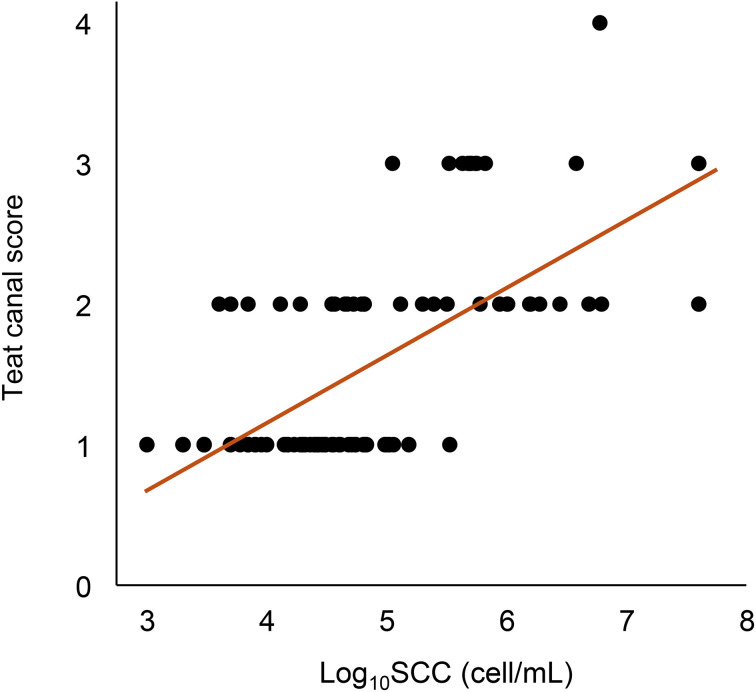
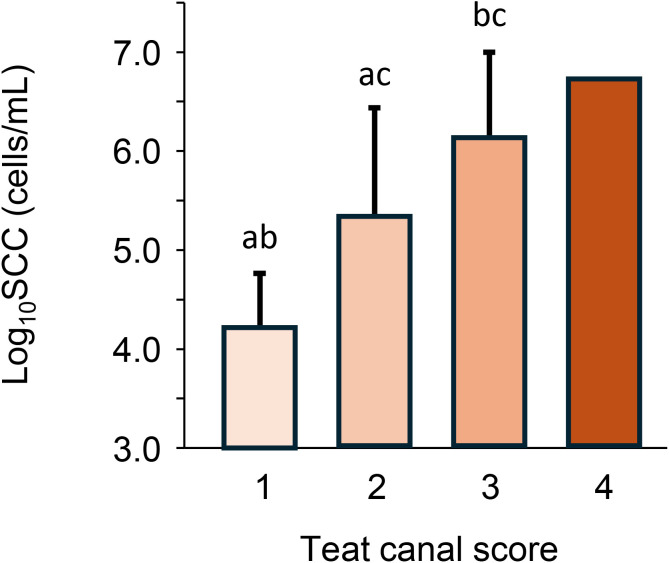
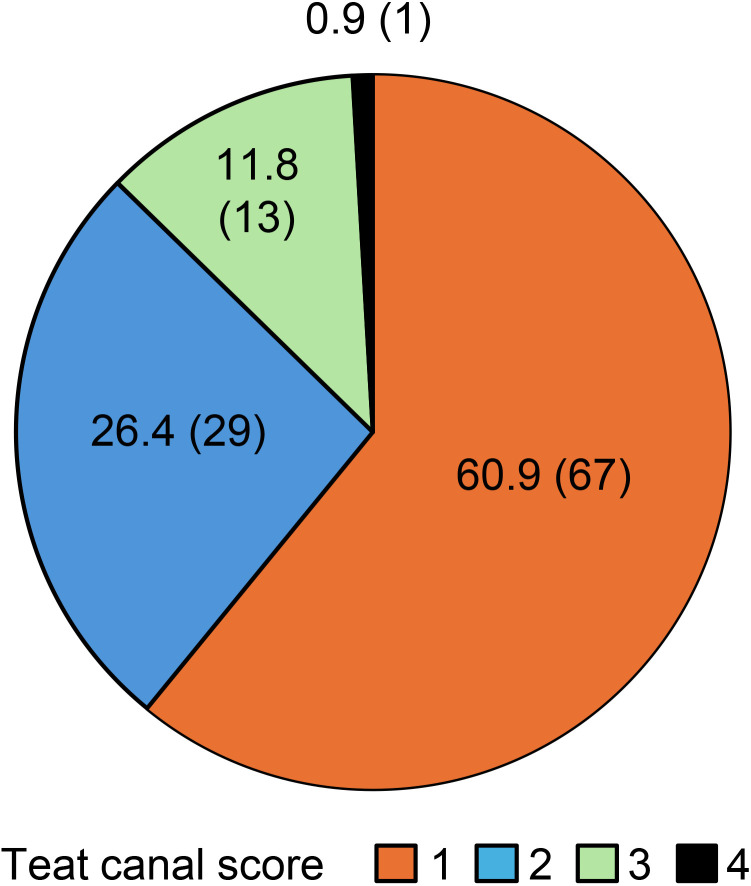
This study examined the relationship between teat canal score (TCS), somatic cell count (SCC), pathogen infection, and milk antimicrobial components in each quarter of milking cows. A total of 110 quarters of 28 healthy Holstein milking cows were used for the TCS and collection of milk samples. Milk samples were analyzed for SCC, antimicrobial components (S100A7 and lingual antimicrobial peptide (LAP)), and acute phase protein (serum amyloid A (SAA)). Milk samples with SCC of at least 105 cells/mL were cultured to isolate and identify the causative organism. A total of 110 teats were classified, TCS of 1, 2, 3, 4 in 60.9% (67), 26.4% (29),11.8% (13) and 0.9% (1) teats, respectively. A positive correlation (r=0.6915, P<0.0001) was found between the TCS and SCC in all teats. Pathogens were detected in 100% of milk samples from TCS ≥3 milk and 91% of those from TCS 2. However, pathogens were detected in only 33% of milk samples from TCS 1, a significantly (P<0.0001) lower detection rate than those from TCS 2 and ≥3. The LAP concentration in the group with detected pathogen was significantly (P<0.01) higher than that in the no growth group. The results suggest that in quarters with higher TCS, SCC and LAP concentrations were significantly higher, milking it easier to detect pathogens due to the greater likelihood of bacterial invasion.
本研究研究了每季度奶牛的乳管评分(TCS)、体细胞计数(SCC)、病原体感染和乳抗菌成分之间的关系。在28头健康的荷斯坦奶牛中,共有110节奶牛被用于TCS和采集牛奶样本。分析牛奶样品的SCC、抗菌成分(S100A7和舌抗菌肽(LAP))和急性期蛋白(血清淀粉样蛋白A (SAA))。培养SCC至少为105个细胞/mL的牛奶样本,以分离和鉴定致病生物。共分110头,TCS为1、2、3、4的分别为60.9%(67头)、26.4%(29头)、11.8%(13头)和0.9%(1头)。正相关(r=0.6915, P
期刊介绍:
JVMS is a peer-reviewed journal and publishes a variety of papers on veterinary science from basic research to applied science and clinical research. JVMS is published monthly and consists of twelve issues per year. Papers are from the areas of anatomy, physiology, pharmacology, toxicology, pathology, immunology, microbiology, virology, parasitology, internal medicine, surgery, clinical pathology, theriogenology, avian disease, public health, ethology, and laboratory animal science. Although JVMS has played a role in publishing the scientific achievements of Japanese researchers and clinicians for many years, it now also accepts papers submitted from all over the world.




 京公网安备 11010802042870号
京ICP备2023020795号-1
京公网安备 11010802042870号
京ICP备2023020795号-1

 分享
分享
 求助内容:
求助内容: 应助结果提醒方式:
 扫码关注我们
