Misha A J B Whittingham, Vera A Korasidis, Danielle Fraser
{"title":"Functional stasis and changing habitat preferences among mammalian communities from the PETM of the Bighorn Basin, Wyoming.","authors":"Misha A J B Whittingham, Vera A Korasidis, Danielle Fraser","doi":"10.1017/ext.2024.25","DOIUrl":null,"url":null,"abstract":"<p><p>The transition between the Paleocene and Eocene epochs (ca. 56 Ma) was marked by a period of rapid global warming of 5 °C to 8 °C following a carbon isotope excursion (CIE) lasting 200 ky or less referred to as the Paleocene-Eocene Thermal Maximum (PETM). The PETM precipitated a significant shift in the composition of North American floral communities and major mammalian turnover. We explored the ecological impacts of this phenomenon by analyzing 173 mammal species from the Bighorn Basin, Wyoming, USA, including their associated body alongside a database of 30 palynofloral localities as proxies for habitat. For each time bin, we calculated mean and median differences in body mass and habitat preference between significantly aggregated and segregated mammal species. Aggregated species showed significant similarity in habitat preference only prior to the PETM, after which habitat preference ceased to be a significant factor in community assembly. Our measures of differences in body mass space provide no evidence of a significant impact of competitive interactions on community assembly across the PETM, aligning with previous work. Our results indicate the persistence of a stable mammalian functional community structure despite taxonomic turnover, climate change and broadening habitat preferences.</p>","PeriodicalId":520449,"journal":{"name":"Cambridge prisms. Extinction","volume":"2 ","pages":"e20"},"PeriodicalIF":0.0000,"publicationDate":"2024-12-05","publicationTypes":"Journal Article","fieldsOfStudy":null,"isOpenAccess":false,"openAccessPdf":"https://www.ncbi.nlm.nih.gov/pmc/articles/PMC11895753/pdf/","citationCount":"0","resultStr":null,"platform":"Semanticscholar","paperid":null,"PeriodicalName":"Cambridge prisms. Extinction","FirstCategoryId":"1085","ListUrlMain":"https://doi.org/10.1017/ext.2024.25","RegionNum":0,"RegionCategory":null,"ArticlePicture":[],"TitleCN":null,"AbstractTextCN":null,"PMCID":null,"EPubDate":"2024/1/1 0:00:00","PubModel":"eCollection","JCR":"","JCRName":"","Score":null,"Total":0}
引用次数: 0
Abstract
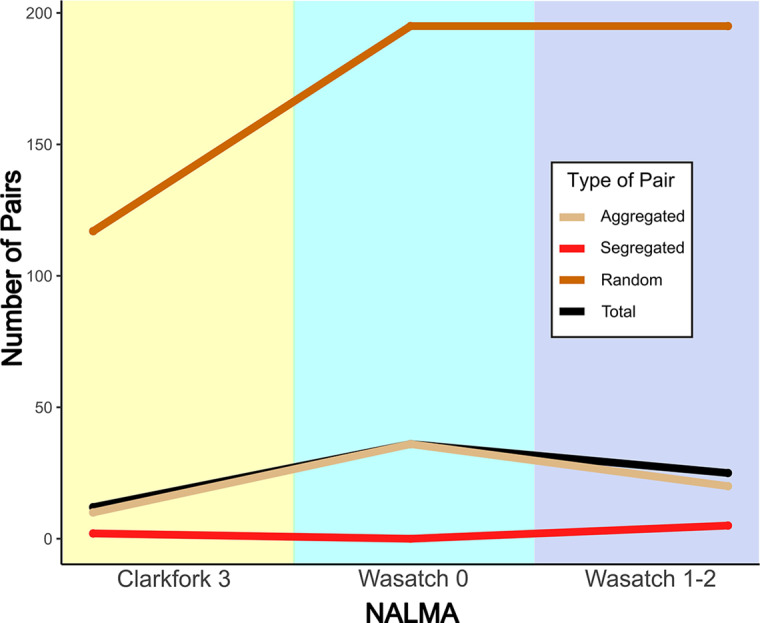
The transition between the Paleocene and Eocene epochs (ca. 56 Ma) was marked by a period of rapid global warming of 5 °C to 8 °C following a carbon isotope excursion (CIE) lasting 200 ky or less referred to as the Paleocene-Eocene Thermal Maximum (PETM). The PETM precipitated a significant shift in the composition of North American floral communities and major mammalian turnover. We explored the ecological impacts of this phenomenon by analyzing 173 mammal species from the Bighorn Basin, Wyoming, USA, including their associated body alongside a database of 30 palynofloral localities as proxies for habitat. For each time bin, we calculated mean and median differences in body mass and habitat preference between significantly aggregated and segregated mammal species. Aggregated species showed significant similarity in habitat preference only prior to the PETM, after which habitat preference ceased to be a significant factor in community assembly. Our measures of differences in body mass space provide no evidence of a significant impact of competitive interactions on community assembly across the PETM, aligning with previous work. Our results indicate the persistence of a stable mammalian functional community structure despite taxonomic turnover, climate change and broadening habitat preferences.





 京公网安备 11010802042870号
京ICP备2023020795号-1
京公网安备 11010802042870号
京ICP备2023020795号-1

 分享
分享

 求助内容:
求助内容: 应助结果提醒方式:
 扫码关注我们
