This is the way the world ends; not with a bang but a whimper: Estimating the number and ongoing rate of extinctions of Australian non-marine invertebrates.
John C Z Woinarski, Michael F Braby, Heloise Gibb, Mark S Harvey, Sarah M Legge, Jessica R Marsh, Melinda L Moir, Tim R New, Michael G Rix, Brett P Murphy
{"title":"<i>This is the way the world ends; not with a bang but a whimper</i>: Estimating the number and ongoing rate of extinctions of Australian non-marine invertebrates.","authors":"John C Z Woinarski, Michael F Braby, Heloise Gibb, Mark S Harvey, Sarah M Legge, Jessica R Marsh, Melinda L Moir, Tim R New, Michael G Rix, Brett P Murphy","doi":"10.1017/ext.2024.26","DOIUrl":null,"url":null,"abstract":"<p><p>Biodiversity is in rapid decline, but the extent of loss is not well resolved for poorly known groups. We estimate the number of extinctions for Australian non-marine invertebrates since the European colonisation of the continent. Our analyses use a range of approaches, incorporate stated uncertainties and recognise explicit caveats. We use plausible bounds for the number of species, two approaches for estimating extinction rate, and Monte Carlo simulations to select combinations of projected distributions from these variables. We conclude that 9,111 (plausible bounds of 1,465 to 56,828) Australian species have become extinct over this 236-year period. These estimates dwarf the number of formally recognised extinctions of Australian invertebrates (10 species) and of the single invertebrate species listed as extinct under Australian legislation. We predict that 39-148 species will become extinct in 2024. This is inconsistent with a recent pledge by the Australian government to prevent all extinctions. This high rate of loss is largely a consequence of pervasive taxonomic biases in community concern and conservation investment. Those characteristics also make it challenging to reduce that rate of loss, as there is uncertainty about which invertebrate species are at the most risk. We outline conservation responses to reduce the likelihood of further extinctions.</p>","PeriodicalId":520449,"journal":{"name":"Cambridge prisms. Extinction","volume":"2 ","pages":"e23"},"PeriodicalIF":0.0000,"publicationDate":"2024-12-09","publicationTypes":"Journal Article","fieldsOfStudy":null,"isOpenAccess":false,"openAccessPdf":"https://www.ncbi.nlm.nih.gov/pmc/articles/PMC11895748/pdf/","citationCount":"0","resultStr":null,"platform":"Semanticscholar","paperid":null,"PeriodicalName":"Cambridge prisms. Extinction","FirstCategoryId":"1085","ListUrlMain":"https://doi.org/10.1017/ext.2024.26","RegionNum":0,"RegionCategory":null,"ArticlePicture":[],"TitleCN":null,"AbstractTextCN":null,"PMCID":null,"EPubDate":"2024/1/1 0:00:00","PubModel":"eCollection","JCR":"","JCRName":"","Score":null,"Total":0}
引用次数: 0
Abstract
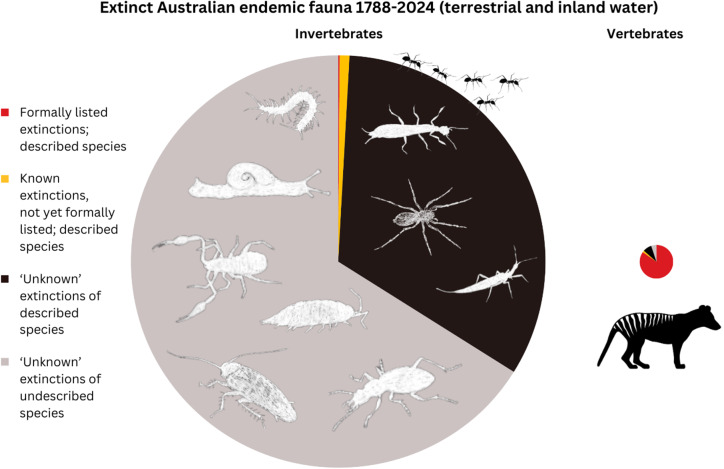
Biodiversity is in rapid decline, but the extent of loss is not well resolved for poorly known groups. We estimate the number of extinctions for Australian non-marine invertebrates since the European colonisation of the continent. Our analyses use a range of approaches, incorporate stated uncertainties and recognise explicit caveats. We use plausible bounds for the number of species, two approaches for estimating extinction rate, and Monte Carlo simulations to select combinations of projected distributions from these variables. We conclude that 9,111 (plausible bounds of 1,465 to 56,828) Australian species have become extinct over this 236-year period. These estimates dwarf the number of formally recognised extinctions of Australian invertebrates (10 species) and of the single invertebrate species listed as extinct under Australian legislation. We predict that 39-148 species will become extinct in 2024. This is inconsistent with a recent pledge by the Australian government to prevent all extinctions. This high rate of loss is largely a consequence of pervasive taxonomic biases in community concern and conservation investment. Those characteristics also make it challenging to reduce that rate of loss, as there is uncertainty about which invertebrate species are at the most risk. We outline conservation responses to reduce the likelihood of further extinctions.





 京公网安备 11010802042870号
京ICP备2023020795号-1
京公网安备 11010802042870号
京ICP备2023020795号-1

 分享
分享

 求助内容:
求助内容: 应助结果提醒方式:
 扫码关注我们
