Jingxuan Bi, Xiaomei Huo, Zhenkai Zhou, Junhui Li, Ke Wang, Zhuzhu Du and Wei Ai
{"title":"Mg-Rich LAPONITE® interface protective layer enables reversible, corrosion-resistant anodes for high-performance magnesium metal batteries†","authors":"Jingxuan Bi, Xiaomei Huo, Zhenkai Zhou, Junhui Li, Ke Wang, Zhuzhu Du and Wei Ai","doi":"10.1039/D5QI00310E","DOIUrl":null,"url":null,"abstract":"<p >Magnesium metal batteries (MMBs) are considered one of the most promising candidates for the post-lithium era but face significant challenges, including non-uniform plating, irregular stripping, and interface passivation. Herein, we have developed a highly reversible, passivation-free, and corrosion-resistant Mg metal anode by integrating a Mg-rich LAPONITE® (Mg-RL) interface protective layer using a doctor-blading technique. The Mg-RL interface protective layer, with its negatively charged interlayer structure, creates abundant cation transport channels and isolates direct contact between the electrolyte and anode, thus facilitating highly reversible Mg plating/stripping while suppressing anode passivation. As a result, Mg-RL/Mg-based symmetric cells exhibit exceptional cycling stability, maintaining over 1500 h in APC electrolyte and 800 h in Mg(TFSI)<small><sub>2</sub></small> electrolyte under practical current densities and area capacities. Furthermore, the corresponding Mo<small><sub>6</sub></small>S<small><sub>8</sub></small>-based full cells demonstrate excellent electrochemical performance, and the Mg–S pouch cells successfully power a toy car, demonstrating practical viability. This study presents a simple, cost-effective strategy for constructing artificial interface protective layers of Mg metal anodes, advancing the development of stable and safe MMBs.</p>","PeriodicalId":79,"journal":{"name":"Inorganic Chemistry Frontiers","volume":" 10","pages":" 3653-3662"},"PeriodicalIF":6.4000,"publicationDate":"2025-03-14","publicationTypes":"Journal Article","fieldsOfStudy":null,"isOpenAccess":false,"openAccessPdf":"","citationCount":"0","resultStr":null,"platform":"Semanticscholar","paperid":null,"PeriodicalName":"Inorganic Chemistry Frontiers","FirstCategoryId":"92","ListUrlMain":"https://pubs.rsc.org/en/content/articlelanding/2025/qi/d5qi00310e","RegionNum":1,"RegionCategory":"化学","ArticlePicture":[],"TitleCN":null,"AbstractTextCN":null,"PMCID":null,"EPubDate":"","PubModel":"","JCR":"Q1","JCRName":"CHEMISTRY, INORGANIC & NUCLEAR","Score":null,"Total":0}
引用次数: 0
Abstract
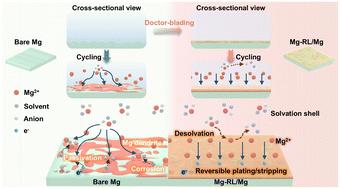
Magnesium metal batteries (MMBs) are considered one of the most promising candidates for the post-lithium era but face significant challenges, including non-uniform plating, irregular stripping, and interface passivation. Herein, we have developed a highly reversible, passivation-free, and corrosion-resistant Mg metal anode by integrating a Mg-rich LAPONITE® (Mg-RL) interface protective layer using a doctor-blading technique. The Mg-RL interface protective layer, with its negatively charged interlayer structure, creates abundant cation transport channels and isolates direct contact between the electrolyte and anode, thus facilitating highly reversible Mg plating/stripping while suppressing anode passivation. As a result, Mg-RL/Mg-based symmetric cells exhibit exceptional cycling stability, maintaining over 1500 h in APC electrolyte and 800 h in Mg(TFSI)2 electrolyte under practical current densities and area capacities. Furthermore, the corresponding Mo6S8-based full cells demonstrate excellent electrochemical performance, and the Mg–S pouch cells successfully power a toy car, demonstrating practical viability. This study presents a simple, cost-effective strategy for constructing artificial interface protective layers of Mg metal anodes, advancing the development of stable and safe MMBs.




 京公网安备 11010802042870号
京ICP备2023020795号-1
京公网安备 11010802042870号
京ICP备2023020795号-1

 分享
分享
 求助内容:
求助内容: 应助结果提醒方式:
 扫码关注我们
