Li-Ping Zhang, Yi-Tao Li, Yu Jiang, Run-Yuan Jiang, Shuang Ni and Qing-Yuan Yang
{"title":"Pore-structure control in bimetallic coordination networks for natural gas purification with record C2H6/CH4 selectivity†","authors":"Li-Ping Zhang, Yi-Tao Li, Yu Jiang, Run-Yuan Jiang, Shuang Ni and Qing-Yuan Yang","doi":"10.1039/D5QI00316D","DOIUrl":null,"url":null,"abstract":"<p >Developing effective adsorbents with high adsorption capacity and selectivity for separating methane (CH<small><sub>4</sub></small>) from natural gas mixtures containing ethane (C<small><sub>2</sub></small>H<small><sub>6</sub></small>) and propane (C<small><sub>3</sub></small>H<small><sub>8</sub></small>) remains a significant challenge. Previous studies on CH<small><sub>4</sub></small>/C<small><sub>2</sub></small>H<small><sub>6</sub></small>/C<small><sub>3</sub></small>H<small><sub>8</sub></small> separation have primarily focused on enhancing C<small><sub>3</sub></small>H<small><sub>8</sub></small>/CH<small><sub>4</sub></small> selectivity, often neglecting the crucial role of C<small><sub>2</sub></small>H<small><sub>6</sub></small>/CH<small><sub>4</sub></small> selectivity, thereby limiting CH<small><sub>4</sub></small> productivity. Here, we present a strategy to modulate pore size and chemistry in two bimetallic coordination networks, CuIn(ina)<small><sub>4</sub></small> and CuIn(3-ain)<small><sub>4</sub></small>, to enhance the separation of CH<small><sub>4</sub></small>/C<small><sub>2</sub></small>H<small><sub>6</sub></small>/C<small><sub>3</sub></small>H<small><sub>8</sub></small> mixtures. Remarkably, CuIn(3-ain)<small><sub>4</sub></small> exhibits a record C<small><sub>2</sub></small>H<small><sub>6</sub></small>/CH<small><sub>4</sub></small> selectivity and a benchmark low-pressure C<small><sub>2</sub></small>H<small><sub>6</sub></small> adsorption capacity, achieving a CH<small><sub>4</sub></small> productivity of 7.92 mmol g<small><sup>−1</sup></small> with a purity exceeding 99.9999%, surpassing most known porous materials. Theoretical simulations reveal how selective adsorption can be finely tuned by adjusting pore size and geometry. Moreover, breakthrough experiments with ternary mixtures, along with regeneration and cycling tests, underscore the exceptional potential of CuIn(3-ain)<small><sub>4</sub></small> as a highly efficient adsorbent for natural gas separation.</p>","PeriodicalId":79,"journal":{"name":"Inorganic Chemistry Frontiers","volume":" 10","pages":" 3602-3610"},"PeriodicalIF":6.4000,"publicationDate":"2025-03-14","publicationTypes":"Journal Article","fieldsOfStudy":null,"isOpenAccess":false,"openAccessPdf":"","citationCount":"0","resultStr":null,"platform":"Semanticscholar","paperid":null,"PeriodicalName":"Inorganic Chemistry Frontiers","FirstCategoryId":"92","ListUrlMain":"https://pubs.rsc.org/en/content/articlelanding/2025/qi/d5qi00316d","RegionNum":1,"RegionCategory":"化学","ArticlePicture":[],"TitleCN":null,"AbstractTextCN":null,"PMCID":null,"EPubDate":"","PubModel":"","JCR":"Q1","JCRName":"CHEMISTRY, INORGANIC & NUCLEAR","Score":null,"Total":0}
引用次数: 0
Abstract
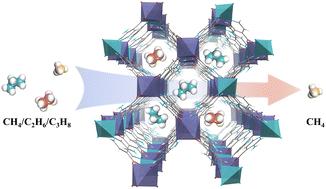
Developing effective adsorbents with high adsorption capacity and selectivity for separating methane (CH4) from natural gas mixtures containing ethane (C2H6) and propane (C3H8) remains a significant challenge. Previous studies on CH4/C2H6/C3H8 separation have primarily focused on enhancing C3H8/CH4 selectivity, often neglecting the crucial role of C2H6/CH4 selectivity, thereby limiting CH4 productivity. Here, we present a strategy to modulate pore size and chemistry in two bimetallic coordination networks, CuIn(ina)4 and CuIn(3-ain)4, to enhance the separation of CH4/C2H6/C3H8 mixtures. Remarkably, CuIn(3-ain)4 exhibits a record C2H6/CH4 selectivity and a benchmark low-pressure C2H6 adsorption capacity, achieving a CH4 productivity of 7.92 mmol g−1 with a purity exceeding 99.9999%, surpassing most known porous materials. Theoretical simulations reveal how selective adsorption can be finely tuned by adjusting pore size and geometry. Moreover, breakthrough experiments with ternary mixtures, along with regeneration and cycling tests, underscore the exceptional potential of CuIn(3-ain)4 as a highly efficient adsorbent for natural gas separation.



 京公网安备 11010802042870号
京ICP备2023020795号-1
京公网安备 11010802042870号
京ICP备2023020795号-1

 分享
分享
 求助内容:
求助内容: 应助结果提醒方式:
 扫码关注我们
