Sebastiano Seminara , Stefania Bennici , Francesco Scollo , Mario Di Guardo , Pablo Aleza , Stefano La Malfa , Alessandra Gentile , Gaetano Distefano
{"title":"High Resolution Melting DNA analysis for the traceability of plants and juices of blond and pigmented sweet orange","authors":"Sebastiano Seminara , Stefania Bennici , Francesco Scollo , Mario Di Guardo , Pablo Aleza , Stefano La Malfa , Alessandra Gentile , Gaetano Distefano","doi":"10.1016/j.jafr.2025.101755","DOIUrl":null,"url":null,"abstract":"<div><div>The economic relevance of sweet orange [<em>Citrus sinensis</em> (L.) Osbeck] raised the interest for the set-up of robust and scalable methods to assess the origin of plants and derived products. Molecular markers, such as single-nucleotide polymorphisms (SNPs), represent a robust tool for the univocal identification of the genetic origin of a specific cultivar (or group of accessions) with relevant application for traceability.</div><div>In this work, the whole-genome sequencing of 29 accessions representing the four varietal groups of sweet orange (i.e.: Common, Navel, Acidless and Pigmented) allowed the <em>in</em> <em>silico</em> detection of unique SNPs to discriminate each group (group-specific SNPs) and ten pigmented orange accessions (genotype-specific SNPs).</div><div>A subset of the SNPs detected <em>in</em> <em>silico</em> was then validated through a high-resolution melting assay (HRM) on additional 81 genotypes held in three <em>ex-situ</em> collections in Italy and Spain and on several matrices: leaves, hand‐squeezed and commercial fresh-squeezed juices, processed orange juices, and beverages. The HRM assay allowed the identification of 13 group-specific and 30 genotype-specific SNPs showing consistent results across the whole germplasm and the different food matrices tested. The HRM assay proved its efficacy also for the identification of juice blending with other sweet orange varieties (with a detection limit of 5 %). The identified unique SNPs represent a valuable tool to trace the varietal correspondence of plants and fruit-derived products. Their implementation with a scalable and robust HRM assay could be readily employed by growers and the food processing industry to ensure traceability along the chain.</div></div>","PeriodicalId":34393,"journal":{"name":"Journal of Agriculture and Food Research","volume":"21 ","pages":"Article 101755"},"PeriodicalIF":6.2000,"publicationDate":"2025-06-01","publicationTypes":"Journal Article","fieldsOfStudy":null,"isOpenAccess":false,"openAccessPdf":"","citationCount":"0","resultStr":null,"platform":"Semanticscholar","paperid":null,"PeriodicalName":"Journal of Agriculture and Food Research","FirstCategoryId":"1085","ListUrlMain":"https://www.sciencedirect.com/science/article/pii/S2666154325001267","RegionNum":0,"RegionCategory":null,"ArticlePicture":[],"TitleCN":null,"AbstractTextCN":null,"PMCID":null,"EPubDate":"2025/2/20 0:00:00","PubModel":"Epub","JCR":"Q1","JCRName":"AGRICULTURE, MULTIDISCIPLINARY","Score":null,"Total":0}
引用次数: 0
Abstract
The economic relevance of sweet orange [Citrus sinensis (L.) Osbeck] raised the interest for the set-up of robust and scalable methods to assess the origin of plants and derived products. Molecular markers, such as single-nucleotide polymorphisms (SNPs), represent a robust tool for the univocal identification of the genetic origin of a specific cultivar (or group of accessions) with relevant application for traceability.
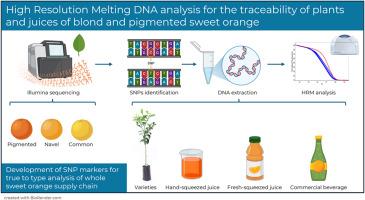
In this work, the whole-genome sequencing of 29 accessions representing the four varietal groups of sweet orange (i.e.: Common, Navel, Acidless and Pigmented) allowed the insilico detection of unique SNPs to discriminate each group (group-specific SNPs) and ten pigmented orange accessions (genotype-specific SNPs).
A subset of the SNPs detected insilico was then validated through a high-resolution melting assay (HRM) on additional 81 genotypes held in three ex-situ collections in Italy and Spain and on several matrices: leaves, hand‐squeezed and commercial fresh-squeezed juices, processed orange juices, and beverages. The HRM assay allowed the identification of 13 group-specific and 30 genotype-specific SNPs showing consistent results across the whole germplasm and the different food matrices tested. The HRM assay proved its efficacy also for the identification of juice blending with other sweet orange varieties (with a detection limit of 5 %). The identified unique SNPs represent a valuable tool to trace the varietal correspondence of plants and fruit-derived products. Their implementation with a scalable and robust HRM assay could be readily employed by growers and the food processing industry to ensure traceability along the chain.




 京公网安备 11010802042870号
京ICP备2023020795号-1
京公网安备 11010802042870号
京ICP备2023020795号-1

 分享
分享
 求助内容:
求助内容: 应助结果提醒方式:
 扫码关注我们
