{"title":"Learning-Based Two-Tiered Online Optimization of Region-Wide Datacenter Resource Allocation","authors":"Chang-Lin Chen;Hanhan Zhou;Jiayu Chen;Mohammad Pedramfar;Tian Lan;Zheqing Zhu;Chi Zhou;Pol Mauri Ruiz;Neeraj Kumar;Hongbo Dong;Vaneet Aggarwal","doi":"10.1109/TNSM.2024.3484213","DOIUrl":null,"url":null,"abstract":"Online optimization of resource management for large-scale data centers and infrastructures to meet dynamic capacity reservation demands and various practical constraints (e.g., feasibility and robustness) is a very challenging problem. Mixed Integer Programming (MIP) approaches suffer from recognized limitations in such a dynamic environment, while learning-based approaches may face with prohibitively large state/action spaces. To this end, this paper presents a novel two-tiered online optimization to enable a learning-based Resource Allowance System (RAS). To solve optimal server-to-reservation assignment in RAS in an online fashion, the proposed solution leverages a reinforcement learning (RL) agent to make high-level decisions, e.g., how much resource to select from the Main Switch Boards (MSBs), and then a low-level Mixed Integer Linear Programming (MILP) solver to generate the local server-to-reservation mapping, conditioned on the RL decisions. We take into account fault tolerance, server movement minimization, and network affinity requirements and apply the proposed solution to large-scale RAS problems. To provide interpretability, we further train a decision tree model to explain the learned policies and to prune unreasonable corner cases at the low-level MILP solver, resulting in further performance improvement. Extensive evaluations show that our two-tiered solution outperforms baselines such as pure MIP solver by over 15% while delivering <inline-formula> <tex-math>$100\\times $ </tex-math></inline-formula> speedup in computation.","PeriodicalId":13423,"journal":{"name":"IEEE Transactions on Network and Service Management","volume":"22 1","pages":"572-581"},"PeriodicalIF":5.4000,"publicationDate":"2024-10-21","publicationTypes":"Journal Article","fieldsOfStudy":null,"isOpenAccess":false,"openAccessPdf":"","citationCount":"0","resultStr":null,"platform":"Semanticscholar","paperid":null,"PeriodicalName":"IEEE Transactions on Network and Service Management","FirstCategoryId":"94","ListUrlMain":"https://ieeexplore.ieee.org/document/10726639/","RegionNum":2,"RegionCategory":"计算机科学","ArticlePicture":[],"TitleCN":null,"AbstractTextCN":null,"PMCID":null,"EPubDate":"","PubModel":"","JCR":"Q1","JCRName":"COMPUTER SCIENCE, INFORMATION SYSTEMS","Score":null,"Total":0}
引用次数: 0
Abstract
Online optimization of resource management for large-scale data centers and infrastructures to meet dynamic capacity reservation demands and various practical constraints (e.g., feasibility and robustness) is a very challenging problem. Mixed Integer Programming (MIP) approaches suffer from recognized limitations in such a dynamic environment, while learning-based approaches may face with prohibitively large state/action spaces. To this end, this paper presents a novel two-tiered online optimization to enable a learning-based Resource Allowance System (RAS). To solve optimal server-to-reservation assignment in RAS in an online fashion, the proposed solution leverages a reinforcement learning (RL) agent to make high-level decisions, e.g., how much resource to select from the Main Switch Boards (MSBs), and then a low-level Mixed Integer Linear Programming (MILP) solver to generate the local server-to-reservation mapping, conditioned on the RL decisions. We take into account fault tolerance, server movement minimization, and network affinity requirements and apply the proposed solution to large-scale RAS problems. To provide interpretability, we further train a decision tree model to explain the learned policies and to prune unreasonable corner cases at the low-level MILP solver, resulting in further performance improvement. Extensive evaluations show that our two-tiered solution outperforms baselines such as pure MIP solver by over 15% while delivering $100\times $ speedup in computation.
期刊介绍:
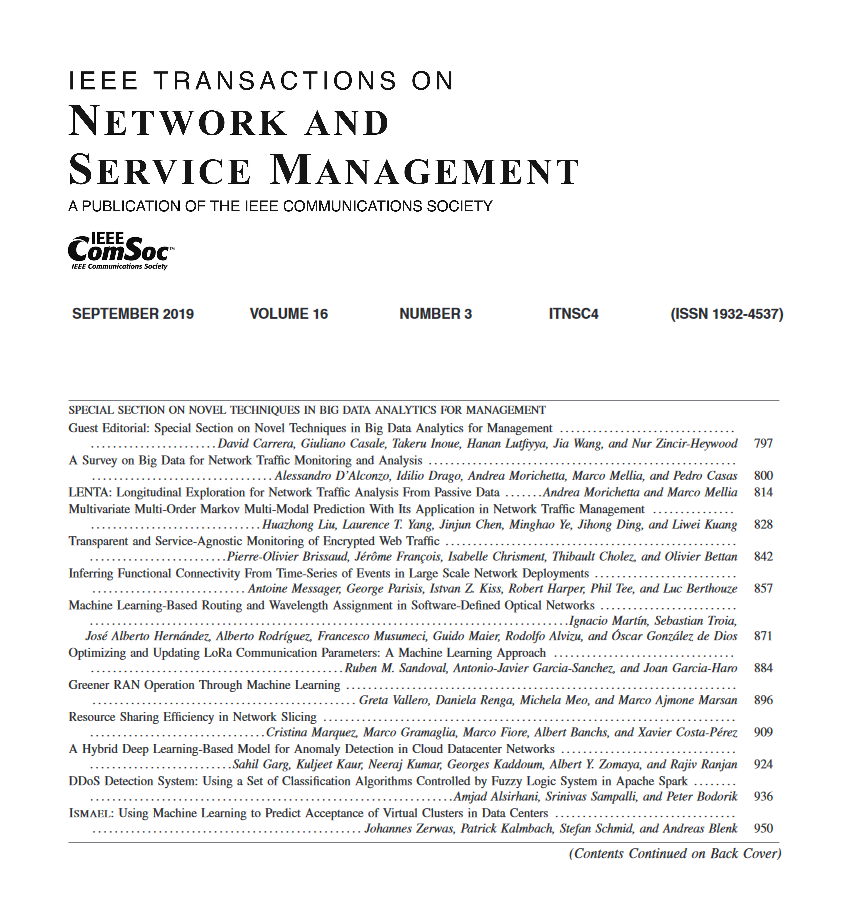
IEEE Transactions on Network and Service Management will publish (online only) peerreviewed archival quality papers that advance the state-of-the-art and practical applications of network and service management. Theoretical research contributions (presenting new concepts and techniques) and applied contributions (reporting on experiences and experiments with actual systems) will be encouraged. These transactions will focus on the key technical issues related to: Management Models, Architectures and Frameworks; Service Provisioning, Reliability and Quality Assurance; Management Functions; Enabling Technologies; Information and Communication Models; Policies; Applications and Case Studies; Emerging Technologies and Standards.



 京公网安备 11010802042870号
京ICP备2023020795号-1
京公网安备 11010802042870号
京ICP备2023020795号-1

 分享
分享
 求助内容:
求助内容: 应助结果提醒方式:
 扫码关注我们
