Structure and Phase-Composition Formation in a Quenched Intermetallic VTI-4 Titanium Alloy with Various Hydrogen Contents during Isothermal Treatment: I. Treatment at 950 and 1000°C
O. Z. Pozhoga, A. V. Shalin, S. V. Skvortsova, K. Rumyantsev, L. I. Zainullina
{"title":"Structure and Phase-Composition Formation in a Quenched Intermetallic VTI-4 Titanium Alloy with Various Hydrogen Contents during Isothermal Treatment: I. Treatment at 950 and 1000°C","authors":"O. Z. Pozhoga, A. V. Shalin, S. V. Skvortsova, K. Rumyantsev, L. I. Zainullina","doi":"10.1134/S0036029524702598","DOIUrl":null,"url":null,"abstract":"<p>The formation of the phase composition and structure in a quenched titanium alloy based on the Ti<sub>2</sub>AlNb intermetallic compound with an initial hydrogen content and with 0.3 wt % hydrogen is studied during isothermal holding at temperatures of 950 and 1000°C for 10–300 min. The introduction of hydrogen into the alloy is shown to decrease the decomposition intensity of the metastable B2 phase under the temperature conditions under study. When the isothermal holding temperature decreases to 950°C, the decomposition dynamics at various hydrogen contents intensifies, which leads to a decrease in the volume fraction of the β phase by 10% compared to holding at 1000°C. After high-temperature isothermal treatment, the decrease in the microhardness of the alloy is not significant, and the microhardness is only 10–30 HV<sub>0.05</sub> less than the values obtained for the quenched single-phase state.</p>","PeriodicalId":769,"journal":{"name":"Russian Metallurgy (Metally)","volume":"2024 6","pages":"1451 - 1459"},"PeriodicalIF":0.3000,"publicationDate":"2025-03-14","publicationTypes":"Journal Article","fieldsOfStudy":null,"isOpenAccess":false,"openAccessPdf":"","citationCount":"0","resultStr":null,"platform":"Semanticscholar","paperid":null,"PeriodicalName":"Russian Metallurgy (Metally)","FirstCategoryId":"5","ListUrlMain":"https://link.springer.com/article/10.1134/S0036029524702598","RegionNum":0,"RegionCategory":null,"ArticlePicture":[],"TitleCN":null,"AbstractTextCN":null,"PMCID":null,"EPubDate":"","PubModel":"","JCR":"Q4","JCRName":"METALLURGY & METALLURGICAL ENGINEERING","Score":null,"Total":0}
引用次数: 0
Abstract
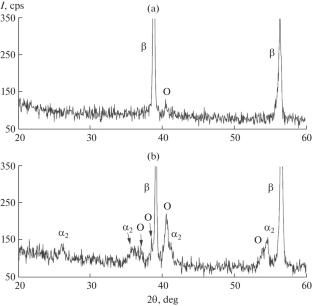
The formation of the phase composition and structure in a quenched titanium alloy based on the Ti2AlNb intermetallic compound with an initial hydrogen content and with 0.3 wt % hydrogen is studied during isothermal holding at temperatures of 950 and 1000°C for 10–300 min. The introduction of hydrogen into the alloy is shown to decrease the decomposition intensity of the metastable B2 phase under the temperature conditions under study. When the isothermal holding temperature decreases to 950°C, the decomposition dynamics at various hydrogen contents intensifies, which leads to a decrease in the volume fraction of the β phase by 10% compared to holding at 1000°C. After high-temperature isothermal treatment, the decrease in the microhardness of the alloy is not significant, and the microhardness is only 10–30 HV0.05 less than the values obtained for the quenched single-phase state.
期刊介绍:
Russian Metallurgy (Metally) publishes results of original experimental and theoretical research in the form of reviews and regular articles devoted to topical problems of metallurgy, physical metallurgy, and treatment of ferrous, nonferrous, rare, and other metals and alloys, intermetallic compounds, and metallic composite materials. The journal focuses on physicochemical properties of metallurgical materials (ores, slags, matters, and melts of metals and alloys); physicochemical processes (thermodynamics and kinetics of pyrometallurgical, hydrometallurgical, electrochemical, and other processes); theoretical metallurgy; metal forming; thermoplastic and thermochemical treatment; computation and experimental determination of phase diagrams and thermokinetic diagrams; mechanisms and kinetics of phase transitions in metallic materials; relations between the chemical composition, phase and structural states of materials and their physicochemical and service properties; interaction between metallic materials and external media; and effects of radiation on these materials.




 京公网安备 11010802042870号
京ICP备2023020795号-1
京公网安备 11010802042870号
京ICP备2023020795号-1

 分享
分享
 求助内容:
求助内容: 应助结果提醒方式:
 扫码关注我们
