Shaofeng Wen, Shuren Zhou, Yimin Gong, Rui Zhang, Xinyu Jia, Lingkang Kong, Haodong Fan, Yi Yin, Changyong Lan, Chun Li and Yong Liu
{"title":"An ultra-fast WSe2 homojunction photodiode with a large linear dynamic range towards in-sensor image processing†","authors":"Shaofeng Wen, Shuren Zhou, Yimin Gong, Rui Zhang, Xinyu Jia, Lingkang Kong, Haodong Fan, Yi Yin, Changyong Lan, Chun Li and Yong Liu","doi":"10.1039/D4NH00656A","DOIUrl":null,"url":null,"abstract":"<p >The versatile photoresponse tunability of two-dimensional (2D) semiconductors achieved by tuning the gate voltage has opened promising pathways for in-sensor visual processing. However, the current limited dynamic range and slow response speed of the gate-tunable 2D photodetectors inhibit their implementation under challenging lighting conditions. Here, using a facile, efficient, and universal localized electrostatic screening strategy, we demonstrate an electrostatic screening enabled single-gate-tunable in-plane homojunction photodiode based on WSe<small><sub>2</sub></small> with bipolar high dynamic ranges (HDRs) and ultrafast photoresponse. The demonstrated WSe<small><sub>2</sub></small>/PdSe<small><sub>2</sub></small> van der Waals (vdW) stacking in-plane homojunction photodiode leveraging the efficient band alignment and less interface recombination inherited from its vdW nature exhibits a large physical linear dynamic range (LDR) of up to 142 dB and an ultrafast response time down to 8 ns. These superior properties ensure that the device captures high-precision HDR images and performs in-sensor image processing with low latency. Our results provide an effective strategy for constructing 2D photodetectors with tunable positive/negative responses and high LDRs, which are promising for in-sensor visual processing of scenes with HDRs.</p>","PeriodicalId":93,"journal":{"name":"Nanoscale Horizons","volume":" 5","pages":" 885-895"},"PeriodicalIF":6.6000,"publicationDate":"2025-03-05","publicationTypes":"Journal Article","fieldsOfStudy":null,"isOpenAccess":false,"openAccessPdf":"","citationCount":"0","resultStr":null,"platform":"Semanticscholar","paperid":null,"PeriodicalName":"Nanoscale Horizons","FirstCategoryId":"88","ListUrlMain":"https://pubs.rsc.org/en/content/articlelanding/2025/nh/d4nh00656a","RegionNum":2,"RegionCategory":"材料科学","ArticlePicture":[],"TitleCN":null,"AbstractTextCN":null,"PMCID":null,"EPubDate":"","PubModel":"","JCR":"Q1","JCRName":"CHEMISTRY, PHYSICAL","Score":null,"Total":0}
引用次数: 0
Abstract
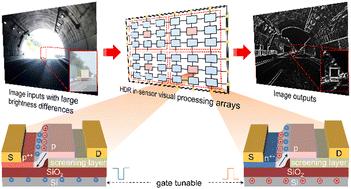
The versatile photoresponse tunability of two-dimensional (2D) semiconductors achieved by tuning the gate voltage has opened promising pathways for in-sensor visual processing. However, the current limited dynamic range and slow response speed of the gate-tunable 2D photodetectors inhibit their implementation under challenging lighting conditions. Here, using a facile, efficient, and universal localized electrostatic screening strategy, we demonstrate an electrostatic screening enabled single-gate-tunable in-plane homojunction photodiode based on WSe2 with bipolar high dynamic ranges (HDRs) and ultrafast photoresponse. The demonstrated WSe2/PdSe2 van der Waals (vdW) stacking in-plane homojunction photodiode leveraging the efficient band alignment and less interface recombination inherited from its vdW nature exhibits a large physical linear dynamic range (LDR) of up to 142 dB and an ultrafast response time down to 8 ns. These superior properties ensure that the device captures high-precision HDR images and performs in-sensor image processing with low latency. Our results provide an effective strategy for constructing 2D photodetectors with tunable positive/negative responses and high LDRs, which are promising for in-sensor visual processing of scenes with HDRs.
期刊介绍:
Nanoscale Horizons stands out as a premier journal for publishing exceptionally high-quality and innovative nanoscience and nanotechnology. The emphasis lies on original research that introduces a new concept or a novel perspective (a conceptual advance), prioritizing this over reporting technological improvements. Nevertheless, outstanding articles showcasing truly groundbreaking developments, including record-breaking performance, may also find a place in the journal. Published work must be of substantial general interest to our broad and diverse readership across the nanoscience and nanotechnology community.




 京公网安备 11010802042870号
京ICP备2023020795号-1
京公网安备 11010802042870号
京ICP备2023020795号-1

 分享
分享
 求助内容:
求助内容: 应助结果提醒方式:
 扫码关注我们
