Hui Liu, Luezhen Yuan, Lucrezia Baldi, Trinadha Rao Sornapudi, G. V. Shivashankar
{"title":"Compressive Forces Induce Epigenetic Activation of Aged Human Dermal Fibroblasts Through ERK Signaling Pathway","authors":"Hui Liu, Luezhen Yuan, Lucrezia Baldi, Trinadha Rao Sornapudi, G. V. Shivashankar","doi":"10.1111/acel.70035","DOIUrl":null,"url":null,"abstract":"<p>Age-related changes in human dermal fibroblasts (HDFs) contribute to impaired wound healing and skin aging. While these changes result in altered mechanotransduction, the epigenetic basis of rejuvenating aging cells remains a significant challenge. This study investigates the effects of compressive forces on nuclear mechanotransduction and epigenetic rejuvenation in aged HDFs. Using a compressive force application model, the activation of HDFs through alpha-smooth muscle actin (ɑ-SMA) is demonstrated. Sustained compressive forces induce significant epigenetic modifications, including chromatin remodeling and altered histone methylation patterns. These epigenetic changes correlate with enhanced cellular migration and rejuvenation. Small-scale drug screening identifies the extracellular signal-regulated kinase (ERK) signaling pathway as a key mediator of compression-induced epigenetic activation. Furthermore, implanting aged cell spheroids into an aged skin model and subjecting the tissue to compressive forces resulted in increased collagen I protein levels. Collectively, these findings demonstrate that applying compressive force to aged fibroblasts activates global epigenetic changes through the ERK signaling pathway, ultimately rejuvenating cellular functions with potential applications for wound healing and skin tissue regeneration.</p>","PeriodicalId":55543,"journal":{"name":"Aging Cell","volume":"24 6","pages":""},"PeriodicalIF":7.1000,"publicationDate":"2025-03-13","publicationTypes":"Journal Article","fieldsOfStudy":null,"isOpenAccess":false,"openAccessPdf":"https://onlinelibrary.wiley.com/doi/epdf/10.1111/acel.70035","citationCount":"0","resultStr":null,"platform":"Semanticscholar","paperid":null,"PeriodicalName":"Aging Cell","FirstCategoryId":"99","ListUrlMain":"https://onlinelibrary.wiley.com/doi/10.1111/acel.70035","RegionNum":1,"RegionCategory":"医学","ArticlePicture":[],"TitleCN":null,"AbstractTextCN":null,"PMCID":null,"EPubDate":"","PubModel":"","JCR":"Q1","JCRName":"Biochemistry, Genetics and Molecular Biology","Score":null,"Total":0}
引用次数: 0
Abstract
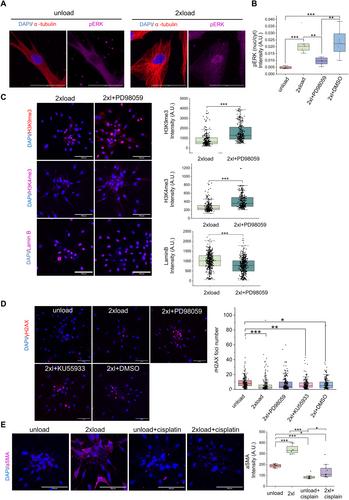
Age-related changes in human dermal fibroblasts (HDFs) contribute to impaired wound healing and skin aging. While these changes result in altered mechanotransduction, the epigenetic basis of rejuvenating aging cells remains a significant challenge. This study investigates the effects of compressive forces on nuclear mechanotransduction and epigenetic rejuvenation in aged HDFs. Using a compressive force application model, the activation of HDFs through alpha-smooth muscle actin (ɑ-SMA) is demonstrated. Sustained compressive forces induce significant epigenetic modifications, including chromatin remodeling and altered histone methylation patterns. These epigenetic changes correlate with enhanced cellular migration and rejuvenation. Small-scale drug screening identifies the extracellular signal-regulated kinase (ERK) signaling pathway as a key mediator of compression-induced epigenetic activation. Furthermore, implanting aged cell spheroids into an aged skin model and subjecting the tissue to compressive forces resulted in increased collagen I protein levels. Collectively, these findings demonstrate that applying compressive force to aged fibroblasts activates global epigenetic changes through the ERK signaling pathway, ultimately rejuvenating cellular functions with potential applications for wound healing and skin tissue regeneration.
期刊介绍:
Aging Cell, an Open Access journal, delves into fundamental aspects of aging biology. It comprehensively explores geroscience, emphasizing research on the mechanisms underlying the aging process and the connections between aging and age-related diseases.



 京公网安备 11010802042870号
京ICP备2023020795号-1
京公网安备 11010802042870号
京ICP备2023020795号-1

 分享
分享
 求助内容:
求助内容: 应助结果提醒方式:
 扫码关注我们
