Md Kamruzzaman, Michael Horowitz, Muhammad Shafiqur Rahman, Harshal Deshmukh, Karen L. Jones, Chinmay S. Marathe
{"title":"Glycemic control is worse in rural compared to urban type 2 diabetes in Bangladesh, irrespective of food security status","authors":"Md Kamruzzaman, Michael Horowitz, Muhammad Shafiqur Rahman, Harshal Deshmukh, Karen L. Jones, Chinmay S. Marathe","doi":"10.1111/jdi.70015","DOIUrl":null,"url":null,"abstract":"<div>\n \n \n <section>\n \n <h3> Background</h3>\n \n <p>Food insecurity (FIS) affects around 25% of Bangladesh's population, and data from developed nations report higher FIS rates among individuals with type 2 diabetes (T2D), potentially worsening glycemic control. The importance of FIS to T2D has not been studied in developing countries such as Bangladesh, with substantial disparities in healthcare access, especially between rural and urban areas. We evaluated the relationships between food insecurity and glycemic control in the context of area of residence among individuals with T2D in Bangladesh.</p>\n </section>\n \n <section>\n \n <h3> Methods</h3>\n \n <p>A total of 849 individuals with T2D attending diabetes clinics in four districts of Bangladesh completed a validated questionnaire to assess the FIS (a score ≥ 3 is indicative of FIS), which was compared with their sociodemographic and biochemical data. Two-way <span>anova</span> and multiple linear and binary logistic regression analyses were performed.</p>\n </section>\n \n <section>\n \n <h3> Results</h3>\n \n <p>Both HbA1c levels (10.8% vs 9.5, <i>P</i> < 0.001) and the prevalence of FIS (45.8% vs 31.4%, <i>P</i> < 0.001) were higher in rural areas. According to two-way <span>anova</span> (0.87–1.78% mean difference, <i>P</i> < 0.05) and multiple linear regression model (<i>β</i> = 1.4, <i>P</i> < 0.001), HbA1c levels were also higher among rural than urban dwellers, irrespective of their FIS status. Rural dwellers were also more than twice as likely to have suboptimal glycemic control (HbA1c ≥7%; AOR: 2.26 (1.35–3.97), <i>P</i> < 0.05), irrespective of their food security status (AOR: 1.19 (0.78–1.84, <i>P</i> > 0.05)).</p>\n </section>\n \n <section>\n \n <h3> Conclusions</h3>\n \n <p>In Bangladesh, rural residence is associated with poor glycemic control, irrespective of food security status, and thus is an important social determinant of diabetes care that warrants further exploration.</p>\n </section>\n </div>","PeriodicalId":51250,"journal":{"name":"Journal of Diabetes Investigation","volume":"16 6","pages":"1112-1118"},"PeriodicalIF":3.0000,"publicationDate":"2025-03-13","publicationTypes":"Journal Article","fieldsOfStudy":null,"isOpenAccess":false,"openAccessPdf":"https://onlinelibrary.wiley.com/doi/epdf/10.1111/jdi.70015","citationCount":"0","resultStr":null,"platform":"Semanticscholar","paperid":null,"PeriodicalName":"Journal of Diabetes Investigation","FirstCategoryId":"3","ListUrlMain":"https://onlinelibrary.wiley.com/doi/10.1111/jdi.70015","RegionNum":3,"RegionCategory":"医学","ArticlePicture":[],"TitleCN":null,"AbstractTextCN":null,"PMCID":null,"EPubDate":"","PubModel":"","JCR":"Q2","JCRName":"ENDOCRINOLOGY & METABOLISM","Score":null,"Total":0}
引用次数: 0
Abstract
Background
Food insecurity (FIS) affects around 25% of Bangladesh's population, and data from developed nations report higher FIS rates among individuals with type 2 diabetes (T2D), potentially worsening glycemic control. The importance of FIS to T2D has not been studied in developing countries such as Bangladesh, with substantial disparities in healthcare access, especially between rural and urban areas. We evaluated the relationships between food insecurity and glycemic control in the context of area of residence among individuals with T2D in Bangladesh.
Methods
A total of 849 individuals with T2D attending diabetes clinics in four districts of Bangladesh completed a validated questionnaire to assess the FIS (a score ≥ 3 is indicative of FIS), which was compared with their sociodemographic and biochemical data. Two-way anova and multiple linear and binary logistic regression analyses were performed.
Results
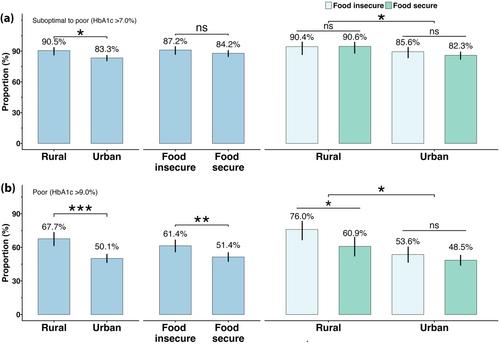
Both HbA1c levels (10.8% vs 9.5, P < 0.001) and the prevalence of FIS (45.8% vs 31.4%, P < 0.001) were higher in rural areas. According to two-way anova (0.87–1.78% mean difference, P < 0.05) and multiple linear regression model (β = 1.4, P < 0.001), HbA1c levels were also higher among rural than urban dwellers, irrespective of their FIS status. Rural dwellers were also more than twice as likely to have suboptimal glycemic control (HbA1c ≥7%; AOR: 2.26 (1.35–3.97), P < 0.05), irrespective of their food security status (AOR: 1.19 (0.78–1.84, P > 0.05)).
Conclusions
In Bangladesh, rural residence is associated with poor glycemic control, irrespective of food security status, and thus is an important social determinant of diabetes care that warrants further exploration.
背景:粮食不安全(FIS)影响了孟加拉国约25%的人口,来自发达国家的数据显示,2型糖尿病(T2D)患者的粮食不安全发生率较高,可能会恶化血糖控制。在孟加拉国等发展中国家,特别是农村和城市地区在获得保健服务方面存在巨大差异,因此尚未研究FIS对T2D的重要性。我们评估了食物不安全与血糖控制之间的关系,在孟加拉国的T2D患者的居住区域的背景下。方法:在孟加拉国4个地区的糖尿病诊所就诊的849名T2D患者完成了一份有效问卷,以评估FIS(得分≥3分表明FIS),并将其与社会人口学和生化数据进行比较。进行了双向方差分析和多元线性和二元逻辑回归分析。结果:两组HbA1c水平(10.8% vs 9.5%, P 0.05)。结论:在孟加拉国,无论食品安全状况如何,农村居住与血糖控制不良有关,因此是糖尿病护理的重要社会决定因素,值得进一步探索。
期刊介绍:
Journal of Diabetes Investigation is your core diabetes journal from Asia; the official journal of the Asian Association for the Study of Diabetes (AASD). The journal publishes original research, country reports, commentaries, reviews, mini-reviews, case reports, letters, as well as editorials and news. Embracing clinical and experimental research in diabetes and related areas, the Journal of Diabetes Investigation includes aspects of prevention, treatment, as well as molecular aspects and pathophysiology. Translational research focused on the exchange of ideas between clinicians and researchers is also welcome. Journal of Diabetes Investigation is indexed by Science Citation Index Expanded (SCIE).





