Improving Pre-Exposure Prophylaxis Provision as Part of Routine Gynecologic Care Among Black Cisgender Women (Project PrEP4Her): Protocol for the Implementation of an Intervention.
{"title":"Improving Pre-Exposure Prophylaxis Provision as Part of Routine Gynecologic Care Among Black Cisgender Women (Project PrEP4Her): Protocol for the Implementation of an Intervention.","authors":"Maira Sohail, Lynn Matthews, Audra Williams, Mirjam-Colette Kempf, Desiree Phillips, Hannah Goymer, Bernadette Johnson, Michael Mugavero, Latesha Elopre","doi":"10.2196/58976","DOIUrl":null,"url":null,"abstract":"<p><strong>Background: </strong>Although HIV pre-exposure prophylaxis (PrEP) has been proven to be an effective prevention tool in decreasing HIV transmission, achieving adequate PrEP uptake has remained a challenge among Black cisgender women living in the Southern United States. Gynecology clinics, which provide primary health care services for many cisgender women, have the potential to be an ideal setting for the integration of PrEP services.</p><p><strong>Objective: </strong>We designed an intervention, PrEP4Her, which aims to implement PrEP service delivery at gynecology clinics in Alabama, the United States, as part of routine reproductive and sexual health care visits to improve PrEP engagement rates among Black cisgender women.</p><p><strong>Methods: </strong>Guided by the information gathered on (1) factors impacting PrEP implementation at gynecology clinics, including key barriers and facilitators to PrEP implementation and potential strategies to address the identified barriers (in-depth interviews with the gynecology care team), (2) structural barriers and provider-level barriers to PrEP implementation (cross-sectional study among gynecologists), and (3) implementation strategies on how to integrate PrEP services into routine gynecology care (in-depth interviews and focus groups with Black cisgender women), a multicomponent implementation strategy, tailored for Black cisgender women, was developed to integrate PrEP in routine women's health visits (ie, PrEP4Her). To determine the efficacy of the program, we will measure implementation outcomes, reach (increase in the absolute number of Black cisgender women receiving PrEP prescriptions), effectiveness (increase in the proportion of PrEP prescriptions over time), and adoption (proportion of team members willing to implement PrEP4Her) using the RE-AIM (Reach, Effectiveness, Adoption, Implementation, and Maintenance) framework. In addition, acceptability (the extent to which providers and Black cisgender women feel PrEP4Her to be acceptable-in-depth interviews); Feasibility (appropriateness of PrEP4Her for a larger, full-scale trial-the Feasibility of Intervention Measure scale); and fidelity (the degree to which PrEP4Her program was implemented as designed-electronic survey with patients) will also be assessed.</p><p><strong>Results: </strong>The qualitative and quantitative data from the gynecology care team and the qualitative data from Black cisgender women were collected from August 9, 2022, to April 19, 2023, and were integrated through joint displays to identify major themes. The combined findings provided a comprehensive understanding of factors that were fundamental in the development and refinement of PrEP4Her implementation. The PrEP4Her was implemented from January 29, 2024, to August 16, 2024. The information gathered is being used to assess PrEP4Her efficacy (based on reach, effectiveness, adoption, acceptability, feasibility, and fidelity).</p><p><strong>Conclusions: </strong>Upon completion of our research, our interdisciplinary team, which includes experts in infectious diseases, implementation science, community-engaged research, and psychology, will be primed to lead a multisite type III implementation trial for PrEP service delivery at gynecology clinics across the Southern United States.</p><p><strong>International registered report identifier (irrid): </strong>DERR1-10.2196/58976.</p>","PeriodicalId":14755,"journal":{"name":"JMIR Research Protocols","volume":"14 ","pages":"e58976"},"PeriodicalIF":1.5000,"publicationDate":"2025-03-14","publicationTypes":"Journal Article","fieldsOfStudy":null,"isOpenAccess":false,"openAccessPdf":"https://www.ncbi.nlm.nih.gov/pmc/articles/PMC11953599/pdf/","citationCount":"0","resultStr":null,"platform":"Semanticscholar","paperid":null,"PeriodicalName":"JMIR Research Protocols","FirstCategoryId":"1085","ListUrlMain":"https://doi.org/10.2196/58976","RegionNum":0,"RegionCategory":null,"ArticlePicture":[],"TitleCN":null,"AbstractTextCN":null,"PMCID":null,"EPubDate":"","PubModel":"","JCR":"Q3","JCRName":"HEALTH CARE SCIENCES & SERVICES","Score":null,"Total":0}
引用次数: 0
Abstract
Background: Although HIV pre-exposure prophylaxis (PrEP) has been proven to be an effective prevention tool in decreasing HIV transmission, achieving adequate PrEP uptake has remained a challenge among Black cisgender women living in the Southern United States. Gynecology clinics, which provide primary health care services for many cisgender women, have the potential to be an ideal setting for the integration of PrEP services.
Objective: We designed an intervention, PrEP4Her, which aims to implement PrEP service delivery at gynecology clinics in Alabama, the United States, as part of routine reproductive and sexual health care visits to improve PrEP engagement rates among Black cisgender women.
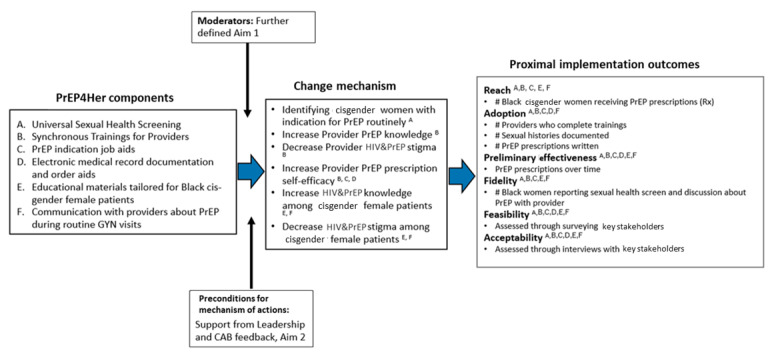
Methods: Guided by the information gathered on (1) factors impacting PrEP implementation at gynecology clinics, including key barriers and facilitators to PrEP implementation and potential strategies to address the identified barriers (in-depth interviews with the gynecology care team), (2) structural barriers and provider-level barriers to PrEP implementation (cross-sectional study among gynecologists), and (3) implementation strategies on how to integrate PrEP services into routine gynecology care (in-depth interviews and focus groups with Black cisgender women), a multicomponent implementation strategy, tailored for Black cisgender women, was developed to integrate PrEP in routine women's health visits (ie, PrEP4Her). To determine the efficacy of the program, we will measure implementation outcomes, reach (increase in the absolute number of Black cisgender women receiving PrEP prescriptions), effectiveness (increase in the proportion of PrEP prescriptions over time), and adoption (proportion of team members willing to implement PrEP4Her) using the RE-AIM (Reach, Effectiveness, Adoption, Implementation, and Maintenance) framework. In addition, acceptability (the extent to which providers and Black cisgender women feel PrEP4Her to be acceptable-in-depth interviews); Feasibility (appropriateness of PrEP4Her for a larger, full-scale trial-the Feasibility of Intervention Measure scale); and fidelity (the degree to which PrEP4Her program was implemented as designed-electronic survey with patients) will also be assessed.
Results: The qualitative and quantitative data from the gynecology care team and the qualitative data from Black cisgender women were collected from August 9, 2022, to April 19, 2023, and were integrated through joint displays to identify major themes. The combined findings provided a comprehensive understanding of factors that were fundamental in the development and refinement of PrEP4Her implementation. The PrEP4Her was implemented from January 29, 2024, to August 16, 2024. The information gathered is being used to assess PrEP4Her efficacy (based on reach, effectiveness, adoption, acceptability, feasibility, and fidelity).
Conclusions: Upon completion of our research, our interdisciplinary team, which includes experts in infectious diseases, implementation science, community-engaged research, and psychology, will be primed to lead a multisite type III implementation trial for PrEP service delivery at gynecology clinics across the Southern United States.
International registered report identifier (irrid): DERR1-10.2196/58976.







 京公网安备 11010802042870号
京ICP备2023020795号-1
京公网安备 11010802042870号
京ICP备2023020795号-1

 分享
分享
 求助内容:
求助内容: 应助结果提醒方式:
 扫码关注我们
