Wenjun Sun , Dehao He , Xueru Ren , Jiayin Li , Linghui Meng , Fang liu , Aiping Zheng
{"title":"The self-fluorescence verification and intracellular imaging of nanocrystals imbedded with aggregation-induced emission luminescent materials","authors":"Wenjun Sun , Dehao He , Xueru Ren , Jiayin Li , Linghui Meng , Fang liu , Aiping Zheng","doi":"10.1016/j.ijpharm.2025.125461","DOIUrl":null,"url":null,"abstract":"<div><div>Understanding cellular uptake and intracellular dissolution of drug nanocrystals is necessary. Due to their superior sensitivity, luminescent materials with aggregation-induced emission (AIE) are embedded into drug nanocrystals (hybrid nanocrystals) as a good strategy for tracking intact nanocrystals in cells. However, AIE materials are strongly hydrophobic and tend to self-aggregate, generating fluorescent interference. To exclusively mark nanocrystals, AIE materials must be embedded in nanocrystals and remain soluble when released from dissolved nanocrystals. In this study, cyclosporin A (CsA) nanocrystals (CsA/THPE NCs) embedded with tetrakis(4-hydroxyphenyl)ethylene (THPE) possessing AIE properties were prepared. The self-fluorescence of CsA/THPE NCs was collectively corroborated by scanning electron microscopy, powder X-ray diffraction, fluorescence microscopy, and dissolution experiments. During the dissolution test, CsA/THPE NCs showed a certain degree of slow-release property. Cellular uptake studies were conducted with Caco-2 cells and characterized by confocal microscopy, flow cytometry, and quantitative analyses. The intact nanocrystals could be directly taken up by cells. The cellular uptake was found to be concentration- and time-dependent. Based on the above experimental results, hybrid nanocrystals integrated with AIE materials were verified to have specific self-fluorescence. Additionally, the dissolution rate of nanocrystals can be adjusted by physically embedding them with other materials.</div></div>","PeriodicalId":14187,"journal":{"name":"International Journal of Pharmaceutics","volume":"674 ","pages":"Article 125461"},"PeriodicalIF":5.2000,"publicationDate":"2025-04-15","publicationTypes":"Journal Article","fieldsOfStudy":null,"isOpenAccess":false,"openAccessPdf":"","citationCount":"0","resultStr":null,"platform":"Semanticscholar","paperid":null,"PeriodicalName":"International Journal of Pharmaceutics","FirstCategoryId":"3","ListUrlMain":"https://www.sciencedirect.com/science/article/pii/S0378517325002972","RegionNum":2,"RegionCategory":"医学","ArticlePicture":[],"TitleCN":null,"AbstractTextCN":null,"PMCID":null,"EPubDate":"2025/3/11 0:00:00","PubModel":"Epub","JCR":"Q1","JCRName":"PHARMACOLOGY & PHARMACY","Score":null,"Total":0}
引用次数: 0
Abstract
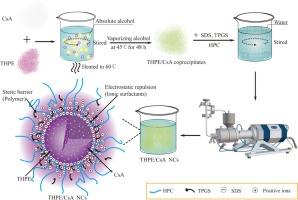
Understanding cellular uptake and intracellular dissolution of drug nanocrystals is necessary. Due to their superior sensitivity, luminescent materials with aggregation-induced emission (AIE) are embedded into drug nanocrystals (hybrid nanocrystals) as a good strategy for tracking intact nanocrystals in cells. However, AIE materials are strongly hydrophobic and tend to self-aggregate, generating fluorescent interference. To exclusively mark nanocrystals, AIE materials must be embedded in nanocrystals and remain soluble when released from dissolved nanocrystals. In this study, cyclosporin A (CsA) nanocrystals (CsA/THPE NCs) embedded with tetrakis(4-hydroxyphenyl)ethylene (THPE) possessing AIE properties were prepared. The self-fluorescence of CsA/THPE NCs was collectively corroborated by scanning electron microscopy, powder X-ray diffraction, fluorescence microscopy, and dissolution experiments. During the dissolution test, CsA/THPE NCs showed a certain degree of slow-release property. Cellular uptake studies were conducted with Caco-2 cells and characterized by confocal microscopy, flow cytometry, and quantitative analyses. The intact nanocrystals could be directly taken up by cells. The cellular uptake was found to be concentration- and time-dependent. Based on the above experimental results, hybrid nanocrystals integrated with AIE materials were verified to have specific self-fluorescence. Additionally, the dissolution rate of nanocrystals can be adjusted by physically embedding them with other materials.
期刊介绍:
The International Journal of Pharmaceutics is the third most cited journal in the "Pharmacy & Pharmacology" category out of 366 journals, being the true home for pharmaceutical scientists concerned with the physical, chemical and biological properties of devices and delivery systems for drugs, vaccines and biologicals, including their design, manufacture and evaluation. This includes evaluation of the properties of drugs, excipients such as surfactants and polymers and novel materials. The journal has special sections on pharmaceutical nanotechnology and personalized medicines, and publishes research papers, reviews, commentaries and letters to the editor as well as special issues.



 京公网安备 11010802042870号
京ICP备2023020795号-1
京公网安备 11010802042870号
京ICP备2023020795号-1

 分享
分享
 求助内容:
求助内容: 应助结果提醒方式:
 扫码关注我们
