Ultrasonic head-mounted device spatiotemporal opening blood–brain barrier enhances the brain permeation of drugs for treatment of radiation-induced brain injury
Ziyan Tang, Hong Niu, Yanpin Wu, Yizhi Zhang, Feng Zhang, Chunqing Wang, Shuxiu Zhang, Xingshuang Song, Yaxin Wang, Lina Du, Yiguang Jin
{"title":"Ultrasonic head-mounted device spatiotemporal opening blood–brain barrier enhances the brain permeation of drugs for treatment of radiation-induced brain injury","authors":"Ziyan Tang, Hong Niu, Yanpin Wu, Yizhi Zhang, Feng Zhang, Chunqing Wang, Shuxiu Zhang, Xingshuang Song, Yaxin Wang, Lina Du, Yiguang Jin","doi":"10.1016/j.ijpharm.2025.125430","DOIUrl":null,"url":null,"abstract":"<div><div>The field of physical therapy is advancing and using focused ultrasound to deliver drugs into the brain gains growing interest. However, the blood–brain barrier makes it difficult for drugs to enter. Finding safe and efficient physical therapy strategies to complement drug treatments is essential. Here, the rule and molecular mechanisms of spatiotemporal opening blood–brain barrier of ultrasound were explored using a Bluetooth-controlled ultrasonic head-mounted device which was used to enhance the brain permeation of drugs for the treatment of radiation-induced brain injury. The falling-off of tight junction proteins in the blood–brain barrier was the key to spatiotemporally opening under ultrasound. Evans blue and Rhodamine B represented macromolecules and small molecules, respectively, which were intravenously injected into the circulation. Their brain permeation was promoted by brain ultrasound and the smaller molecules required the lower sound intensity that also affected the speed of drug-passing. During the blood–brain barrier restoration after ultrasound, biomarkers like enzymes and growth factors changed, which could be used for selection of dosing window. After the use of the helmet, the blood–brain barrier was restored after 24 h, and the efficacy of water-soluble drugs for the treatment of radiation brain injury was increased. It was suitable for non-invasive external use and enhanced the treating effect when cooperating with drugs. This study provides a research basis for applying ultrasound technology into physio-pharmacotherapy.</div></div>","PeriodicalId":14187,"journal":{"name":"International Journal of Pharmaceutics","volume":"674 ","pages":"Article 125430"},"PeriodicalIF":5.2000,"publicationDate":"2025-04-15","publicationTypes":"Journal Article","fieldsOfStudy":null,"isOpenAccess":false,"openAccessPdf":"","citationCount":"0","resultStr":null,"platform":"Semanticscholar","paperid":null,"PeriodicalName":"International Journal of Pharmaceutics","FirstCategoryId":"3","ListUrlMain":"https://www.sciencedirect.com/science/article/pii/S0378517325002662","RegionNum":2,"RegionCategory":"医学","ArticlePicture":[],"TitleCN":null,"AbstractTextCN":null,"PMCID":null,"EPubDate":"2025/3/11 0:00:00","PubModel":"Epub","JCR":"Q1","JCRName":"PHARMACOLOGY & PHARMACY","Score":null,"Total":0}
引用次数: 0
Abstract
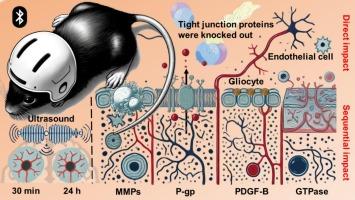
The field of physical therapy is advancing and using focused ultrasound to deliver drugs into the brain gains growing interest. However, the blood–brain barrier makes it difficult for drugs to enter. Finding safe and efficient physical therapy strategies to complement drug treatments is essential. Here, the rule and molecular mechanisms of spatiotemporal opening blood–brain barrier of ultrasound were explored using a Bluetooth-controlled ultrasonic head-mounted device which was used to enhance the brain permeation of drugs for the treatment of radiation-induced brain injury. The falling-off of tight junction proteins in the blood–brain barrier was the key to spatiotemporally opening under ultrasound. Evans blue and Rhodamine B represented macromolecules and small molecules, respectively, which were intravenously injected into the circulation. Their brain permeation was promoted by brain ultrasound and the smaller molecules required the lower sound intensity that also affected the speed of drug-passing. During the blood–brain barrier restoration after ultrasound, biomarkers like enzymes and growth factors changed, which could be used for selection of dosing window. After the use of the helmet, the blood–brain barrier was restored after 24 h, and the efficacy of water-soluble drugs for the treatment of radiation brain injury was increased. It was suitable for non-invasive external use and enhanced the treating effect when cooperating with drugs. This study provides a research basis for applying ultrasound technology into physio-pharmacotherapy.
期刊介绍:
The International Journal of Pharmaceutics is the third most cited journal in the "Pharmacy & Pharmacology" category out of 366 journals, being the true home for pharmaceutical scientists concerned with the physical, chemical and biological properties of devices and delivery systems for drugs, vaccines and biologicals, including their design, manufacture and evaluation. This includes evaluation of the properties of drugs, excipients such as surfactants and polymers and novel materials. The journal has special sections on pharmaceutical nanotechnology and personalized medicines, and publishes research papers, reviews, commentaries and letters to the editor as well as special issues.



 京公网安备 11010802042870号
京ICP备2023020795号-1
京公网安备 11010802042870号
京ICP备2023020795号-1

 分享
分享
 求助内容:
求助内容: 应助结果提醒方式:
 扫码关注我们
