The diagnostic accuracy of blood C-reactive protein and erythrocyte sedimentation rate in periprosthetic joint infections - A 10-year analysis of 1510 revision hip and knee arthroplasties from a single orthopaedic center.
Dariusz Grzelecki, Maciej Kocon, Rafał Mazur, Aleksandra Grajek, Jacek Kowalczewski
{"title":"The diagnostic accuracy of blood C-reactive protein and erythrocyte sedimentation rate in periprosthetic joint infections - A 10-year analysis of 1510 revision hip and knee arthroplasties from a single orthopaedic center.","authors":"Dariusz Grzelecki, Maciej Kocon, Rafał Mazur, Aleksandra Grajek, Jacek Kowalczewski","doi":"10.1186/s13018-025-05531-7","DOIUrl":null,"url":null,"abstract":"<p><strong>Background: </strong>Despite the availability of many highly accurate biomarkers and novel criteria, serum C-reactive protein (CRP) and erythrocyte sedimentation rate (ESR) are still the basis for diagnosing periprosthetic joint infection (PJI). This study aims to analyze the influence of different demographical and clinical factors on the cut-off values and accuracy of CRP and ESR in diagnosing chronic PJI.</p><p><strong>Methods: </strong>A total number of 4757 patients (with ICD-10 codes T84.0 and T84.5) operated on between January 2014 to December 2023 in a single orthopaedic center were screened in terms of the inclusion and exclusion criteria. Finally, 1510 patients (1032 aseptic revisions and 478 periprosthetic joint infections [PJI]) were included in the analysis. The best cut-off values, sensitivity, specificity, positive predictive value (PPV) and negative predictive value (NPV) for both CRP and ESR for all cohort and for subgroups divided depending on the demographical (gender, joint and BMI) and clinical factors (prosthesis fixation, specific diagnostic criteria, and virulence of the bacteria) were calculated.</p><p><strong>Results: </strong>For all cohort, the best cut-off value for CRP was 9.6 mg/L with an area under the curve (AUC) of 0.93 and for ESR was 29 mm/h with the AUC of 0.891. For CRP the sensitivity was higher (84.9%) than for ESR (75.1%), with the same values of specificity (90.5% and 90.8%, respectively). According to the specific subgroups, for CRP higher sensitivity was observed for males (89.6%) than for females (82.6%) if lower thresholds were used. Similarly, when the higher cut-off value for CRP was applied, better specificity for high-virulent (94.8%) than for low-virulent pathogens (88.9%) was observed. For ESR, superior sensitivity values were observed if a fistula was observed, for lower BMI thresholds and for infections caused by high-virulent pathogens. Higher optimal threshold and better specificity were observed for knees than for hips, without the appearance of fistula, when minor criteria were used and infection was caused by high-virulent pathogens.</p><p><strong>Conclusions: </strong>Our study indicates better sensitivity for CRP than ESR and similar specificity values for diagnosing chronic PJI. If results oscillate close to 10 mg/L for CRP and between 25 and 30 mm/h for ESR we propose to use different cut-off values depending on the demographic and/or clinical factors to increase diagnostic accuracy.</p>","PeriodicalId":16629,"journal":{"name":"Journal of Orthopaedic Surgery and Research","volume":"20 1","pages":"276"},"PeriodicalIF":2.8000,"publicationDate":"2025-03-14","publicationTypes":"Journal Article","fieldsOfStudy":null,"isOpenAccess":false,"openAccessPdf":"https://www.ncbi.nlm.nih.gov/pmc/articles/PMC11907961/pdf/","citationCount":"0","resultStr":null,"platform":"Semanticscholar","paperid":null,"PeriodicalName":"Journal of Orthopaedic Surgery and Research","FirstCategoryId":"3","ListUrlMain":"https://doi.org/10.1186/s13018-025-05531-7","RegionNum":3,"RegionCategory":"医学","ArticlePicture":[],"TitleCN":null,"AbstractTextCN":null,"PMCID":null,"EPubDate":"","PubModel":"","JCR":"Q1","JCRName":"ORTHOPEDICS","Score":null,"Total":0}
引用次数: 0
Abstract
Background: Despite the availability of many highly accurate biomarkers and novel criteria, serum C-reactive protein (CRP) and erythrocyte sedimentation rate (ESR) are still the basis for diagnosing periprosthetic joint infection (PJI). This study aims to analyze the influence of different demographical and clinical factors on the cut-off values and accuracy of CRP and ESR in diagnosing chronic PJI.
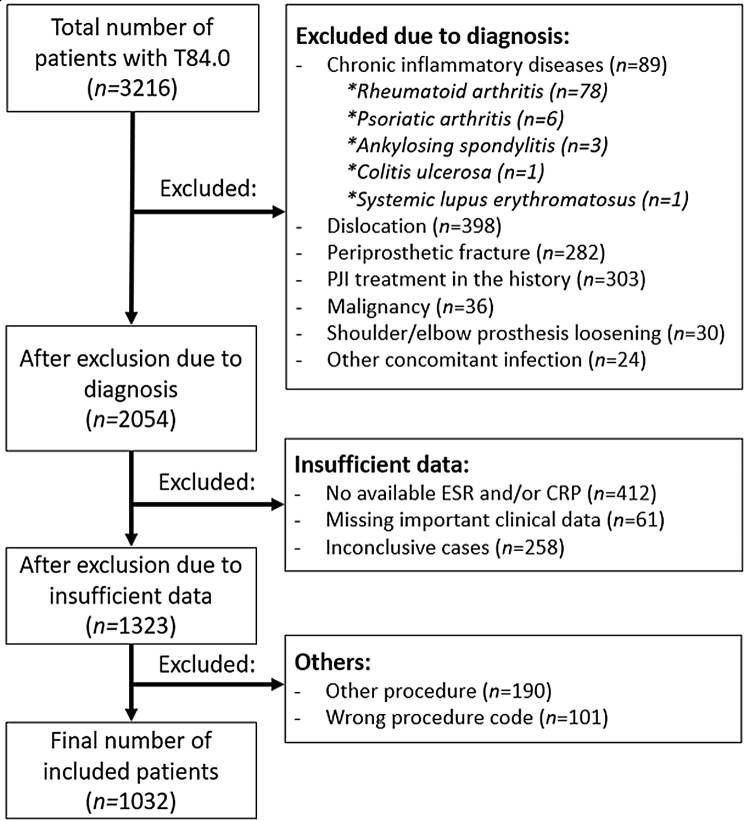
Methods: A total number of 4757 patients (with ICD-10 codes T84.0 and T84.5) operated on between January 2014 to December 2023 in a single orthopaedic center were screened in terms of the inclusion and exclusion criteria. Finally, 1510 patients (1032 aseptic revisions and 478 periprosthetic joint infections [PJI]) were included in the analysis. The best cut-off values, sensitivity, specificity, positive predictive value (PPV) and negative predictive value (NPV) for both CRP and ESR for all cohort and for subgroups divided depending on the demographical (gender, joint and BMI) and clinical factors (prosthesis fixation, specific diagnostic criteria, and virulence of the bacteria) were calculated.
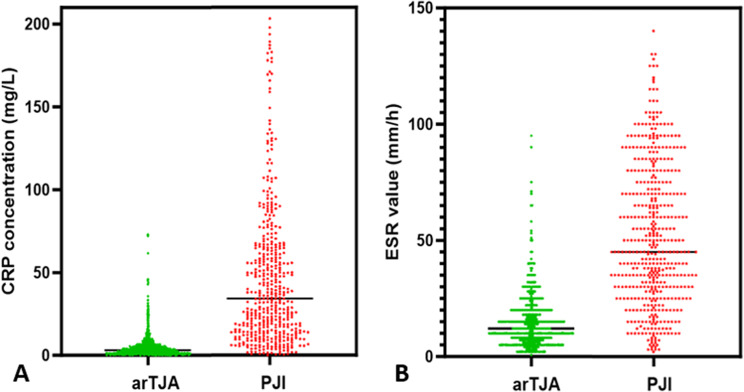
Results: For all cohort, the best cut-off value for CRP was 9.6 mg/L with an area under the curve (AUC) of 0.93 and for ESR was 29 mm/h with the AUC of 0.891. For CRP the sensitivity was higher (84.9%) than for ESR (75.1%), with the same values of specificity (90.5% and 90.8%, respectively). According to the specific subgroups, for CRP higher sensitivity was observed for males (89.6%) than for females (82.6%) if lower thresholds were used. Similarly, when the higher cut-off value for CRP was applied, better specificity for high-virulent (94.8%) than for low-virulent pathogens (88.9%) was observed. For ESR, superior sensitivity values were observed if a fistula was observed, for lower BMI thresholds and for infections caused by high-virulent pathogens. Higher optimal threshold and better specificity were observed for knees than for hips, without the appearance of fistula, when minor criteria were used and infection was caused by high-virulent pathogens.
Conclusions: Our study indicates better sensitivity for CRP than ESR and similar specificity values for diagnosing chronic PJI. If results oscillate close to 10 mg/L for CRP and between 25 and 30 mm/h for ESR we propose to use different cut-off values depending on the demographic and/or clinical factors to increase diagnostic accuracy.
期刊介绍:
Journal of Orthopaedic Surgery and Research is an open access journal that encompasses all aspects of clinical and basic research studies related to musculoskeletal issues.
Orthopaedic research is conducted at clinical and basic science levels. With the advancement of new technologies and the increasing expectation and demand from doctors and patients, we are witnessing an enormous growth in clinical orthopaedic research, particularly in the fields of traumatology, spinal surgery, joint replacement, sports medicine, musculoskeletal tumour management, hand microsurgery, foot and ankle surgery, paediatric orthopaedic, and orthopaedic rehabilitation. The involvement of basic science ranges from molecular, cellular, structural and functional perspectives to tissue engineering, gait analysis, automation and robotic surgery. Implant and biomaterial designs are new disciplines that complement clinical applications.
JOSR encourages the publication of multidisciplinary research with collaboration amongst clinicians and scientists from different disciplines, which will be the trend in the coming decades.




 京公网安备 11010802042870号
京ICP备2023020795号-1
京公网安备 11010802042870号
京ICP备2023020795号-1

 分享
分享
 求助内容:
求助内容: 应助结果提醒方式:
 扫码关注我们
