Yi-Tao Yang, Zhuo Wang, Chen-Yang Meng, Xing-Hao Deng, Yi Long, Jing-Yi Hou, Rui Yang
{"title":"Arthroscopic Upper Third Subscapularis Tendon Repair Using H-Loop Technique: A Case Series.","authors":"Yi-Tao Yang, Zhuo Wang, Chen-Yang Meng, Xing-Hao Deng, Yi Long, Jing-Yi Hou, Rui Yang","doi":"10.1111/os.70014","DOIUrl":null,"url":null,"abstract":"<p><strong>Objective: </strong>Arthroscopic repair of upper one-third subscapularis tendon tears remains challenging due to suture management difficulties and repair quality limitations. We proposed a simpler knotless technique-the H-Loop technique. This study evaluates its early clinical and imaging outcomes.</p><p><strong>Method: </strong>This is a case series of 38 patients (9 males and 29 females), who underwent arthroscopic H-Loop technique repair for upper one-third subscapularis tendon tears between January 2021 and August 2023. Postoperative assessments include the American Shoulder and Elbow Surgeons (ASES) score, the University of California, Los Angeles (UCLA) shoulder score, the Constant-Murley score, the visual analog scale (VAS), range of motion (ROM) (internal and external rotation), and internal rotation strength. In addition, MRI (30 patients) evaluated fatty infiltration, re-tears, and subscapularis integrity, comparing tendon dimensions and signal-to-signal ratios with a control group of patients with normal subscapularis tendons.</p><p><strong>Result: </strong>Preoperative symptom duration ranged from 3 to 36 months, with an average of 9 months. Follow-up ranged from 12 to 14 months, with an average duration of 12.6 months. No complications were observed in any patient. Postoperative ASES scores increased significantly compared to preoperative scores (55.63 ± 15.85 vs. 88.92 ± 8.24), as did UCLA scores (21.82 ± 4.44 vs. 29.74 ± 3.55) and Constant-Murley scores (69.76 ± 15.30 vs. 86.34 ± 14.48). VAS scores decreased significantly (5.16 ± 1.84 vs. 0.89 ± 0.76). Postoperative ROM showed significant improvement in internal rotation (7.79 ± 2.07 vs. 8.45 ± 1.33) and external rotation (57.63° ± 15.84° vs. 66.58° ± 9.08°) (p < 0.05). Internal rotation strength ratios increased markedly (78.00% ± 15.86% vs. 91.97% ± 6.62%). MRI indicated no re-tears or fatty infiltration in the 30 patients, and compared to the control group, there were no statistically significant differences in the vertical diameter of the subscapularis muscle (62.89 mm ± 9.30 mm vs. 59.41 mm ± 7.55 mm; p = 0.153), transverse diameter of the upper subscapularis muscle (17.82 mm ± 3.79 mm vs. 19.43 mm ± 4.76 mm; p = 0.395), transverse diameter of the lower subscapularis muscle (24.09 mm ± 5.84 mm vs. 25.23 mm ± 5.41 mm; p = 0.870), cross-sectional area of the subscapularis muscle (1338.54 mm<sup>2</sup> ± 277.26 mm<sup>2</sup> vs. 1247.94 mm<sup>2</sup> ± 210.55 mm<sup>2</sup>; p = 0.098), signal-to-signal ratio of the upper subscapularis muscle (1.18 ± 0.28 vs. 1.24 ± 0.28; p = 0.792), or the signal-to-signal ratio of the lower subscapularis muscle (1.02 ± 0.24 vs. 1.03 ± 0.16; p = 0.128).</p><p><strong>Conclusion: </strong>The arthroscopic H-Loop technique significantly restores function, improves range of motion, and enhances internal rotation strength, maintaining good tendon integrity in the early postoperative period.</p>","PeriodicalId":19566,"journal":{"name":"Orthopaedic Surgery","volume":" ","pages":"1525-1535"},"PeriodicalIF":2.1000,"publicationDate":"2025-05-01","publicationTypes":"Journal Article","fieldsOfStudy":null,"isOpenAccess":false,"openAccessPdf":"https://www.ncbi.nlm.nih.gov/pmc/articles/PMC12050182/pdf/","citationCount":"0","resultStr":null,"platform":"Semanticscholar","paperid":null,"PeriodicalName":"Orthopaedic Surgery","FirstCategoryId":"3","ListUrlMain":"https://doi.org/10.1111/os.70014","RegionNum":2,"RegionCategory":"医学","ArticlePicture":[],"TitleCN":null,"AbstractTextCN":null,"PMCID":null,"EPubDate":"2025/3/13 0:00:00","PubModel":"Epub","JCR":"Q2","JCRName":"ORTHOPEDICS","Score":null,"Total":0}
引用次数: 0
Abstract
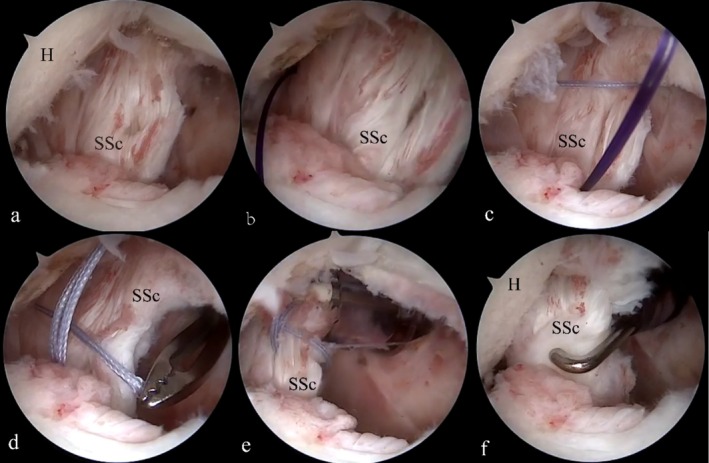
Objective: Arthroscopic repair of upper one-third subscapularis tendon tears remains challenging due to suture management difficulties and repair quality limitations. We proposed a simpler knotless technique-the H-Loop technique. This study evaluates its early clinical and imaging outcomes.
Method: This is a case series of 38 patients (9 males and 29 females), who underwent arthroscopic H-Loop technique repair for upper one-third subscapularis tendon tears between January 2021 and August 2023. Postoperative assessments include the American Shoulder and Elbow Surgeons (ASES) score, the University of California, Los Angeles (UCLA) shoulder score, the Constant-Murley score, the visual analog scale (VAS), range of motion (ROM) (internal and external rotation), and internal rotation strength. In addition, MRI (30 patients) evaluated fatty infiltration, re-tears, and subscapularis integrity, comparing tendon dimensions and signal-to-signal ratios with a control group of patients with normal subscapularis tendons.
Result: Preoperative symptom duration ranged from 3 to 36 months, with an average of 9 months. Follow-up ranged from 12 to 14 months, with an average duration of 12.6 months. No complications were observed in any patient. Postoperative ASES scores increased significantly compared to preoperative scores (55.63 ± 15.85 vs. 88.92 ± 8.24), as did UCLA scores (21.82 ± 4.44 vs. 29.74 ± 3.55) and Constant-Murley scores (69.76 ± 15.30 vs. 86.34 ± 14.48). VAS scores decreased significantly (5.16 ± 1.84 vs. 0.89 ± 0.76). Postoperative ROM showed significant improvement in internal rotation (7.79 ± 2.07 vs. 8.45 ± 1.33) and external rotation (57.63° ± 15.84° vs. 66.58° ± 9.08°) (p < 0.05). Internal rotation strength ratios increased markedly (78.00% ± 15.86% vs. 91.97% ± 6.62%). MRI indicated no re-tears or fatty infiltration in the 30 patients, and compared to the control group, there were no statistically significant differences in the vertical diameter of the subscapularis muscle (62.89 mm ± 9.30 mm vs. 59.41 mm ± 7.55 mm; p = 0.153), transverse diameter of the upper subscapularis muscle (17.82 mm ± 3.79 mm vs. 19.43 mm ± 4.76 mm; p = 0.395), transverse diameter of the lower subscapularis muscle (24.09 mm ± 5.84 mm vs. 25.23 mm ± 5.41 mm; p = 0.870), cross-sectional area of the subscapularis muscle (1338.54 mm2 ± 277.26 mm2 vs. 1247.94 mm2 ± 210.55 mm2; p = 0.098), signal-to-signal ratio of the upper subscapularis muscle (1.18 ± 0.28 vs. 1.24 ± 0.28; p = 0.792), or the signal-to-signal ratio of the lower subscapularis muscle (1.02 ± 0.24 vs. 1.03 ± 0.16; p = 0.128).
Conclusion: The arthroscopic H-Loop technique significantly restores function, improves range of motion, and enhances internal rotation strength, maintaining good tendon integrity in the early postoperative period.
期刊介绍:
Orthopaedic Surgery (OS) is the official journal of the Chinese Orthopaedic Association, focusing on all aspects of orthopaedic technique and surgery.
The journal publishes peer-reviewed articles in the following categories: Original Articles, Clinical Articles, Review Articles, Guidelines, Editorials, Commentaries, Surgical Techniques, Case Reports and Meeting Reports.





 京公网安备 11010802042870号
京ICP备2023020795号-1
京公网安备 11010802042870号
京ICP备2023020795号-1

 分享
分享
 求助内容:
求助内容: 应助结果提醒方式:
 扫码关注我们
