Shengnan Wang, Yu Li, Zijuan Li, Chao Li, Lin Xu, Ning Zhai
{"title":"Tracing meristem cell lineages during plant development and regeneration by the all-in-one CRE/LOX system.","authors":"Shengnan Wang, Yu Li, Zijuan Li, Chao Li, Lin Xu, Ning Zhai","doi":"10.1186/s13007-025-01352-1","DOIUrl":null,"url":null,"abstract":"<p><p>The root apical meristem (RAM) and the shoot apical meristem (SAM), which contain stem cells and their lineages, are the centers for underground and aboveground organ formation in vascular plants. Accurately tracing stem cell lineage is important to understand how the RAM and SAM are formed and how they give rise to new organs. Here, we introduce the all-in-one CRE/LOX system, which is assembled in a single plasmid and can be used to efficiently trace cell lineage during de novo formation of meristems and cell differentiation within meristems in Arabidopsis thaliana. Using the CRE/LOX-GUS system driven by the WUSCHEL-RELATED HOMEOBOX5 (WOX5) promoter (i.e., WOX5<sub>pro</sub>-CRE/LOX-GUS), we show that cell division of the quiescent center (QC) within the stem cell niche of the RAM might replenish initial/stem cells in plants grown on mannitol-containing medium or in soil. The results obtained using WOX5<sub>pro</sub>-CRE/LOX-GUS also show that a group of shoot progenitor cells acts together to initiate the SAM during de novo shoot regeneration from callus in tissue culture. We also demonstrate the use of the CRE/LOX-RUBY system for real-time in vivo tracing of cell lineages in live organs. Overall, this paper not only introduces the all-in-one CRE/LOX tool, but also reveals the cell lineages during meristem development and regeneration.</p>","PeriodicalId":20100,"journal":{"name":"Plant Methods","volume":"21 1","pages":"36"},"PeriodicalIF":4.4000,"publicationDate":"2025-03-14","publicationTypes":"Journal Article","fieldsOfStudy":null,"isOpenAccess":false,"openAccessPdf":"https://www.ncbi.nlm.nih.gov/pmc/articles/PMC11907920/pdf/","citationCount":"0","resultStr":null,"platform":"Semanticscholar","paperid":null,"PeriodicalName":"Plant Methods","FirstCategoryId":"99","ListUrlMain":"https://doi.org/10.1186/s13007-025-01352-1","RegionNum":2,"RegionCategory":"生物学","ArticlePicture":[],"TitleCN":null,"AbstractTextCN":null,"PMCID":null,"EPubDate":"","PubModel":"","JCR":"Q1","JCRName":"BIOCHEMICAL RESEARCH METHODS","Score":null,"Total":0}
引用次数: 0
Abstract
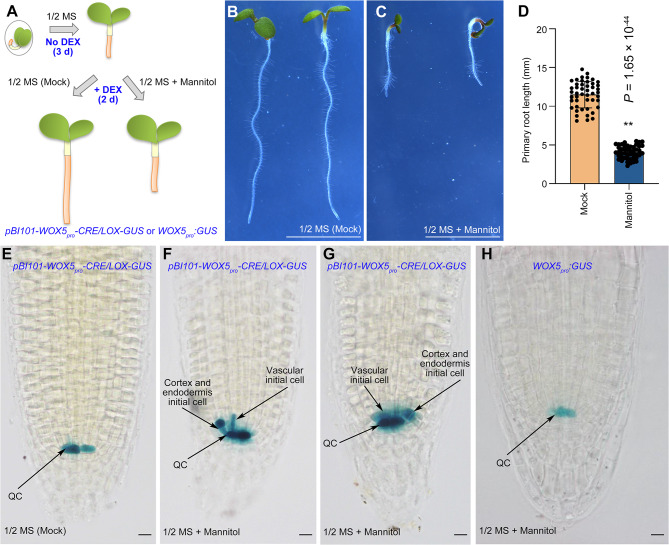
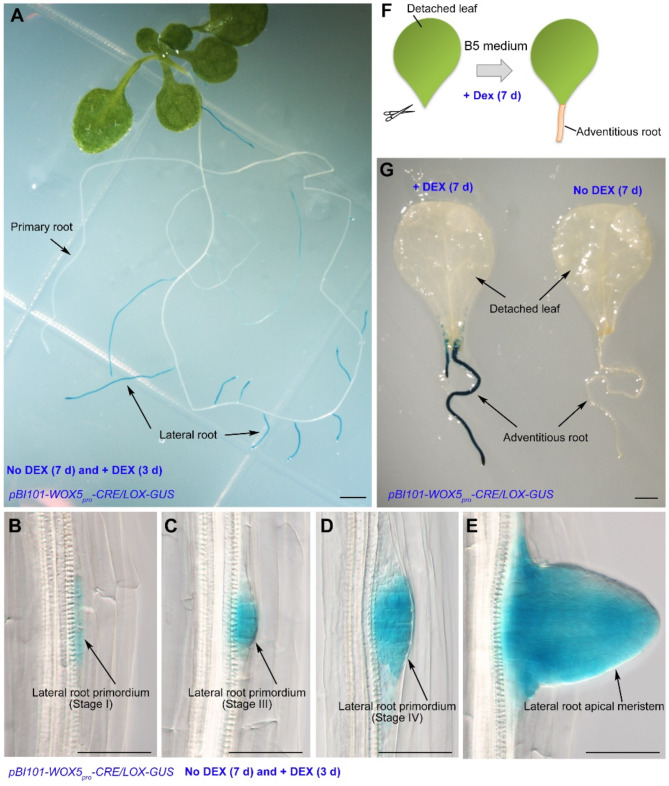
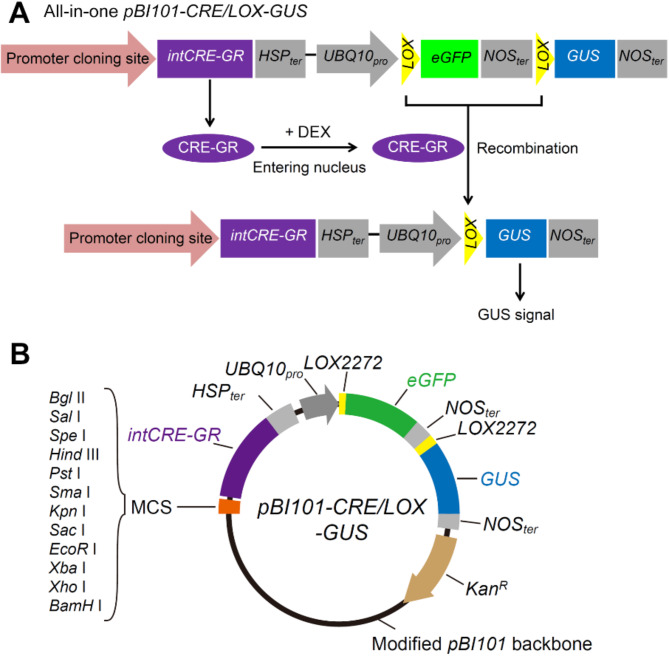
The root apical meristem (RAM) and the shoot apical meristem (SAM), which contain stem cells and their lineages, are the centers for underground and aboveground organ formation in vascular plants. Accurately tracing stem cell lineage is important to understand how the RAM and SAM are formed and how they give rise to new organs. Here, we introduce the all-in-one CRE/LOX system, which is assembled in a single plasmid and can be used to efficiently trace cell lineage during de novo formation of meristems and cell differentiation within meristems in Arabidopsis thaliana. Using the CRE/LOX-GUS system driven by the WUSCHEL-RELATED HOMEOBOX5 (WOX5) promoter (i.e., WOX5pro-CRE/LOX-GUS), we show that cell division of the quiescent center (QC) within the stem cell niche of the RAM might replenish initial/stem cells in plants grown on mannitol-containing medium or in soil. The results obtained using WOX5pro-CRE/LOX-GUS also show that a group of shoot progenitor cells acts together to initiate the SAM during de novo shoot regeneration from callus in tissue culture. We also demonstrate the use of the CRE/LOX-RUBY system for real-time in vivo tracing of cell lineages in live organs. Overall, this paper not only introduces the all-in-one CRE/LOX tool, but also reveals the cell lineages during meristem development and regeneration.
期刊介绍:
Plant Methods is an open access, peer-reviewed, online journal for the plant research community that encompasses all aspects of technological innovation in the plant sciences.
There is no doubt that we have entered an exciting new era in plant biology. The completion of the Arabidopsis genome sequence, and the rapid progress being made in other plant genomics projects are providing unparalleled opportunities for progress in all areas of plant science. Nevertheless, enormous challenges lie ahead if we are to understand the function of every gene in the genome, and how the individual parts work together to make the whole organism. Achieving these goals will require an unprecedented collaborative effort, combining high-throughput, system-wide technologies with more focused approaches that integrate traditional disciplines such as cell biology, biochemistry and molecular genetics.
Technological innovation is probably the most important catalyst for progress in any scientific discipline. Plant Methods’ goal is to stimulate the development and adoption of new and improved techniques and research tools and, where appropriate, to promote consistency of methodologies for better integration of data from different laboratories.



 京公网安备 11010802042870号
京ICP备2023020795号-1
京公网安备 11010802042870号
京ICP备2023020795号-1

 分享
分享
 求助内容:
求助内容: 应助结果提醒方式:
 扫码关注我们
