Bruno Rodrigues, António Videira-Silva, Luís Lopes, Eduarda Sousa-Sá, Susana Vale, Dylan P Cliff, Romeu Mendes, Rute Santos
{"title":"Methodological Choices on 24-h Movement Behavior Assessment by Accelerometry: A Scoping Review.","authors":"Bruno Rodrigues, António Videira-Silva, Luís Lopes, Eduarda Sousa-Sá, Susana Vale, Dylan P Cliff, Romeu Mendes, Rute Santos","doi":"10.1186/s40798-025-00820-1","DOIUrl":null,"url":null,"abstract":"<p><strong>Background: </strong>There are no reviews describing current measurement protocols and accelerometer processing decisions that are being used in 24-h MovBeh studies, across the lifespan. We aim to synthesise information on methods for assessing 24-h movement behaviors using accelerometry across all age groups.</p><p><strong>Main body: </strong>PubMed, PsycINFO, SPORTDiscus, and EMBASE were searched until December 2022. Observational or intervention reports describing accelerometry methods in studies on combinations of movement behaviors, with a 24-h protocol across all ages, were included. This review included 102 studies: three studies in toddlers, 15 in preschoolers, 17 in children, 23 in adolescents and 44 in adults and older adults. The Actigraph GT3X was the most commonly used device; the majority of the included reports collected data for seven days, including three weekdays and one weekend day, with a ≥ 16 h/day per 24-h period for valid data. The criteria for non-wear time varied between ≥ 20 and ≥ 90 min of consecutive zero counts, depending on the age group. The most common epoch used was 15 or 60 s for youth and adults, respectively. The choice of sleep algorithms and SB/PA cut-points, of the included reports, depended on age and the original validation/calibration study. To deal with non-compliant participants, exclusion of non-compliant participants from the analysis was most frequently used. Most studies used diaries/logs to complement the accelerometer data.</p><p><strong>Conclusions: </strong>Accelerometer protocols and methodological decisions varied considerably between reports. Therefore, consensus on methodological decisions is needed to improve precision and comparability between studies, which is challenging given the complexity of the procedures, the number of available brands and types of accelerometers, and the plethora of programming options.</p>","PeriodicalId":21788,"journal":{"name":"Sports Medicine - Open","volume":"11 1","pages":"25"},"PeriodicalIF":5.9000,"publicationDate":"2025-03-13","publicationTypes":"Journal Article","fieldsOfStudy":null,"isOpenAccess":false,"openAccessPdf":"https://www.ncbi.nlm.nih.gov/pmc/articles/PMC11906950/pdf/","citationCount":"0","resultStr":null,"platform":"Semanticscholar","paperid":null,"PeriodicalName":"Sports Medicine - Open","FirstCategoryId":"3","ListUrlMain":"https://doi.org/10.1186/s40798-025-00820-1","RegionNum":2,"RegionCategory":"医学","ArticlePicture":[],"TitleCN":null,"AbstractTextCN":null,"PMCID":null,"EPubDate":"","PubModel":"","JCR":"Q1","JCRName":"SPORT SCIENCES","Score":null,"Total":0}
引用次数: 0
Abstract
Background: There are no reviews describing current measurement protocols and accelerometer processing decisions that are being used in 24-h MovBeh studies, across the lifespan. We aim to synthesise information on methods for assessing 24-h movement behaviors using accelerometry across all age groups.
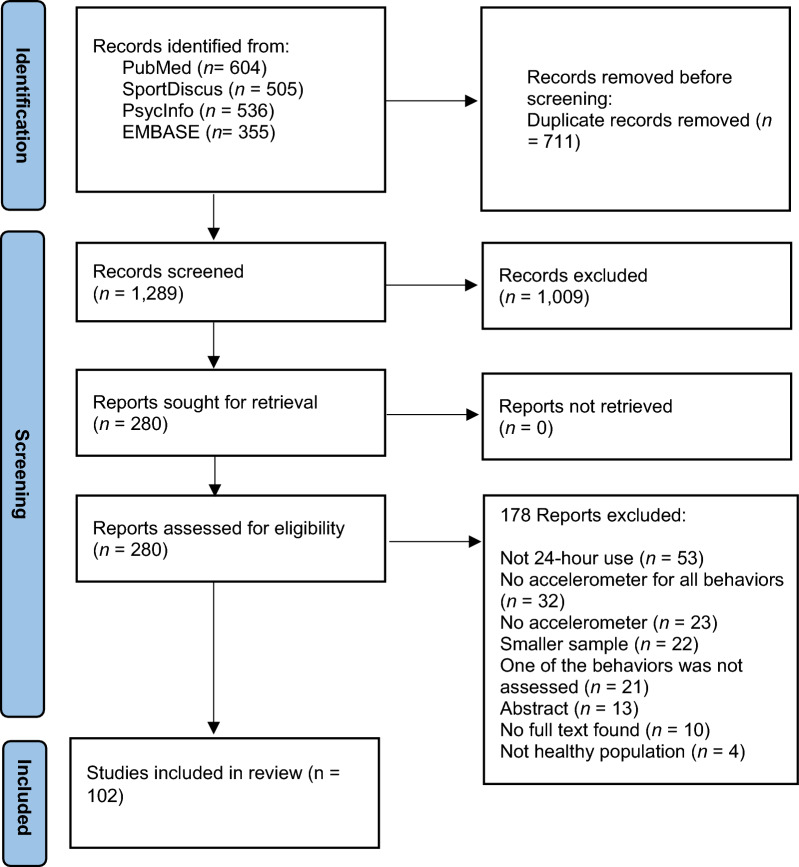
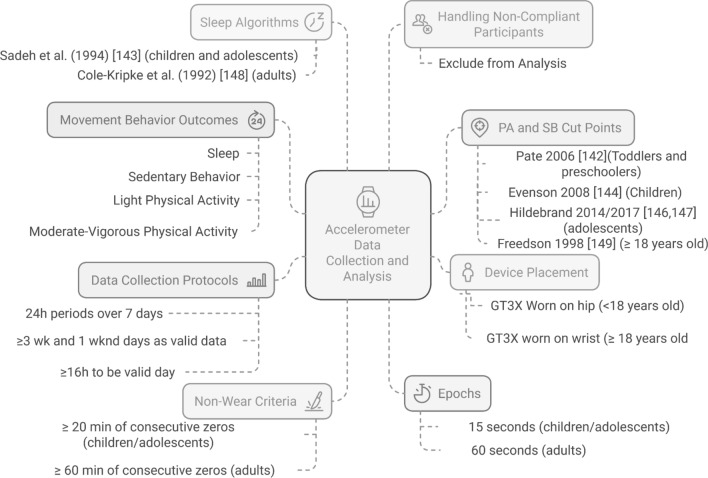
Main body: PubMed, PsycINFO, SPORTDiscus, and EMBASE were searched until December 2022. Observational or intervention reports describing accelerometry methods in studies on combinations of movement behaviors, with a 24-h protocol across all ages, were included. This review included 102 studies: three studies in toddlers, 15 in preschoolers, 17 in children, 23 in adolescents and 44 in adults and older adults. The Actigraph GT3X was the most commonly used device; the majority of the included reports collected data for seven days, including three weekdays and one weekend day, with a ≥ 16 h/day per 24-h period for valid data. The criteria for non-wear time varied between ≥ 20 and ≥ 90 min of consecutive zero counts, depending on the age group. The most common epoch used was 15 or 60 s for youth and adults, respectively. The choice of sleep algorithms and SB/PA cut-points, of the included reports, depended on age and the original validation/calibration study. To deal with non-compliant participants, exclusion of non-compliant participants from the analysis was most frequently used. Most studies used diaries/logs to complement the accelerometer data.
Conclusions: Accelerometer protocols and methodological decisions varied considerably between reports. Therefore, consensus on methodological decisions is needed to improve precision and comparability between studies, which is challenging given the complexity of the procedures, the number of available brands and types of accelerometers, and the plethora of programming options.




 京公网安备 11010802042870号
京ICP备2023020795号-1
京公网安备 11010802042870号
京ICP备2023020795号-1

 分享
分享
 求助内容:
求助内容: 应助结果提醒方式:
 扫码关注我们
