Clinical practice in stereotactic radiotherapy delivery at treatment unit: a practitioner survey and consensus-based recommendations for multidisciplinary professional development.
{"title":"Clinical practice in stereotactic radiotherapy delivery at treatment unit: a practitioner survey and consensus-based recommendations for multidisciplinary professional development.","authors":"Nicolas Martz, Vincent Marchesi, Maximilien Rogé, Camille Verry, Pierre Clavère, Karine Peignaux, Yazid Belkacemi, Alexandre Coutte, Véronique Vendrely, Delphine Antoni, Elise Champeau-Orange, Sébastien Thureau, Khadija Aabibou, Claire Drouin, Amandine Grimon, Christelle Monod, Perrine Farasse, Stéphane Supiot, Jean-Christophe Faivre","doi":"10.1186/s13014-025-02615-w","DOIUrl":null,"url":null,"abstract":"<p><strong>Purpose: </strong>Stereotactic radiation therapy (SRT) is on the rise around the world. We aimed to provide recommendations to streamline and assess medical practices in SRT delivery at treatment unit, while complying with legal obligations concerning safety.</p><p><strong>Materials and methods: </strong>We conducted an online closed practice survey for heads of radiotherapy departments both nationally in comprehensive cancer centers and university hospitals throughout France, and internationally. The aim was to obtain a better understanding of how the delivery of SRT at treatment unit was managed across different centers according to experience, and to the machines and repositioning techniques used. Radiation oncologists (ROs) were also asked to assess the difficulties of technical implementation in the department, and whether residents were involved in the validation and delivery of SRT. Differences among countries regarding legislation governing the validation of SRT sessions at treatment unit were also collected. A videoconference was then held to draw up proposals for regulatory changes based on the results obtained. Finally, recommendations were drawn up by the steering committee and approved by heads of radiotherapy departments in comprehensive cancer centers and university hospitals throughout France.</p><p><strong>Results: </strong>Thirty-five French centers and 15 centers from 14 foreign countries responded to the questionnaire. The most common stereotactic machines were Varian Truebeam STX® (45%) and Cyberknife® (39.2%). The departments had been performing SRT for more than 10 years in 60.5% of cases, and for less than 5 years in 10.1% of cases. A RO validated the SRT fractions at each session in 62.9% of French departments, while in countries outside France RO validation concerned the first fraction only for 35.3% or was performed only in the event of an issue for 23.5%. RO patient positioning validation of SRT fractions were considered as: time-consuming / task-interrupting (80%); having no added value with regards its systematic use (41.8%); and leading to a loss of machine time (33.1%). Most heads of departments would like to see an evolution towards systematic RO validation for the first session, then validation by a radiation therapist (RTT) for all subsequent sessions, leaving open the possibility of RO intervention when required in case of difficulty. We drew up a task delegation procedure to meet these requirements.</p><p><strong>Conclusion: </strong>Comparing the French practice to international ones confirmed the need to develop and harmonize recommendations in terms of patient positioning validation at treatment unit. Regulatory changes incorporating a competence transfer to RTTs, particularly after the empowerment process, is key. However, these changes need to be adapted to the experience of each Center and to that of each RTT, as assessed with clearly established criteria and learning curve.</p>","PeriodicalId":49639,"journal":{"name":"Radiation Oncology","volume":"20 1","pages":"36"},"PeriodicalIF":3.3000,"publicationDate":"2025-03-13","publicationTypes":"Journal Article","fieldsOfStudy":null,"isOpenAccess":false,"openAccessPdf":"https://www.ncbi.nlm.nih.gov/pmc/articles/PMC11905610/pdf/","citationCount":"0","resultStr":null,"platform":"Semanticscholar","paperid":null,"PeriodicalName":"Radiation Oncology","FirstCategoryId":"3","ListUrlMain":"https://doi.org/10.1186/s13014-025-02615-w","RegionNum":2,"RegionCategory":"医学","ArticlePicture":[],"TitleCN":null,"AbstractTextCN":null,"PMCID":null,"EPubDate":"","PubModel":"","JCR":"Q2","JCRName":"ONCOLOGY","Score":null,"Total":0}
引用次数: 0
Abstract
Purpose: Stereotactic radiation therapy (SRT) is on the rise around the world. We aimed to provide recommendations to streamline and assess medical practices in SRT delivery at treatment unit, while complying with legal obligations concerning safety.
Materials and methods: We conducted an online closed practice survey for heads of radiotherapy departments both nationally in comprehensive cancer centers and university hospitals throughout France, and internationally. The aim was to obtain a better understanding of how the delivery of SRT at treatment unit was managed across different centers according to experience, and to the machines and repositioning techniques used. Radiation oncologists (ROs) were also asked to assess the difficulties of technical implementation in the department, and whether residents were involved in the validation and delivery of SRT. Differences among countries regarding legislation governing the validation of SRT sessions at treatment unit were also collected. A videoconference was then held to draw up proposals for regulatory changes based on the results obtained. Finally, recommendations were drawn up by the steering committee and approved by heads of radiotherapy departments in comprehensive cancer centers and university hospitals throughout France.
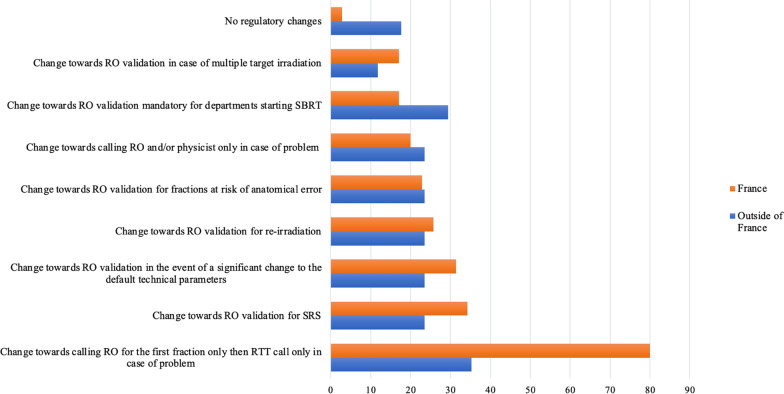
Results: Thirty-five French centers and 15 centers from 14 foreign countries responded to the questionnaire. The most common stereotactic machines were Varian Truebeam STX® (45%) and Cyberknife® (39.2%). The departments had been performing SRT for more than 10 years in 60.5% of cases, and for less than 5 years in 10.1% of cases. A RO validated the SRT fractions at each session in 62.9% of French departments, while in countries outside France RO validation concerned the first fraction only for 35.3% or was performed only in the event of an issue for 23.5%. RO patient positioning validation of SRT fractions were considered as: time-consuming / task-interrupting (80%); having no added value with regards its systematic use (41.8%); and leading to a loss of machine time (33.1%). Most heads of departments would like to see an evolution towards systematic RO validation for the first session, then validation by a radiation therapist (RTT) for all subsequent sessions, leaving open the possibility of RO intervention when required in case of difficulty. We drew up a task delegation procedure to meet these requirements.
Conclusion: Comparing the French practice to international ones confirmed the need to develop and harmonize recommendations in terms of patient positioning validation at treatment unit. Regulatory changes incorporating a competence transfer to RTTs, particularly after the empowerment process, is key. However, these changes need to be adapted to the experience of each Center and to that of each RTT, as assessed with clearly established criteria and learning curve.
Radiation OncologyONCOLOGY-RADIOLOGY, NUCLEAR MEDICINE & MEDICAL IMAGING
CiteScore
6.50
自引率
2.80%
发文量
181
审稿时长
3-6 weeks
期刊介绍:
Radiation Oncology encompasses all aspects of research that impacts on the treatment of cancer using radiation. It publishes findings in molecular and cellular radiation biology, radiation physics, radiation technology, and clinical oncology.




 京公网安备 11010802042870号
京ICP备2023020795号-1
京公网安备 11010802042870号
京ICP备2023020795号-1

 分享
分享
 求助内容:
求助内容: 应助结果提醒方式:
 扫码关注我们
