Nadia Kasmi, Laetitia Pieruccioni, Eve Pitot, Isabelle Fourquaux, Alexandre Wodrinski, Laure Gibot and Juliette Fitremann
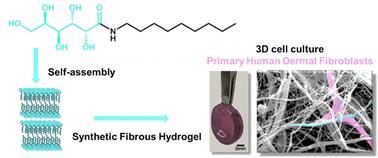
{"title":"The potential of carbohydrate supramolecular hydrogels for long-term 3D culture of primary fibroblasts†","authors":"Nadia Kasmi, Laetitia Pieruccioni, Eve Pitot, Isabelle Fourquaux, Alexandre Wodrinski, Laure Gibot and Juliette Fitremann","doi":"10.1039/D4TB02658F","DOIUrl":null,"url":null,"abstract":"<p >\r\n <em>N</em>-Alkyl-galactonamides, which are small synthetic molecules derived from galactose, self-assemble to give fibrous hydrogels. These molecules are biocompatible and, in a previous study, the cell culture of human neural stem cells was performed for 7 days on a gel of <em>N</em>-heptyl-<small>D</small>-galactonamide. With the objective of broadening the scope of these molecules as scaffolds for cell culture, in the present study, the culture of primary human dermal fibroblasts has been carried out on <em>N</em>-nonyl-<small>D</small>-galactonamide hydrogels. These supramolecular fibrillar hydrogels have a sufficient mechanical strength to withstand cell culture (≈50 kPa) and they are resistant enough on the long term to carry out the cell culture over at least 3 weeks. In contrast to <em>N</em>-heptyl-<small>D</small>-galactonamide, <em>N</em>-nonyl-<small>D</small>-galactonamide is insoluble in the culture medium. It avoids its dissolution at each renewal of the culture medium. The molecule is only slowly eliminated by other mechanisms (1/3rd in 3 weeks), which did not impair the cell culture on a monthly scale. The hydrogel's microstructure and how the cells organize on this scaffold have been studied using electron and two-photon microscopies. The gel is made of a quite homogeneous network with a width of ≈180 nm and hundreds of micrometer long fibers, except at the surface where a dense mat of heterogeneous fibers is formed. We focused on methods able to colocalize the cells and the gel fibers. Many cell clusters have elongated and multidirectionnal shapes, guided by the fibers. Chains of single cells are also found following the fibers from one cluster to another. <em>N</em>-Nonyl-<small>D</small>-galactonamide fibers, which have the advantage of not being autofluorescent, do not mask the fluorescence of cells. But interestingly, they give a strong second harmonic generation (SHG) signal, due to their well-organized lamellar structure. We also made a special effort to visualize the penetration of cells within the depth of the hydrogels, in 3D, notably by sectioning the hydrogels, despite their softness. It was found that most of the cells stayed at the surface, but several cells grew within the supramolecular fiber network between 50 and 100 μm depth.</p>","PeriodicalId":83,"journal":{"name":"Journal of Materials Chemistry B","volume":" 14","pages":" 4386-4405"},"PeriodicalIF":6.1000,"publicationDate":"2025-03-14","publicationTypes":"Journal Article","fieldsOfStudy":null,"isOpenAccess":false,"openAccessPdf":"","citationCount":"0","resultStr":null,"platform":"Semanticscholar","paperid":null,"PeriodicalName":"Journal of Materials Chemistry B","FirstCategoryId":"1","ListUrlMain":"https://pubs.rsc.org/en/content/articlelanding/2025/tb/d4tb02658f","RegionNum":3,"RegionCategory":"医学","ArticlePicture":[],"TitleCN":null,"AbstractTextCN":null,"PMCID":null,"EPubDate":"","PubModel":"","JCR":"Q1","JCRName":"MATERIALS SCIENCE, BIOMATERIALS","Score":null,"Total":0}
引用次数: 0
Abstract
N-Alkyl-galactonamides, which are small synthetic molecules derived from galactose, self-assemble to give fibrous hydrogels. These molecules are biocompatible and, in a previous study, the cell culture of human neural stem cells was performed for 7 days on a gel of N-heptyl-D-galactonamide. With the objective of broadening the scope of these molecules as scaffolds for cell culture, in the present study, the culture of primary human dermal fibroblasts has been carried out on N-nonyl-D-galactonamide hydrogels. These supramolecular fibrillar hydrogels have a sufficient mechanical strength to withstand cell culture (≈50 kPa) and they are resistant enough on the long term to carry out the cell culture over at least 3 weeks. In contrast to N-heptyl-D-galactonamide, N-nonyl-D-galactonamide is insoluble in the culture medium. It avoids its dissolution at each renewal of the culture medium. The molecule is only slowly eliminated by other mechanisms (1/3rd in 3 weeks), which did not impair the cell culture on a monthly scale. The hydrogel's microstructure and how the cells organize on this scaffold have been studied using electron and two-photon microscopies. The gel is made of a quite homogeneous network with a width of ≈180 nm and hundreds of micrometer long fibers, except at the surface where a dense mat of heterogeneous fibers is formed. We focused on methods able to colocalize the cells and the gel fibers. Many cell clusters have elongated and multidirectionnal shapes, guided by the fibers. Chains of single cells are also found following the fibers from one cluster to another. N-Nonyl-D-galactonamide fibers, which have the advantage of not being autofluorescent, do not mask the fluorescence of cells. But interestingly, they give a strong second harmonic generation (SHG) signal, due to their well-organized lamellar structure. We also made a special effort to visualize the penetration of cells within the depth of the hydrogels, in 3D, notably by sectioning the hydrogels, despite their softness. It was found that most of the cells stayed at the surface, but several cells grew within the supramolecular fiber network between 50 and 100 μm depth.
n -烷基半乳糖酰胺是一种从半乳糖中提取的小合成分子,可以自组装形成纤维状水凝胶。这些分子具有生物相容性,在之前的一项研究中,人类神经干细胞在n -庚基- d -半乳糖酰胺凝胶上进行了7天的细胞培养。为了扩大这些分子作为细胞培养支架的范围,本研究在n -壬基- d -半乳糖酰胺水凝胶上进行了人真皮成纤维细胞的培养。这些超分子纤维状水凝胶具有足够的机械强度来承受细胞培养(≈50 kPa),并且它们具有足够的长期抵抗能力,可以进行至少3周的细胞培养。与n -庚基- d -半乳糖酰胺相反,n -壬基- d -半乳糖酰胺在培养基中不溶。它避免了每次更新培养基时它的溶解。该分子仅通过其他机制缓慢消除(3周内1/3),这不会影响每月的细胞培养。利用电子和双光子显微镜研究了水凝胶的微观结构和细胞在支架上的组织方式。凝胶是由一个非常均匀的网络,宽度约为180纳米,数百微米长的纤维,除了在表面形成密集的非均匀纤维垫。我们专注于能够将细胞和凝胶纤维共定位的方法。许多细胞簇在纤维的引导下呈细长的多向形状。单细胞链也被发现跟随纤维从一个簇到另一个簇。n -壬基- d -半乳糖酰胺纤维,其优点是不具有自荧光,不掩盖细胞的荧光。但有趣的是,由于它们组织良好的层状结构,它们会产生很强的二次谐波(SHG)信号。我们也做了特别的努力来可视化细胞在水凝胶深度内的渗透,在3D,特别是通过对水凝胶的切片,尽管它们很柔软。结果发现,大部分细胞停留在表面,但在深度为50 ~ 100 μm的超分子纤维网络中也有少量细胞生长。
期刊介绍:
Journal of Materials Chemistry A, B & C cover high quality studies across all fields of materials chemistry. The journals focus on those theoretical or experimental studies that report new understanding, applications, properties and synthesis of materials. Journal of Materials Chemistry A, B & C are separated by the intended application of the material studied. Broadly, applications in energy and sustainability are of interest to Journal of Materials Chemistry A, applications in biology and medicine are of interest to Journal of Materials Chemistry B, and applications in optical, magnetic and electronic devices are of interest to Journal of Materials Chemistry C.Journal of Materials Chemistry B is a Transformative Journal and Plan S compliant. Example topic areas within the scope of Journal of Materials Chemistry B are listed below. This list is neither exhaustive nor exclusive:
Antifouling coatings
Biocompatible materials
Bioelectronics
Bioimaging
Biomimetics
Biomineralisation
Bionics
Biosensors
Diagnostics
Drug delivery
Gene delivery
Immunobiology
Nanomedicine
Regenerative medicine & Tissue engineering
Scaffolds
Soft robotics
Stem cells
Therapeutic devices




 京公网安备 11010802042870号
京ICP备2023020795号-1
京公网安备 11010802042870号
京ICP备2023020795号-1

 分享
分享
 求助内容:
求助内容: 应助结果提醒方式:
 扫码关注我们
