{"title":"A Generalized Pointing Error Model for FSO Links With Fixed-Wing UAVs for 6G: Analysis and Trajectory Optimization","authors":"Hyung-Joo Moon;Chan-Byoung Chae;Kai-Kit Wong;Mohamed-Slim Alouini","doi":"10.1109/TWC.2025.3549062","DOIUrl":null,"url":null,"abstract":"Free-space optical (FSO) communication is a promising solution to support wireless backhaul links in emerging 6G non-terrestrial networks. At the link level, pointing errors in FSO links can significantly impact capacity, making accurate modeling of these errors essential for both assessing and enhancing communication performance. In this paper, we introduce a novel model for FSO pointing errors in autonomous aerial vehicles (UAVs) that incorporates three-dimensional (3D) jitter, including roll, pitch, and yaw angle jittering. We derive a probability density function for the pointing error angle based on the relative position and posture of the UAV to the ground station. This model is then integrated into a trajectory optimization problem designed to maximize energy efficiency while meeting constraints on speed, acceleration, and elevation angle. Our proposed optimization method significantly improves energy efficiency by adjusting the UAV’s flight trajectory to minimize exposure to directions highly affected by jitter. The simulation results emphasize the importance of using UAV-specific 3D jitter models in achieving accurate performance measurements and effective system optimization in FSO communication networks. Using our generalized model, the optimized trajectories achieve up to 11.8% higher energy efficiency compared to those derived from conventional Gaussian pointing error models.","PeriodicalId":13431,"journal":{"name":"IEEE Transactions on Wireless Communications","volume":"24 7","pages":"5723-5737"},"PeriodicalIF":10.7000,"publicationDate":"2025-03-14","publicationTypes":"Journal Article","fieldsOfStudy":null,"isOpenAccess":false,"openAccessPdf":"","citationCount":"0","resultStr":null,"platform":"Semanticscholar","paperid":null,"PeriodicalName":"IEEE Transactions on Wireless Communications","FirstCategoryId":"94","ListUrlMain":"https://ieeexplore.ieee.org/document/10927643/","RegionNum":1,"RegionCategory":"计算机科学","ArticlePicture":[],"TitleCN":null,"AbstractTextCN":null,"PMCID":null,"EPubDate":"","PubModel":"","JCR":"Q1","JCRName":"ENGINEERING, ELECTRICAL & ELECTRONIC","Score":null,"Total":0}
引用次数: 0
Abstract
Free-space optical (FSO) communication is a promising solution to support wireless backhaul links in emerging 6G non-terrestrial networks. At the link level, pointing errors in FSO links can significantly impact capacity, making accurate modeling of these errors essential for both assessing and enhancing communication performance. In this paper, we introduce a novel model for FSO pointing errors in autonomous aerial vehicles (UAVs) that incorporates three-dimensional (3D) jitter, including roll, pitch, and yaw angle jittering. We derive a probability density function for the pointing error angle based on the relative position and posture of the UAV to the ground station. This model is then integrated into a trajectory optimization problem designed to maximize energy efficiency while meeting constraints on speed, acceleration, and elevation angle. Our proposed optimization method significantly improves energy efficiency by adjusting the UAV’s flight trajectory to minimize exposure to directions highly affected by jitter. The simulation results emphasize the importance of using UAV-specific 3D jitter models in achieving accurate performance measurements and effective system optimization in FSO communication networks. Using our generalized model, the optimized trajectories achieve up to 11.8% higher energy efficiency compared to those derived from conventional Gaussian pointing error models.
期刊介绍:
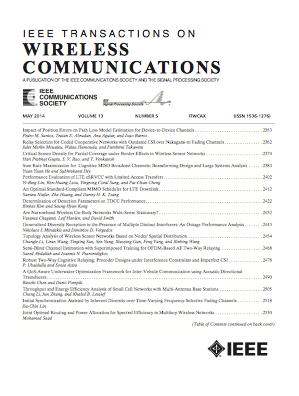
The IEEE Transactions on Wireless Communications is a prestigious publication that showcases cutting-edge advancements in wireless communications. It welcomes both theoretical and practical contributions in various areas. The scope of the Transactions encompasses a wide range of topics, including modulation and coding, detection and estimation, propagation and channel characterization, and diversity techniques. The journal also emphasizes the physical and link layer communication aspects of network architectures and protocols.
The journal is open to papers on specific topics or non-traditional topics related to specific application areas. This includes simulation tools and methodologies, orthogonal frequency division multiplexing, MIMO systems, and wireless over optical technologies.
Overall, the IEEE Transactions on Wireless Communications serves as a platform for high-quality manuscripts that push the boundaries of wireless communications and contribute to advancements in the field.



 京公网安备 11010802042870号
京ICP备2023020795号-1
京公网安备 11010802042870号
京ICP备2023020795号-1

 分享
分享
 求助内容:
求助内容: 应助结果提醒方式:
 扫码关注我们
