Ed de Jong , Mark Mascal , Sandra Constant , Tom Claessen , Pierluigi Tosi , Alice Mija
{"title":"The origin, composition, and applications of industrial humins – a review","authors":"Ed de Jong , Mark Mascal , Sandra Constant , Tom Claessen , Pierluigi Tosi , Alice Mija","doi":"10.1039/d4gc06244b","DOIUrl":null,"url":null,"abstract":"<div><div>Humins are side-products derived from the acid-catalysed conversion of carbohydrate-containing biomass, including sugars (<em>e.g.</em> glucose, fructose, sucrose), oligosaccharides, polysaccharides, and lignocellulosic feedstocks into hydroxymethylfurfural (HMF), furfural, and levulinic acid. Until recently, humins were primarily burned as a power and heat source, but now several higher value applications for humins are within reach. This review covers the history, state of the art, and future outlook on the subject of industrial humins, including their origin, production conditions, compositions, characterisation, and proposed structures. Current opinion on humin formation mechanisms, kinetic studies, ways to minimise their production, established valorisation routes, and novel applications are also discussed.</div></div>","PeriodicalId":78,"journal":{"name":"Green Chemistry","volume":"27 12","pages":"Pages 3136-3166"},"PeriodicalIF":9.2000,"publicationDate":"2025-02-26","publicationTypes":"Journal Article","fieldsOfStudy":null,"isOpenAccess":false,"openAccessPdf":"https://pubs.rsc.org/en/content/articlepdf/2025/gc/d4gc06244b?page=search","citationCount":"0","resultStr":null,"platform":"Semanticscholar","paperid":null,"PeriodicalName":"Green Chemistry","FirstCategoryId":"92","ListUrlMain":"https://www.sciencedirect.com/org/science/article/pii/S1463926225001487","RegionNum":1,"RegionCategory":"化学","ArticlePicture":[],"TitleCN":null,"AbstractTextCN":null,"PMCID":null,"EPubDate":"","PubModel":"","JCR":"Q1","JCRName":"CHEMISTRY, MULTIDISCIPLINARY","Score":null,"Total":0}
引用次数: 0
Abstract
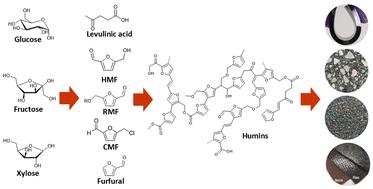
Humins are side-products derived from the acid-catalysed conversion of carbohydrate-containing biomass, including sugars (e.g. glucose, fructose, sucrose), oligosaccharides, polysaccharides, and lignocellulosic feedstocks into hydroxymethylfurfural (HMF), furfural, and levulinic acid. Until recently, humins were primarily burned as a power and heat source, but now several higher value applications for humins are within reach. This review covers the history, state of the art, and future outlook on the subject of industrial humins, including their origin, production conditions, compositions, characterisation, and proposed structures. Current opinion on humin formation mechanisms, kinetic studies, ways to minimise their production, established valorisation routes, and novel applications are also discussed.
期刊介绍:
Green Chemistry is a journal that provides a unique forum for the publication of innovative research on the development of alternative green and sustainable technologies. The scope of Green Chemistry is based on the definition proposed by Anastas and Warner (Green Chemistry: Theory and Practice, P T Anastas and J C Warner, Oxford University Press, Oxford, 1998), which defines green chemistry as the utilisation of a set of principles that reduces or eliminates the use or generation of hazardous substances in the design, manufacture and application of chemical products. Green Chemistry aims to reduce the environmental impact of the chemical enterprise by developing a technology base that is inherently non-toxic to living things and the environment. The journal welcomes submissions on all aspects of research relating to this endeavor and publishes original and significant cutting-edge research that is likely to be of wide general appeal. For a work to be published, it must present a significant advance in green chemistry, including a comparison with existing methods and a demonstration of advantages over those methods.



 京公网安备 11010802042870号
京ICP备2023020795号-1
京公网安备 11010802042870号
京ICP备2023020795号-1

 分享
分享
 求助内容:
求助内容: 应助结果提醒方式:
 扫码关注我们
