Jiahao Huang , Zongle Huang , Chen Zhang , Tianliang Hao , Tao Wang , Dingfei Deng , Zhipeng Sun , Yue Wang , Chenyang Xu , Jinjue Zeng , Shaochun Tang , Chaobo Huang , Lijun Yang , Xuebin Wang
{"title":"Monolithic carbon derived from biomass via zinc-assisted pyrolysis for lithium–sulfur batteries†","authors":"Jiahao Huang , Zongle Huang , Chen Zhang , Tianliang Hao , Tao Wang , Dingfei Deng , Zhipeng Sun , Yue Wang , Chenyang Xu , Jinjue Zeng , Shaochun Tang , Chaobo Huang , Lijun Yang , Xuebin Wang","doi":"10.1039/d4gc05753h","DOIUrl":null,"url":null,"abstract":"<div><div>The lithium–sulfur battery is one of the outstanding candidates for next-generation high-energy batteries. Porous carbon is acknowledged as a promising support for sulfur in the cathode. However, a high-areal-loading cost-effective support remains challenging. Herein, a monolith of porous carbon is derived from rice husk <em>via</em> zinc-assisted pyrolysis. It is applied to loading sulfur as a binder-free cathode, where the conductive network improves the conductance and buffers the volume change. The high surface area and rich pores confer the carbon a high sulfur loading of 73 wt% and 10.3 mg cm<sup>−2</sup>. Meanwhile, the defective sites of the carbon promote the conversion of polysulfides to suppress the shuttle effect. The cathode thus demonstrates high capacities of 1337 and 721 mA h g<sup>−1</sup> at 0.2 and 3 C, respectively, and it has a long cycling life over 500 cycles at 1 C.</div></div>","PeriodicalId":78,"journal":{"name":"Green Chemistry","volume":"27 12","pages":"Pages 3326-3334"},"PeriodicalIF":9.2000,"publicationDate":"2025-02-26","publicationTypes":"Journal Article","fieldsOfStudy":null,"isOpenAccess":false,"openAccessPdf":"","citationCount":"0","resultStr":null,"platform":"Semanticscholar","paperid":null,"PeriodicalName":"Green Chemistry","FirstCategoryId":"92","ListUrlMain":"https://www.sciencedirect.com/org/science/article/pii/S1463926225001384","RegionNum":1,"RegionCategory":"化学","ArticlePicture":[],"TitleCN":null,"AbstractTextCN":null,"PMCID":null,"EPubDate":"2025/2/19 0:00:00","PubModel":"Epub","JCR":"Q1","JCRName":"CHEMISTRY, MULTIDISCIPLINARY","Score":null,"Total":0}
引用次数: 0
Abstract
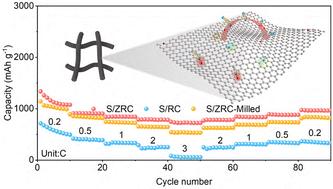
The lithium–sulfur battery is one of the outstanding candidates for next-generation high-energy batteries. Porous carbon is acknowledged as a promising support for sulfur in the cathode. However, a high-areal-loading cost-effective support remains challenging. Herein, a monolith of porous carbon is derived from rice husk via zinc-assisted pyrolysis. It is applied to loading sulfur as a binder-free cathode, where the conductive network improves the conductance and buffers the volume change. The high surface area and rich pores confer the carbon a high sulfur loading of 73 wt% and 10.3 mg cm−2. Meanwhile, the defective sites of the carbon promote the conversion of polysulfides to suppress the shuttle effect. The cathode thus demonstrates high capacities of 1337 and 721 mA h g−1 at 0.2 and 3 C, respectively, and it has a long cycling life over 500 cycles at 1 C.
锂硫电池是下一代高能电池的杰出候选者之一。多孔碳被认为是阴极中硫的有希望的载体。然而,高面积负载的高成本效益支持仍然具有挑战性。本文通过锌辅助热解从稻壳中获得多孔碳单体。它被应用于作为无粘结剂负载硫的阴极,其中导电网络提高了电导率并缓冲了体积变化。高表面积和丰富的孔隙使碳具有73 wt%和10.3 mg cm−2的高硫负荷。同时,碳的缺陷位点促进了多硫化物的转化,抑制了穿梭效应。因此,阴极在0.2℃和3℃下分别表现出1337和721 mA h g−1的高容量,并且在1℃下具有超过500次循环的长循环寿命。
期刊介绍:
Green Chemistry is a journal that provides a unique forum for the publication of innovative research on the development of alternative green and sustainable technologies. The scope of Green Chemistry is based on the definition proposed by Anastas and Warner (Green Chemistry: Theory and Practice, P T Anastas and J C Warner, Oxford University Press, Oxford, 1998), which defines green chemistry as the utilisation of a set of principles that reduces or eliminates the use or generation of hazardous substances in the design, manufacture and application of chemical products. Green Chemistry aims to reduce the environmental impact of the chemical enterprise by developing a technology base that is inherently non-toxic to living things and the environment. The journal welcomes submissions on all aspects of research relating to this endeavor and publishes original and significant cutting-edge research that is likely to be of wide general appeal. For a work to be published, it must present a significant advance in green chemistry, including a comparison with existing methods and a demonstration of advantages over those methods.



 京公网安备 11010802042870号
京ICP备2023020795号-1
京公网安备 11010802042870号
京ICP备2023020795号-1

 分享
分享
 求助内容:
求助内容: 应助结果提醒方式:
 扫码关注我们
