Kasey E. Yu , Sanjali Mitra , Qi Meng , Irish DelRosario , Sherin U. Devaskar , Carla Janzen , Peggy S. Sullivan , Liwei Chen , Michael Jerrett , Beate Ritz
{"title":"Diet, polycyclic aromatic hydrocarbons, and oxidative stress biomarkers in pregnancy: A Los Angeles pregnancy cohort","authors":"Kasey E. Yu , Sanjali Mitra , Qi Meng , Irish DelRosario , Sherin U. Devaskar , Carla Janzen , Peggy S. Sullivan , Liwei Chen , Michael Jerrett , Beate Ritz","doi":"10.1016/j.envres.2025.121399","DOIUrl":null,"url":null,"abstract":"<div><div>Polycyclic aromatic hydrocarbon (PAH) exposure during pregnancy has been associated with increased oxidative stress. Few studies have evaluated the relationship between diet, urinary PAHs, and oxidative stress biomarkers among pregnant women. We enrolled a prospective cohort of pregnant women who gave birth at UCLA between 2016 and 2019. Dietary intake over the past month was evaluated by a food frequency questionnaire during mid-pregnancy, and three diet index scores were calculated: Healthy Eating Index (HEI) 2015, Alternate Mediterranean Diet (aMED), and Alternate Healthy Eating Index for Pregnancy (AHEI-P). Urine samples were collected up to three times during pregnancy and analyzed for PAH biomarkers, including 2-hydroxyfluorene + 3-hydroxyfluorene (FLUO2FLUO3), 1-hydroxyphenanthrene (PHEN1), 2-hydroxyphenanthrene (PHEN2), 3-hydroxyphenanthrene (PHEN3), 4-hydroxyphenanthrene (PHEN4), 2-hydroxynaphthalene (NAP2), and 1-hydroxypyrene (PYR1), and two oxidative stress biomarkers, malondialdehyde (MDA) and 8-hydroxyguanosine (8-OHdG). We employed multiple linear regression models to estimate effects of diet on measures of urinary PAHs and oxidative stress biomarkers. A better diet quality, as indicated by three diet indices, was associated with lower urinary PAH metabolites and lower concentrations of oxidative stress biomarkers. This pattern appeared to be consistent across all three sampling periods (9–17 weeks, 18–29 weeks, and 30 weeks-delivery). Healthier diets may lower PAH exposure and oxidative stress in pregnancy.</div></div>","PeriodicalId":312,"journal":{"name":"Environmental Research","volume":"275 ","pages":"Article 121399"},"PeriodicalIF":7.7000,"publicationDate":"2025-03-13","publicationTypes":"Journal Article","fieldsOfStudy":null,"isOpenAccess":false,"openAccessPdf":"","citationCount":"0","resultStr":null,"platform":"Semanticscholar","paperid":null,"PeriodicalName":"Environmental Research","FirstCategoryId":"93","ListUrlMain":"https://www.sciencedirect.com/science/article/pii/S0013935125006504","RegionNum":2,"RegionCategory":"环境科学与生态学","ArticlePicture":[],"TitleCN":null,"AbstractTextCN":null,"PMCID":null,"EPubDate":"","PubModel":"","JCR":"Q1","JCRName":"ENVIRONMENTAL SCIENCES","Score":null,"Total":0}
引用次数: 0
Abstract
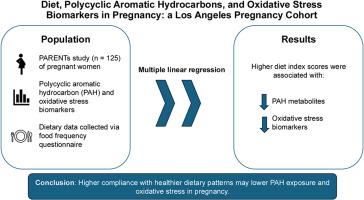
Polycyclic aromatic hydrocarbon (PAH) exposure during pregnancy has been associated with increased oxidative stress. Few studies have evaluated the relationship between diet, urinary PAHs, and oxidative stress biomarkers among pregnant women. We enrolled a prospective cohort of pregnant women who gave birth at UCLA between 2016 and 2019. Dietary intake over the past month was evaluated by a food frequency questionnaire during mid-pregnancy, and three diet index scores were calculated: Healthy Eating Index (HEI) 2015, Alternate Mediterranean Diet (aMED), and Alternate Healthy Eating Index for Pregnancy (AHEI-P). Urine samples were collected up to three times during pregnancy and analyzed for PAH biomarkers, including 2-hydroxyfluorene + 3-hydroxyfluorene (FLUO2FLUO3), 1-hydroxyphenanthrene (PHEN1), 2-hydroxyphenanthrene (PHEN2), 3-hydroxyphenanthrene (PHEN3), 4-hydroxyphenanthrene (PHEN4), 2-hydroxynaphthalene (NAP2), and 1-hydroxypyrene (PYR1), and two oxidative stress biomarkers, malondialdehyde (MDA) and 8-hydroxyguanosine (8-OHdG). We employed multiple linear regression models to estimate effects of diet on measures of urinary PAHs and oxidative stress biomarkers. A better diet quality, as indicated by three diet indices, was associated with lower urinary PAH metabolites and lower concentrations of oxidative stress biomarkers. This pattern appeared to be consistent across all three sampling periods (9–17 weeks, 18–29 weeks, and 30 weeks-delivery). Healthier diets may lower PAH exposure and oxidative stress in pregnancy.
期刊介绍:
The Environmental Research journal presents a broad range of interdisciplinary research, focused on addressing worldwide environmental concerns and featuring innovative findings. Our publication strives to explore relevant anthropogenic issues across various environmental sectors, showcasing practical applications in real-life settings.



 京公网安备 11010802042870号
京ICP备2023020795号-1
京公网安备 11010802042870号
京ICP备2023020795号-1

 分享
分享
 求助内容:
求助内容: 应助结果提醒方式:
 扫码关注我们
