Lin Zhang, Xiaoxue Ruan, Xudong Hang, Ding Heng, Chang Cai, Liping Zeng, Guoxin Zhang, Lu Zhou, Hongkai Bi, Liang Zhang
{"title":"Antagonist Targeting the Species-Specific Fatty Acid Dehydrogenase/Isomerase FabX for Anti-H. pylori Infection","authors":"Lin Zhang, Xiaoxue Ruan, Xudong Hang, Ding Heng, Chang Cai, Liping Zeng, Guoxin Zhang, Lu Zhou, Hongkai Bi, Liang Zhang","doi":"10.1002/advs.202414844","DOIUrl":null,"url":null,"abstract":"<p><i>Helicobacter pylori</i> (<i>H. pylori</i>) is a group-1 definite pathogenic carcinogen that infects approximately half of the global population, yet no species-specific chemotherapy has yet been developed. It is previously discovered that <i>H. pylori</i> encodes an atypical dehydrogenase/isomerase FabX in the Type-II fatty acid biosynthesis pathway to produce unsaturated fatty acids (UFA) as well as superoxide (ROS). Here, it is demonstrated that FabX is essential for <i>H. pylori</i> growth and gastric colonization by retaining UFA synthesis and producing ROS, respectively, and is a species-specific anti-<i>H. pylori</i> drug target. The first small molecule inhibitor FBX-1991 against FabX, which inhibits the enzymatic activity with an <i>IC</i><sub>50</sub> value of 0.158 × 10<sup>−6</sup> <span>m</span> in vitro, is developed. FBX-1991 binds inside the catalytic tunnel of FabX, disrupts the conformation of the key catalytic loop, and prevents the insertion of the acyl substrate for catalysis. Further in vivo studies suggest that FBX-1991 inhibits the <i>H. pylori</i> growth by partially inhibiting UFA synthesis and ROS excretion through targeting FabX. This study identifies a species-specific anti-<i>H. pylori</i> drug target, FabX, and discovers the first highly potent and selective FabX inhibitor against <i>H. pylori</i> infection, which provides the molecular basis for developing species-specific anti<i>-H. pylori</i> chemotherapy.</p>","PeriodicalId":117,"journal":{"name":"Advanced Science","volume":"12 18","pages":""},"PeriodicalIF":14.1000,"publicationDate":"2025-03-16","publicationTypes":"Journal Article","fieldsOfStudy":null,"isOpenAccess":false,"openAccessPdf":"https://onlinelibrary.wiley.com/doi/epdf/10.1002/advs.202414844","citationCount":"0","resultStr":null,"platform":"Semanticscholar","paperid":null,"PeriodicalName":"Advanced Science","FirstCategoryId":"88","ListUrlMain":"https://advanced.onlinelibrary.wiley.com/doi/10.1002/advs.202414844","RegionNum":1,"RegionCategory":"材料科学","ArticlePicture":[],"TitleCN":null,"AbstractTextCN":null,"PMCID":null,"EPubDate":"","PubModel":"","JCR":"Q1","JCRName":"CHEMISTRY, MULTIDISCIPLINARY","Score":null,"Total":0}
引用次数: 0
Abstract
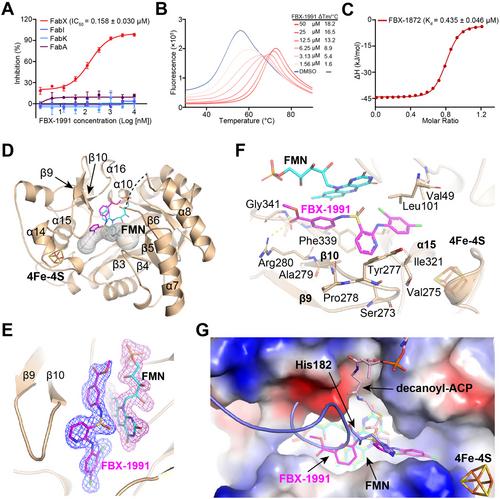
Helicobacter pylori (H. pylori) is a group-1 definite pathogenic carcinogen that infects approximately half of the global population, yet no species-specific chemotherapy has yet been developed. It is previously discovered that H. pylori encodes an atypical dehydrogenase/isomerase FabX in the Type-II fatty acid biosynthesis pathway to produce unsaturated fatty acids (UFA) as well as superoxide (ROS). Here, it is demonstrated that FabX is essential for H. pylori growth and gastric colonization by retaining UFA synthesis and producing ROS, respectively, and is a species-specific anti-H. pylori drug target. The first small molecule inhibitor FBX-1991 against FabX, which inhibits the enzymatic activity with an IC50 value of 0.158 × 10⁻⁶m in vitro, is developed. FBX-1991 binds inside the catalytic tunnel of FabX, disrupts the conformation of the key catalytic loop, and prevents the insertion of the acyl substrate for catalysis. Further in vivo studies suggest that FBX-1991 inhibits the H. pylori growth by partially inhibiting UFA synthesis and ROS excretion through targeting FabX. This study identifies a species-specific anti-H. pylori drug target, FabX, and discovers the first highly potent and selective FabX inhibitor against H. pylori infection, which provides the molecular basis for developing species-specific anti-H. pylori chemotherapy.
期刊介绍:
Advanced Science is a prestigious open access journal that focuses on interdisciplinary research in materials science, physics, chemistry, medical and life sciences, and engineering. The journal aims to promote cutting-edge research by employing a rigorous and impartial review process. It is committed to presenting research articles with the highest quality production standards, ensuring maximum accessibility of top scientific findings. With its vibrant and innovative publication platform, Advanced Science seeks to revolutionize the dissemination and organization of scientific knowledge.





 京公网安备 11010802042870号
京ICP备2023020795号-1
京公网安备 11010802042870号
京ICP备2023020795号-1

 分享
分享
 求助内容:
求助内容: 应助结果提醒方式:
 扫码关注我们
