{"title":"Stress hyperglycemia ratio and 30-day mortality among critically ill patients with acute heart failure: analysis of the MIMIC-IV database","authors":"Xiaodong You, Hengzhi Zhang, Tianshi Li, Yi Zhu, Zhongman Zhang, Xufeng Chen, Peipei Huang","doi":"10.1007/s00592-025-02486-3","DOIUrl":null,"url":null,"abstract":"<div><h3>Background</h3><p>The association between the stress hyperglycemia ratio (SHR) and short-term prognosis of acute heart failure (AHF), particularly among those admitted to the intensive care unit (ICU), has not been elucidated. This study aimed to investigate the association between the SHR and adverse outcomes among critically ill patients with AHF and provide a reference for glycemic management range in these patients.</p><h3>Methods</h3><p>We extracted the clinical data of patients from the MIMIC-IV (v3.0) database. The association between the SHR and short-term prognosis was analyzed using the Kaplan‒Meier survival curve, Cox regression, and subgroup analysis. Important features were identified utilizing machine learning methods. Furthermore, the association between the dynamic SHR level and mortality was explored using restricted cubic splines and Cox regression.</p><h3>Results</h3><p>A total of 994 patients were included. Patients with the highest SHR (Quartile 4) had a higher risk of 30-day mortality (HR = 2.14; 95% CI = 1.32–3.45; <i>P</i> = 0.002) and in-hospital mortality (HR = 2.22; 95% CI = 1.27–3.88; <i>P</i> = 0.005) than those in Quartile 2 (as reference). The results of machine learning methods revealed the SHR was an important predictor for 30-day mortality of patients with critical AHF. Restricted cubic splines indicated a J-shaped association between the dynamic SHR level and mortality, and the cut-off values were 0.84 and 1.07.</p><h3>Conclusion</h3><p>The SHR was significantly associated with 30-day mortality and in-hospital mortality among patients with critical AHF. The SHR may be a useful indicator for the glycemic management of patients with AHF in the ICU.</p><h3>Graphical Abstract</h3><div><figure><div><div><picture><source><img></source></picture></div></div></figure></div></div>","PeriodicalId":6921,"journal":{"name":"Acta Diabetologica","volume":"62 9","pages":"1537 - 1547"},"PeriodicalIF":2.9000,"publicationDate":"2025-03-15","publicationTypes":"Journal Article","fieldsOfStudy":null,"isOpenAccess":false,"openAccessPdf":"","citationCount":"0","resultStr":null,"platform":"Semanticscholar","paperid":null,"PeriodicalName":"Acta Diabetologica","FirstCategoryId":"3","ListUrlMain":"https://link.springer.com/article/10.1007/s00592-025-02486-3","RegionNum":3,"RegionCategory":"医学","ArticlePicture":[],"TitleCN":null,"AbstractTextCN":null,"PMCID":null,"EPubDate":"","PubModel":"","JCR":"Q2","JCRName":"ENDOCRINOLOGY & METABOLISM","Score":null,"Total":0}
引用次数: 0
Abstract
Background
The association between the stress hyperglycemia ratio (SHR) and short-term prognosis of acute heart failure (AHF), particularly among those admitted to the intensive care unit (ICU), has not been elucidated. This study aimed to investigate the association between the SHR and adverse outcomes among critically ill patients with AHF and provide a reference for glycemic management range in these patients.
Methods
We extracted the clinical data of patients from the MIMIC-IV (v3.0) database. The association between the SHR and short-term prognosis was analyzed using the Kaplan‒Meier survival curve, Cox regression, and subgroup analysis. Important features were identified utilizing machine learning methods. Furthermore, the association between the dynamic SHR level and mortality was explored using restricted cubic splines and Cox regression.
Results
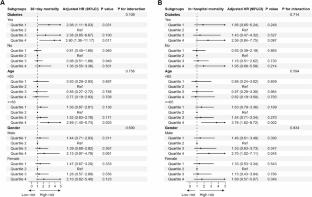
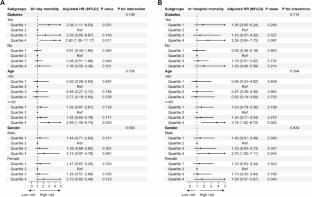
A total of 994 patients were included. Patients with the highest SHR (Quartile 4) had a higher risk of 30-day mortality (HR = 2.14; 95% CI = 1.32–3.45; P = 0.002) and in-hospital mortality (HR = 2.22; 95% CI = 1.27–3.88; P = 0.005) than those in Quartile 2 (as reference). The results of machine learning methods revealed the SHR was an important predictor for 30-day mortality of patients with critical AHF. Restricted cubic splines indicated a J-shaped association between the dynamic SHR level and mortality, and the cut-off values were 0.84 and 1.07.
Conclusion
The SHR was significantly associated with 30-day mortality and in-hospital mortality among patients with critical AHF. The SHR may be a useful indicator for the glycemic management of patients with AHF in the ICU.
期刊介绍:
Acta Diabetologica is a journal that publishes reports of experimental and clinical research on diabetes mellitus and related metabolic diseases. Original contributions on biochemical, physiological, pathophysiological and clinical aspects of research on diabetes and metabolic diseases are welcome. Reports are published in the form of original articles, short communications and letters to the editor. Invited reviews and editorials are also published. A Methodology forum, which publishes contributions on methodological aspects of diabetes in vivo and in vitro, is also available. The Editor-in-chief will be pleased to consider articles describing new techniques (e.g., new transplantation methods, metabolic models), of innovative importance in the field of diabetes/metabolism. Finally, workshop reports are also welcome in Acta Diabetologica.



 京公网安备 11010802042870号
京ICP备2023020795号-1
京公网安备 11010802042870号
京ICP备2023020795号-1

 分享
分享
 求助内容:
求助内容: 应助结果提醒方式:
 扫码关注我们
