{"title":"Effects of psychosocial factors on postpartum depression: a half-longitudinal mediation analysis of cognitive reactivity.","authors":"Huilan Hong, Qiuhong Chen, Yiyang Lin, Yonglin Li, Jianqing Zheng, Ping Gao, Yang Lei, Feifei Huang","doi":"10.1186/s12884-025-07364-y","DOIUrl":null,"url":null,"abstract":"<p><strong>Background: </strong>The prevention and treatment of perinatal depression are currently the focus of perinatal health care, with cognitive reactivity confirmed to be an important predictor. However, how cognitive reactivity mediates the relationship between psychosocial factors (e.g. family function, perceived stress, mindfulness, and insomnia) and perinatal depression remains unclear. This study aims to investigate the mediating role of cognitive reactivity between psychosocial factors and perinatal depression.</p><p><strong>Methods: </strong>Based on a half-longitudinal design, this study investigated 368 perinatal women from China in the third trimester (T1) and three months postpartum (T2) using the Perceived Stress Scale, Cognitive and Affective Mindfulness Scale, Athens Insomnia Scale, Family Adaptation Partnership Growth Affection and Resolve Index, Leiden Index of Depression Sensitivity, and Edinburgh Postnatal Depression Scale. Data were analysed using structural equation modelling.</p><p><strong>Results: </strong>The overall fit of the hypothetical structural model is acceptable. The analysis confirmed a direct relationship between family function, perceived stress, mindfulness, and insomnia at T1, and cognitive reactivity at T2. Factors other than mindfulness at T1 had a direct effect on perinatal depression at T2. Furthermore, cognitive reactivity at T2 mediated the influences of family function, perceived stress, mindfulness, and insomnia at T1 on perinatal depression at T2.</p><p><strong>Conclusions: </strong>Cognitive reactivity levels in the third trimester were stable predictors and mediators of postpartum depression. Effective strategies to reduce cognitive reactivity in perinatal women should focus on enhancing family function, mindfulness, and sleep quality and in guiding women toward adopting positive coping styles to alleviate stress levels, ultimately reducing postpartum depression.</p>","PeriodicalId":9033,"journal":{"name":"BMC Pregnancy and Childbirth","volume":"25 1","pages":"296"},"PeriodicalIF":2.7000,"publicationDate":"2025-03-15","publicationTypes":"Journal Article","fieldsOfStudy":null,"isOpenAccess":false,"openAccessPdf":"https://www.ncbi.nlm.nih.gov/pmc/articles/PMC11910840/pdf/","citationCount":"0","resultStr":null,"platform":"Semanticscholar","paperid":null,"PeriodicalName":"BMC Pregnancy and Childbirth","FirstCategoryId":"3","ListUrlMain":"https://doi.org/10.1186/s12884-025-07364-y","RegionNum":2,"RegionCategory":"医学","ArticlePicture":[],"TitleCN":null,"AbstractTextCN":null,"PMCID":null,"EPubDate":"","PubModel":"","JCR":"Q1","JCRName":"OBSTETRICS & GYNECOLOGY","Score":null,"Total":0}
引用次数: 0
Abstract
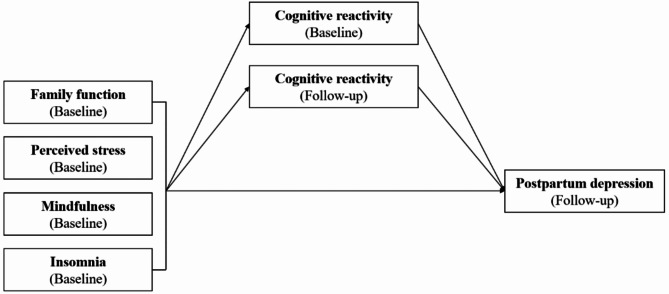
Background: The prevention and treatment of perinatal depression are currently the focus of perinatal health care, with cognitive reactivity confirmed to be an important predictor. However, how cognitive reactivity mediates the relationship between psychosocial factors (e.g. family function, perceived stress, mindfulness, and insomnia) and perinatal depression remains unclear. This study aims to investigate the mediating role of cognitive reactivity between psychosocial factors and perinatal depression.
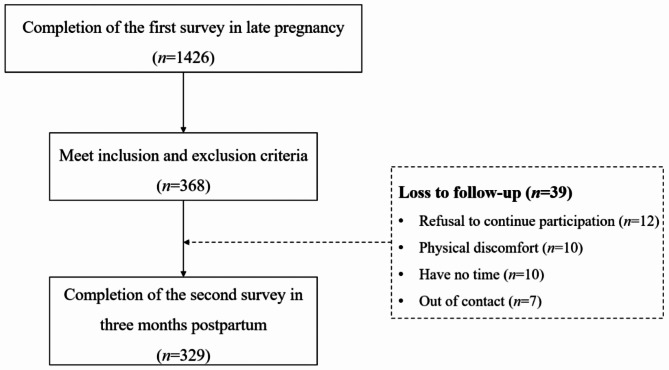
Methods: Based on a half-longitudinal design, this study investigated 368 perinatal women from China in the third trimester (T1) and three months postpartum (T2) using the Perceived Stress Scale, Cognitive and Affective Mindfulness Scale, Athens Insomnia Scale, Family Adaptation Partnership Growth Affection and Resolve Index, Leiden Index of Depression Sensitivity, and Edinburgh Postnatal Depression Scale. Data were analysed using structural equation modelling.
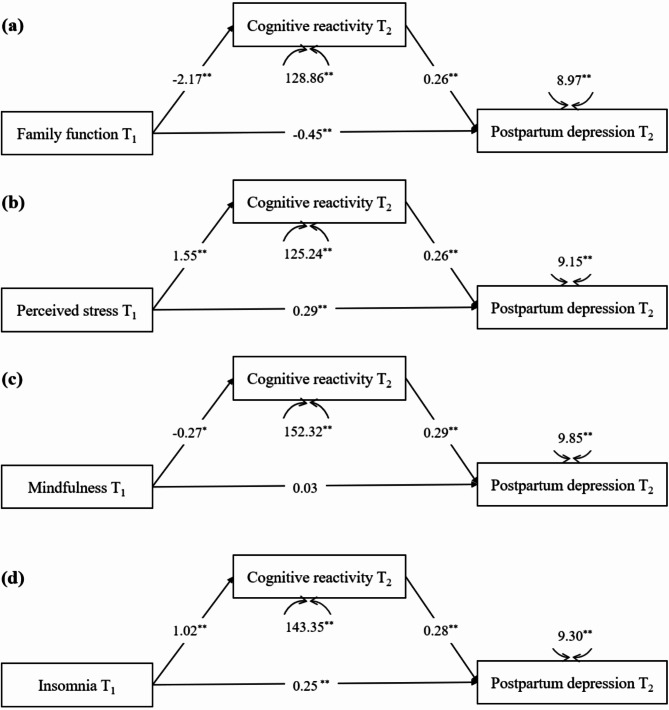
Results: The overall fit of the hypothetical structural model is acceptable. The analysis confirmed a direct relationship between family function, perceived stress, mindfulness, and insomnia at T1, and cognitive reactivity at T2. Factors other than mindfulness at T1 had a direct effect on perinatal depression at T2. Furthermore, cognitive reactivity at T2 mediated the influences of family function, perceived stress, mindfulness, and insomnia at T1 on perinatal depression at T2.
Conclusions: Cognitive reactivity levels in the third trimester were stable predictors and mediators of postpartum depression. Effective strategies to reduce cognitive reactivity in perinatal women should focus on enhancing family function, mindfulness, and sleep quality and in guiding women toward adopting positive coping styles to alleviate stress levels, ultimately reducing postpartum depression.
期刊介绍:
BMC Pregnancy & Childbirth is an open access, peer-reviewed journal that considers articles on all aspects of pregnancy and childbirth. The journal welcomes submissions on the biomedical aspects of pregnancy, breastfeeding, labor, maternal health, maternity care, trends and sociological aspects of pregnancy and childbirth.



 京公网安备 11010802042870号
京ICP备2023020795号-1
京公网安备 11010802042870号
京ICP备2023020795号-1

 分享
分享
 求助内容:
求助内容: 应助结果提醒方式:
 扫码关注我们
