Xiaoming Bai, Tinghong Duan, Jiaofang Shao, Yutong Zhang, Guangyuan Xing, Jie Wang, Xue Liu, Min Wang, Yuanqiao He, Hai Wang, Zhi-Yuan Zhang, Min Ni, Jin-Yong Zhou, Jinshun Pan
{"title":"CBX3 promotes multidrug resistance by suppressing ferroptosis in colorectal carcinoma via the CUL3/NRF2/GPX2 axis","authors":"Xiaoming Bai, Tinghong Duan, Jiaofang Shao, Yutong Zhang, Guangyuan Xing, Jie Wang, Xue Liu, Min Wang, Yuanqiao He, Hai Wang, Zhi-Yuan Zhang, Min Ni, Jin-Yong Zhou, Jinshun Pan","doi":"10.1038/s41388-025-03337-9","DOIUrl":null,"url":null,"abstract":"Chemoresistance poses a significant challenge in colorectal cancer (CRC) treatment. However, the mechanisms underlying chemoresistance remain unclear. CBX3 promoted proliferation and metastasis in CRC. However, the role and mechanism of CBX3 in chemoresistance remain unknown. Therefore, we aimed to investigate the effects and mechanisms of CBX3 on multidrug resistance in CRC. Our studies showed that higher levels of CBX3 expression were associated with poor survival, especially in groups with progression following chemotherapy. CBX3 overexpression increased Irinotecan and Oxaliplatin resistance, whereas CBX3 knockdown suppressed multidrug resistance in CRC cells. Additionally, CBX3 inhibited ferroptosis associated with multidrug resistance, and the ferroptosis activators prevented CBX3 overexpression-mediated cell survival. RNA sequencing revealed that the NRF2-signaling pathway was involved in this process. CBX3-upregulated NRF2 protein expression by directly binding to the promoter of Cullin3 (CUL3) to suppress CUL3 transcription and CUL3-mediated NRF2 degradation. Moreover, Glutathione Peroxidase 2 (GPX2) was downstream of the CBX3-NRF2 pathway in CRC chemoresistance. ML385, an NRF2 inhibitor, suppressed GPX2 expression, and increased ferroptosis in PDX models. Our study identified CBX3/NRF2/GPX2 axis may be a novel signaling pathway that mediates multidrug resistance in CRC. This study proposes developing novel strategies for cancer treatment to overcome drug resistance in the future.","PeriodicalId":19524,"journal":{"name":"Oncogene","volume":"44 22","pages":"1678-1693"},"PeriodicalIF":7.3000,"publicationDate":"2025-03-16","publicationTypes":"Journal Article","fieldsOfStudy":null,"isOpenAccess":false,"openAccessPdf":"https://www.nature.com/articles/s41388-025-03337-9.pdf","citationCount":"0","resultStr":null,"platform":"Semanticscholar","paperid":null,"PeriodicalName":"Oncogene","FirstCategoryId":"3","ListUrlMain":"https://www.nature.com/articles/s41388-025-03337-9","RegionNum":1,"RegionCategory":"医学","ArticlePicture":[],"TitleCN":null,"AbstractTextCN":null,"PMCID":null,"EPubDate":"","PubModel":"","JCR":"Q1","JCRName":"BIOCHEMISTRY & MOLECULAR BIOLOGY","Score":null,"Total":0}
引用次数: 0
Abstract
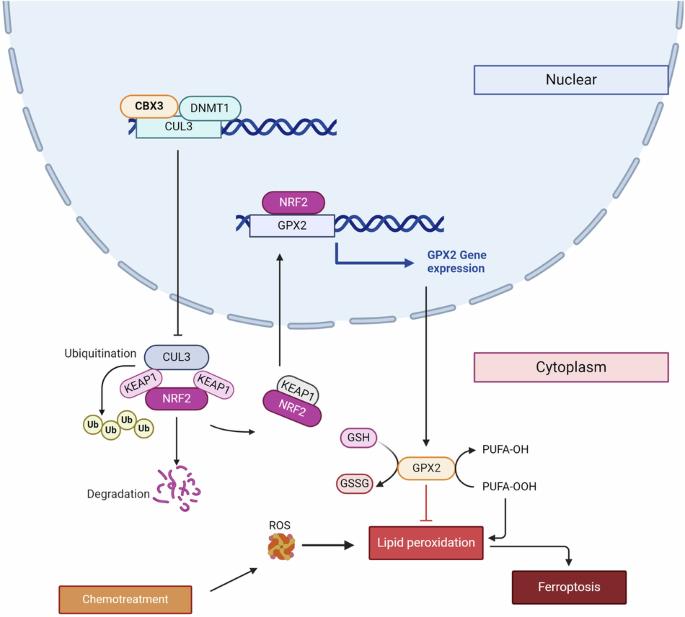
Chemoresistance poses a significant challenge in colorectal cancer (CRC) treatment. However, the mechanisms underlying chemoresistance remain unclear. CBX3 promoted proliferation and metastasis in CRC. However, the role and mechanism of CBX3 in chemoresistance remain unknown. Therefore, we aimed to investigate the effects and mechanisms of CBX3 on multidrug resistance in CRC. Our studies showed that higher levels of CBX3 expression were associated with poor survival, especially in groups with progression following chemotherapy. CBX3 overexpression increased Irinotecan and Oxaliplatin resistance, whereas CBX3 knockdown suppressed multidrug resistance in CRC cells. Additionally, CBX3 inhibited ferroptosis associated with multidrug resistance, and the ferroptosis activators prevented CBX3 overexpression-mediated cell survival. RNA sequencing revealed that the NRF2-signaling pathway was involved in this process. CBX3-upregulated NRF2 protein expression by directly binding to the promoter of Cullin3 (CUL3) to suppress CUL3 transcription and CUL3-mediated NRF2 degradation. Moreover, Glutathione Peroxidase 2 (GPX2) was downstream of the CBX3-NRF2 pathway in CRC chemoresistance. ML385, an NRF2 inhibitor, suppressed GPX2 expression, and increased ferroptosis in PDX models. Our study identified CBX3/NRF2/GPX2 axis may be a novel signaling pathway that mediates multidrug resistance in CRC. This study proposes developing novel strategies for cancer treatment to overcome drug resistance in the future.
期刊介绍:
Oncogene is dedicated to advancing our understanding of cancer processes through the publication of exceptional research. The journal seeks to disseminate work that challenges conventional theories and contributes to establishing new paradigms in the etio-pathogenesis, diagnosis, treatment, or prevention of cancers. Emphasis is placed on research shedding light on processes driving metastatic spread and providing crucial insights into cancer biology beyond existing knowledge.
Areas covered include the cellular and molecular biology of cancer, resistance to cancer therapies, and the development of improved approaches to enhance survival. Oncogene spans the spectrum of cancer biology, from fundamental and theoretical work to translational, applied, and clinical research, including early and late Phase clinical trials, particularly those with biologic and translational endpoints.




 京公网安备 11010802042870号
京ICP备2023020795号-1
京公网安备 11010802042870号
京ICP备2023020795号-1

 分享
分享
 求助内容:
求助内容: 应助结果提醒方式:
 扫码关注我们
