Lei Li, Ziyi Liu, Xiaocheng Xu, Lei Xu, Xiaofan Yang, Hanxi Guan, Zhonglong Li, Chengliang Xiao
{"title":"A negatively-charged supramolecular trap for precisely catching strontium ion","authors":"Lei Li, Ziyi Liu, Xiaocheng Xu, Lei Xu, Xiaofan Yang, Hanxi Guan, Zhonglong Li, Chengliang Xiao","doi":"10.1038/s41467-025-57844-0","DOIUrl":null,"url":null,"abstract":"<p>Due to the analogous physicochemical properties and weak coordination ability of alkali and alkaline earth metals, accurate separation of radioactive <sup>90</sup>Sr from groundwater or seawater still presents a big challenge in environmental radioactivity remediation. Here we mimic the complexation behavior of molecular crown-ether carboxylic acids to construct an elegant negatively charged supramolecular trap in an anionic crown ether-based metal-organic framework (ZJU-X99) for precisely catching Sr<sup>2+</sup>. Owing to the synergistic effects of electrostatic interactions arising from the In(COO)<sub>4</sub><sup>-</sup> nodes and supramolecular host-guest recognition from the 18-crown-6 rings, ZJU-X99 exhibits rapid adsorption kinetics (1 min), high adsorption capacity (263 mg/g), and exceptional selectivity for Sr<sup>2+</sup> even when 1000-fold of Na⁺, K⁺ and Cs⁺ coexist. Relative to alkali metals, Sr<sup>2+</sup> ions are intricately ensconced within the supramolecular trap, resulting in lowest binding energy and minimal structural alterations. Dynamic column experiments and radioactive <sup>90</sup>Sr decontamination trials further validate its practical application prospects. Our findings offer valuable insights into the design of supramolecular frameworks featuring tailored binding sites for targeted ions.</p>","PeriodicalId":19066,"journal":{"name":"Nature Communications","volume":"45 1","pages":""},"PeriodicalIF":15.7000,"publicationDate":"2025-03-17","publicationTypes":"Journal Article","fieldsOfStudy":null,"isOpenAccess":false,"openAccessPdf":"","citationCount":"0","resultStr":null,"platform":"Semanticscholar","paperid":null,"PeriodicalName":"Nature Communications","FirstCategoryId":"103","ListUrlMain":"https://doi.org/10.1038/s41467-025-57844-0","RegionNum":1,"RegionCategory":"综合性期刊","ArticlePicture":[],"TitleCN":null,"AbstractTextCN":null,"PMCID":null,"EPubDate":"","PubModel":"","JCR":"Q1","JCRName":"MULTIDISCIPLINARY SCIENCES","Score":null,"Total":0}
引用次数: 0
Abstract
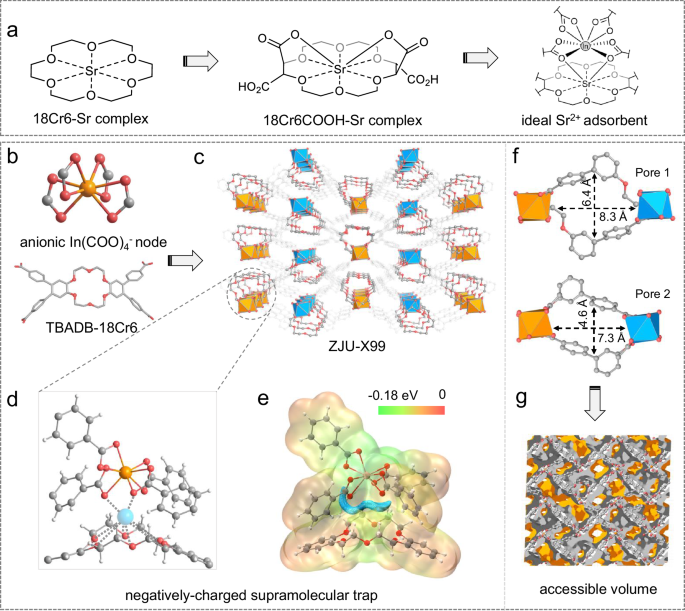
Due to the analogous physicochemical properties and weak coordination ability of alkali and alkaline earth metals, accurate separation of radioactive 90Sr from groundwater or seawater still presents a big challenge in environmental radioactivity remediation. Here we mimic the complexation behavior of molecular crown-ether carboxylic acids to construct an elegant negatively charged supramolecular trap in an anionic crown ether-based metal-organic framework (ZJU-X99) for precisely catching Sr2+. Owing to the synergistic effects of electrostatic interactions arising from the In(COO)4- nodes and supramolecular host-guest recognition from the 18-crown-6 rings, ZJU-X99 exhibits rapid adsorption kinetics (1 min), high adsorption capacity (263 mg/g), and exceptional selectivity for Sr2+ even when 1000-fold of Na⁺, K⁺ and Cs⁺ coexist. Relative to alkali metals, Sr2+ ions are intricately ensconced within the supramolecular trap, resulting in lowest binding energy and minimal structural alterations. Dynamic column experiments and radioactive 90Sr decontamination trials further validate its practical application prospects. Our findings offer valuable insights into the design of supramolecular frameworks featuring tailored binding sites for targeted ions.
期刊介绍:
Nature Communications, an open-access journal, publishes high-quality research spanning all areas of the natural sciences. Papers featured in the journal showcase significant advances relevant to specialists in each respective field. With a 2-year impact factor of 16.6 (2022) and a median time of 8 days from submission to the first editorial decision, Nature Communications is committed to rapid dissemination of research findings. As a multidisciplinary journal, it welcomes contributions from biological, health, physical, chemical, Earth, social, mathematical, applied, and engineering sciences, aiming to highlight important breakthroughs within each domain.



 京公网安备 11010802042870号
京ICP备2023020795号-1
京公网安备 11010802042870号
京ICP备2023020795号-1

 分享
分享
 求助内容:
求助内容: 应助结果提醒方式:
 扫码关注我们
