Lijie Wang, Yue Liu, Jie Yang, Xiangming Xu, Bingyao Shao, Hongwei Zhu, Haiting Cai, Tulai Sun, Jun Yin, Husam N. Alshareef, Osman M. Bakr, Yihan Zhu, Omar F. Mohammed
{"title":"Lattice Expansion Enables Large Surface Carrier Diffusion in WS2 Monolayer","authors":"Lijie Wang, Yue Liu, Jie Yang, Xiangming Xu, Bingyao Shao, Hongwei Zhu, Haiting Cai, Tulai Sun, Jun Yin, Husam N. Alshareef, Osman M. Bakr, Yihan Zhu, Omar F. Mohammed","doi":"10.1021/acsenergylett.5c00307","DOIUrl":null,"url":null,"abstract":"Two-dimensional (2D) materials hold great promise for next-generation optoelectronic devices, with photogenerated charge carrier transport being critical to their performance. However, the influence of photoexcitation-induced commensurate lattice thermal effects on surface charge carrier dynamics is poorly understood. Traditional photon-pump/photon-probe methods have constraints in capturing the subtle yet critical surface dynamics, especially for these ultrathin materials due to challenges in spatial resolution and penetration depth. In this study, we utilized scanning ultrafast electron microscopy (SUEM), a technique that offers unparalleled sensitivity to surface phenomena that are entirely inaccessible through other methods. Our findings reveal a ∼1.4% negative thermal expansion at elevated temperatures, inducing internal strain that modifies the electronic structure and significantly enhances surface carrier transport, resulting in an order-of-magnitude improvement in photodetection performance. Moreover, we demonstrate that photoinduced charge carrier diffusion occurs predominantly within the first tens of picoseconds after photoexcitation, a regime characterized by thermal excitation resulting from carrier–phonon interactions. These results establish a direct link among lattice thermal expansion, carrier dynamics, and optoelectronic performance.","PeriodicalId":16,"journal":{"name":"ACS Energy Letters ","volume":"55 1","pages":""},"PeriodicalIF":18.2000,"publicationDate":"2025-03-17","publicationTypes":"Journal Article","fieldsOfStudy":null,"isOpenAccess":false,"openAccessPdf":"","citationCount":"0","resultStr":null,"platform":"Semanticscholar","paperid":null,"PeriodicalName":"ACS Energy Letters ","FirstCategoryId":"88","ListUrlMain":"https://doi.org/10.1021/acsenergylett.5c00307","RegionNum":1,"RegionCategory":"材料科学","ArticlePicture":[],"TitleCN":null,"AbstractTextCN":null,"PMCID":null,"EPubDate":"","PubModel":"","JCR":"Q1","JCRName":"CHEMISTRY, PHYSICAL","Score":null,"Total":0}
引用次数: 0
Abstract
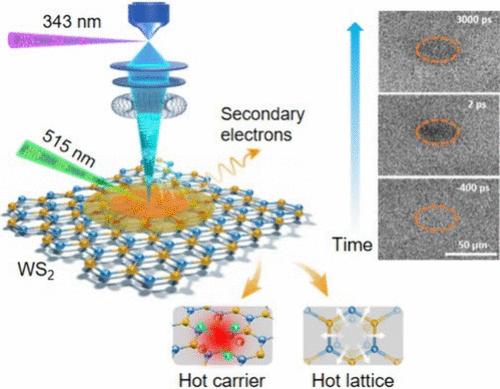
Two-dimensional (2D) materials hold great promise for next-generation optoelectronic devices, with photogenerated charge carrier transport being critical to their performance. However, the influence of photoexcitation-induced commensurate lattice thermal effects on surface charge carrier dynamics is poorly understood. Traditional photon-pump/photon-probe methods have constraints in capturing the subtle yet critical surface dynamics, especially for these ultrathin materials due to challenges in spatial resolution and penetration depth. In this study, we utilized scanning ultrafast electron microscopy (SUEM), a technique that offers unparalleled sensitivity to surface phenomena that are entirely inaccessible through other methods. Our findings reveal a ∼1.4% negative thermal expansion at elevated temperatures, inducing internal strain that modifies the electronic structure and significantly enhances surface carrier transport, resulting in an order-of-magnitude improvement in photodetection performance. Moreover, we demonstrate that photoinduced charge carrier diffusion occurs predominantly within the first tens of picoseconds after photoexcitation, a regime characterized by thermal excitation resulting from carrier–phonon interactions. These results establish a direct link among lattice thermal expansion, carrier dynamics, and optoelectronic performance.
ACS Energy Letters Energy-Renewable Energy, Sustainability and the Environment
CiteScore
31.20
自引率
5.00%
发文量
469
审稿时长
1 months
期刊介绍:
ACS Energy Letters is a monthly journal that publishes papers reporting new scientific advances in energy research. The journal focuses on topics that are of interest to scientists working in the fundamental and applied sciences. Rapid publication is a central criterion for acceptance, and the journal is known for its quick publication times, with an average of 4-6 weeks from submission to web publication in As Soon As Publishable format.
ACS Energy Letters is ranked as the number one journal in the Web of Science Electrochemistry category. It also ranks within the top 10 journals for Physical Chemistry, Energy & Fuels, and Nanoscience & Nanotechnology.
The journal offers several types of articles, including Letters, Energy Express, Perspectives, Reviews, Editorials, Viewpoints and Energy Focus. Additionally, authors have the option to submit videos that summarize or support the information presented in a Perspective or Review article, which can be highlighted on the journal's website. ACS Energy Letters is abstracted and indexed in Chemical Abstracts Service/SciFinder, EBSCO-summon, PubMed, Web of Science, Scopus and Portico.



 京公网安备 11010802042870号
京ICP备2023020795号-1
京公网安备 11010802042870号
京ICP备2023020795号-1

 分享
分享
 求助内容:
求助内容: 应助结果提醒方式:
 扫码关注我们
