Chuanqi Zhao , Hannah Schnicke , J. Diego Garcia-Hernandez , Jiandong Cai , Yifan Zhang , Charlotte E. Boott , Ian Manners
{"title":"Biocompatible two-dimensional platelets with tunable sizes from polycarbonate-based block copolymers†","authors":"Chuanqi Zhao , Hannah Schnicke , J. Diego Garcia-Hernandez , Jiandong Cai , Yifan Zhang , Charlotte E. Boott , Ian Manners","doi":"10.1039/d5py00078e","DOIUrl":null,"url":null,"abstract":"<div><div>Two-dimensional (2D) nanoparticles have received considerable attention due to their versatile applications ranging from catalysis, optoelectronics to nanomedicine. However, it remains challenging to access size tunable flat nanostructures with spatially tailored chemistries. The seeded-growth method, “living” crystallization-driven self-assembly (CDSA) has emerged as a promising approach for preparing well-defined 1D and 2D core–shell micellar assemblies from crystallizable block copolymers (BCPs). Nevertheless, the development of biocompatible aliphatic polycarbonates, such as poly(trimethylene carbonate) (PTMC), as core-forming blocks for CDSA is considerably less explored and represents a key challenge due to their low crystallinity. Herein, we report the development of poly(dimethyltrimethylene carbonate) (PDTC) as a crystallizable core-forming block through the introduction of side chains to PTMC. The BCPs containing crystallizable PDTC were shown to undergo living CDSA to prepare uniform and size-controlled 2D platelets. In addition, uniform segmented platelets with spatially localized coronal chemistries were successfully constructed. The colloidal stability of the platelets in aqueous solution allowed for an assessment of their toxicity toward healthy WI-38 and cancerous U-87 MG cells. These studies reveal that PDTC nanostructures exhibit no discernible cytotoxicity and excellent biocompatibility, indicating great potential for biomedical applications.</div></div>","PeriodicalId":100,"journal":{"name":"Polymer Chemistry","volume":"16 15","pages":"Pages 1669-1679"},"PeriodicalIF":3.9000,"publicationDate":"2025-03-17","publicationTypes":"Journal Article","fieldsOfStudy":null,"isOpenAccess":false,"openAccessPdf":"","citationCount":"0","resultStr":null,"platform":"Semanticscholar","paperid":null,"PeriodicalName":"Polymer Chemistry","FirstCategoryId":"92","ListUrlMain":"https://www.sciencedirect.com/org/science/article/pii/S175999542500097X","RegionNum":2,"RegionCategory":"化学","ArticlePicture":[],"TitleCN":null,"AbstractTextCN":null,"PMCID":null,"EPubDate":"","PubModel":"","JCR":"Q2","JCRName":"POLYMER SCIENCE","Score":null,"Total":0}
引用次数: 0
Abstract
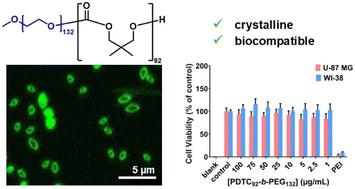
Two-dimensional (2D) nanoparticles have received considerable attention due to their versatile applications ranging from catalysis, optoelectronics to nanomedicine. However, it remains challenging to access size tunable flat nanostructures with spatially tailored chemistries. The seeded-growth method, “living” crystallization-driven self-assembly (CDSA) has emerged as a promising approach for preparing well-defined 1D and 2D core–shell micellar assemblies from crystallizable block copolymers (BCPs). Nevertheless, the development of biocompatible aliphatic polycarbonates, such as poly(trimethylene carbonate) (PTMC), as core-forming blocks for CDSA is considerably less explored and represents a key challenge due to their low crystallinity. Herein, we report the development of poly(dimethyltrimethylene carbonate) (PDTC) as a crystallizable core-forming block through the introduction of side chains to PTMC. The BCPs containing crystallizable PDTC were shown to undergo living CDSA to prepare uniform and size-controlled 2D platelets. In addition, uniform segmented platelets with spatially localized coronal chemistries were successfully constructed. The colloidal stability of the platelets in aqueous solution allowed for an assessment of their toxicity toward healthy WI-38 and cancerous U-87 MG cells. These studies reveal that PDTC nanostructures exhibit no discernible cytotoxicity and excellent biocompatibility, indicating great potential for biomedical applications.
期刊介绍:
Polymer Chemistry welcomes submissions in all areas of polymer science that have a strong focus on macromolecular chemistry. Manuscripts may cover a broad range of fields, yet no direct application focus is required.




 京公网安备 11010802042870号
京ICP备2023020795号-1
京公网安备 11010802042870号
京ICP备2023020795号-1

 分享
分享
 求助内容:
求助内容: 应助结果提醒方式:
 扫码关注我们
