Development of a Highly Sensitive Gold and Bismuth Nanoparticle-Modified Amperometric Sensor for Ceftriaxone Detection: Experimental and Density Functional Theory Insights
Mahmoud Elrouby, Doaa S. Ameer, Adila E. Mohamed, Atiat A. Montaser
{"title":"Development of a Highly Sensitive Gold and Bismuth Nanoparticle-Modified Amperometric Sensor for Ceftriaxone Detection: Experimental and Density Functional Theory Insights","authors":"Mahmoud Elrouby, Doaa S. Ameer, Adila E. Mohamed, Atiat A. Montaser","doi":"10.1002/elan.12042","DOIUrl":null,"url":null,"abstract":"<p>The detection of pharmaceutical contaminants, such as Ceftriaxone (CTRX), in water sources is a critical environmental and public health concern. Conventional detection methods often suffer from limited sensitivity and stability, making the accurate quantification of low CTRX concentrations challenging. To overcome these limitations, a novel amperometric sensor was developed using a carbon paste electrode (CPE) modified with gold and bismuth nanoparticles (Au-BiNPs). The synergistic electrocatalytic properties of these nanoparticles significantly enhance the sensitivity and stability of CTRX detection in complex environments. The Au-BiNPs-modified CPE (Au-BiNPs/CPE) exhibited excellent electrocatalytic activity toward the oxidation of CTRX, achieving a low detection limit of 0.267 µM and a high sensitivity of 25.9 μA/μM cm<sup>2</sup>. The sensor was optimized to operate at pH 4.0 using Britton–Robinson buffer, following a mixed adsorption–diffusion reaction mechanism. Furthermore, the electrode demonstrated remarkable reproducibility (relative standard deviation [RSD] = 3.0%) and repeatability (RSD = 1.5%). Stability and corrosion resistance were confirmed through Tafel polarization studies, underscoring the sensor's durability and long-term performance. Additionally, density functional theory calculations provided molecular-level insights into the CTRX oxidation mechanism, complementing the experimental findings and further validating the sensor's design. This study presents the first Au-BiNPs-modified CPE for the sensitive detection of CTRX, integrating experimental optimization with theoretical insights. The significant outcomes of this work lay the foundation for advanced sensor development, offering a reliable and efficient platform for the detection of antibiotics in environmental and clinical settings.</p>","PeriodicalId":162,"journal":{"name":"Electroanalysis","volume":"37 3","pages":""},"PeriodicalIF":2.3000,"publicationDate":"2025-03-17","publicationTypes":"Journal Article","fieldsOfStudy":null,"isOpenAccess":false,"openAccessPdf":"","citationCount":"0","resultStr":null,"platform":"Semanticscholar","paperid":null,"PeriodicalName":"Electroanalysis","FirstCategoryId":"92","ListUrlMain":"https://analyticalsciencejournals.onlinelibrary.wiley.com/doi/10.1002/elan.12042","RegionNum":3,"RegionCategory":"化学","ArticlePicture":[],"TitleCN":null,"AbstractTextCN":null,"PMCID":null,"EPubDate":"","PubModel":"","JCR":"Q2","JCRName":"CHEMISTRY, ANALYTICAL","Score":null,"Total":0}
引用次数: 0
Abstract
The detection of pharmaceutical contaminants, such as Ceftriaxone (CTRX), in water sources is a critical environmental and public health concern. Conventional detection methods often suffer from limited sensitivity and stability, making the accurate quantification of low CTRX concentrations challenging. To overcome these limitations, a novel amperometric sensor was developed using a carbon paste electrode (CPE) modified with gold and bismuth nanoparticles (Au-BiNPs). The synergistic electrocatalytic properties of these nanoparticles significantly enhance the sensitivity and stability of CTRX detection in complex environments. The Au-BiNPs-modified CPE (Au-BiNPs/CPE) exhibited excellent electrocatalytic activity toward the oxidation of CTRX, achieving a low detection limit of 0.267 µM and a high sensitivity of 25.9 μA/μM cm2. The sensor was optimized to operate at pH 4.0 using Britton–Robinson buffer, following a mixed adsorption–diffusion reaction mechanism. Furthermore, the electrode demonstrated remarkable reproducibility (relative standard deviation [RSD] = 3.0%) and repeatability (RSD = 1.5%). Stability and corrosion resistance were confirmed through Tafel polarization studies, underscoring the sensor's durability and long-term performance. Additionally, density functional theory calculations provided molecular-level insights into the CTRX oxidation mechanism, complementing the experimental findings and further validating the sensor's design. This study presents the first Au-BiNPs-modified CPE for the sensitive detection of CTRX, integrating experimental optimization with theoretical insights. The significant outcomes of this work lay the foundation for advanced sensor development, offering a reliable and efficient platform for the detection of antibiotics in environmental and clinical settings.
期刊介绍:
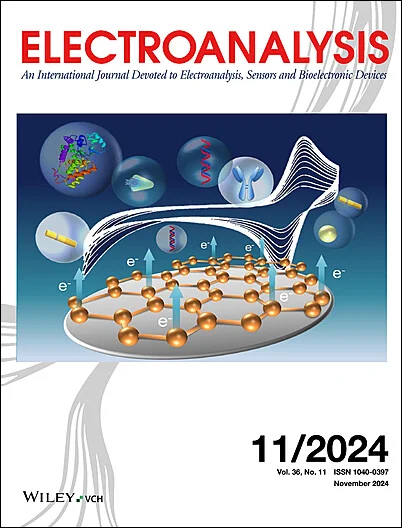
Electroanalysis is an international, peer-reviewed journal covering all branches of electroanalytical chemistry, including both fundamental and application papers as well as reviews dealing with new electrochemical sensors and biosensors, nanobioelectronics devices, analytical voltammetry, potentiometry, new electrochemical detection schemes based on novel nanomaterials, fuel cells and biofuel cells, and important practical applications.
Serving as a vital communication link between the research labs and the field, Electroanalysis helps you to quickly adapt the latest innovations into practical clinical, environmental, food analysis, industrial and energy-related applications. Electroanalysis provides the most comprehensive coverage of the field and is the number one source for information on electroanalytical chemistry, electrochemical sensors and biosensors and fuel/biofuel cells.





 京公网安备 11010802042870号
京ICP备2023020795号-1
京公网安备 11010802042870号
京ICP备2023020795号-1

 分享
分享
 求助内容:
求助内容: 应助结果提醒方式:
 扫码关注我们
